French regional elections: Macron and Le Pen suffer serious setbacks but what does this mean for the Presidential election?

French President Emmanuel Macron and his party, La République en Marche, suffered extensive defeats in last week’s bout of regional elections in France. With decreasing popularity, his position heading into next year’s presidential election is looking increasingly unstable. (Image Credit: Lorie Shaull via Flickr, Creative Commons License)
Last week’s regional elections in France, marred by record-breaking rates of abstention, have dented the egos of Presidential election front-runners, incumbent Emmanuel Macron and his far-right rival Marine Le Pen.
Both of their political parties, the newly formed La République en Marche (LREM) and the newly revived Rassemblement national (RN), failed to win a single region, with right-wing coalitions dominating an electoral map that has not much changed since the last regional elections in 2015. Although these results may have knocked the confidence of both Macron and Le Pen, their fates and hopes for the 2022 Presidential election are certainly not sealed.
Macron and Le Pen: The biggest losers
In a political environment still dominated by the handling, or mishandling, of the coronavirus pandemic, with growing anti-establishment and anti-Paris sentiments, many considered it a foregone conclusion that Marine Le Pen and her party, Rassemblement national, would emerge the victors following France’s regional elections. This prediction, however, could not have been further from the reality.
In the run up to the elections, RN was leading polls in six out of France’s 13 regions and expected to win up to five following the two electoral rounds. Yet, as results were declared, it became clear that Le Pen’s party had fallen incredibly short, failing to win a single region. The party’s undeniable shortcomings left Le Pen branded as the election’s biggest loser.
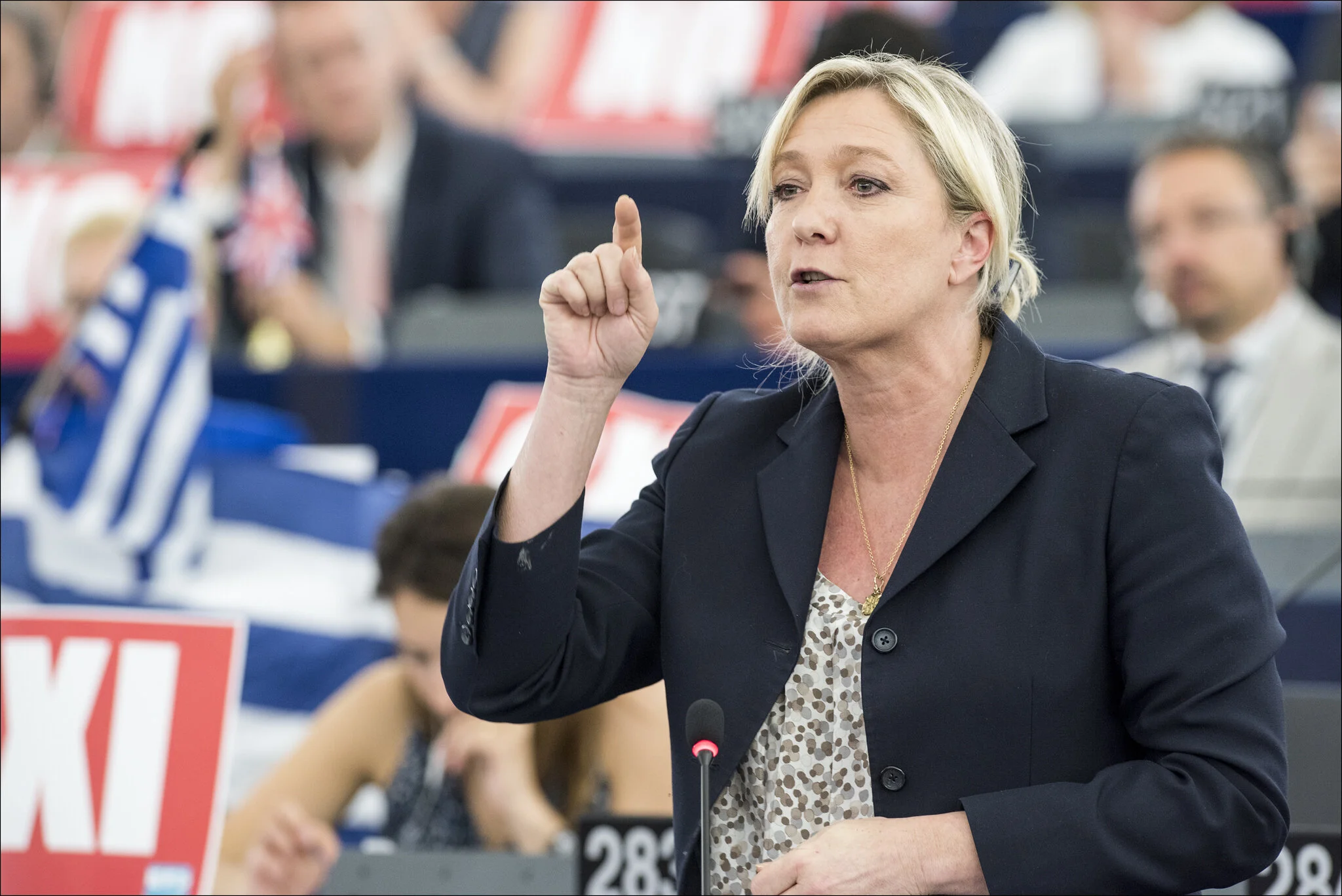
Marine Le Pen and her party Rassemblement national were expected to be the big winners of the regional elections, but her string of defeats puts her in an unstable position heading into the upcoming Presidential election. (Image Credits: European Parliament via Flickr, Creative Commons License)
But not far behind was the incumbent President’s party, La République en Marche, which had an equally dismal success rate. LREM burst onto France’s political scene in 2017 in a rushed attempt to establish a functioning political party when newcomer Emmanuel Macron took the Élysée from established political groups. That meant that this round of regional elections was LREM’s first, and they certainly did not have any beginner’s luck. LREM also failed to win any regions and held a somewhat embarrassing 7% of the vote after being eliminated from the majority of races in the first round, despite the President’s extensive nationwide tour and desperate drive for votes.
Les Républicains: The biggest winners
Stealing the win from both Macron and Le Pen were delegates from both the centre-right and the centre-left, the more traditional camps of the French political spectrum. Overall, the centre-right holds the largest number of seats and regions, winning seven out of 13. The centre-left hold five and regionalist parties took the final region, Corsica. Although the right are the largest group, they lost a total of 128 seats, whereas the left gained a total of 88.
This creates an electoral map almost identical to the one drawn up following the 2015 elections, a potential sign that the French people are reverting back to more traditional political centres of gravity, a considerable threat to both Macron and Le Pen.
Division of seats
The results are particularly positive for Les Républicains (LR), a party that saw many of its candidates re-elected and, consequently, prepared for potential Presidential runs in 2022. Most notably, Xavier Bertrand crushed his RN rival in Hauts-de-France, a region where Le Pen was sure of a victory, winning 110 seats to Sébastien Chenu’s 32. The former Minister of Health is now expected to be LR’s frontrunner in the 2022 election.
A further success story for LR unfolded in Provence-Alpes-Côte-d’Azur, a region considered to be RN’s heartland, where, united with LREM and with the support of the Greens, Républicain Renaud Muselier beat RN superstar Thierry Mariani by 45 seats, creating serious upset in RN headquarters.
Similarly, Les Républicains consolidated their support in the Parisian region, Île-de-France, with the comfortable re-election of Valérie Pécresse, former Minister of the Budget and likely soon-to-be Presidential candidate.

Xavier Bertrand was successfully re-elected for Les Républicains in Hauts-de-France and is now well positioned to be the party’s frontrunner in the 2022 Presidential election, posing a strong challenge for Macron and Le Pen. (Image Credits: Wikimedia Commons via Creative Commons License)
A missed opportunity for Le Pen
These sets of results not only outline potential future Presidential candidates and demonstrate the reversion to more traditional parties, they also act as a foreboding warning to Marine Le Pen and Emmanuel Macron.
In recent months, and indeed since her defeat in 2017, Le Pen has driven for radical change within her party. She has launched a rebranded version of the former Front national, that was previously considered racist, xenophobic, islamophobic and anti-semitic, by investing heavily in re-creating her party’s image.
In order to appeal to a larger proportion of the electorate, RN policy makers have adopted economic policy from the left of the spectrum and have pacified its former populist and aggressive politics. In many ways, this rebrand has been successful; Le Pen has brought her party back from the brink of electoral annihilation, creating a mainstream manifesto that is appealing to a vast number of voters. Most importantly, French people, especially young people, are no longer ashamed to say they vote RN.
These elections were the new model’s first real test after four years of preparation. Crucially, they were an opportunity for Le Pen to prove that her party were stable, serious and competent in governing. Yet, these losses do not give Le Pen any such opportunity. In fact, many party members have already accused their leader of misjudging the electoral field in creating a manifesto that abandoned their most loyal and fervent supporters in exchange for a wider network. She has been accused of feeding into the hands of rich Parisian donors, causing her to forget the party’s roots and origins. Her rejuvenated program clearly failed to inspire this time round and a question now remains over the future position of RN on key and dividing policy issues.
The rise of tactical unions
However, it is not just policy that has damaged Le Pen’s success. This election has seen an overwhelming dominance of tactical voting and tactical unions to prevent RN from obtaining office. Signs of this tactical voting first emerged in the second round of the 2017 Presidential election, where swathes of voters chose Macron, despite strongly disliking him, in order to prevent a Le Pen presidency.
This technique was repeated in many of the second round races in the regional elections, most notably in Provence-Alpes-Côte-d’Azur, RN’s most important stronghold. Here, LREM deliberately chose to not to field a candidate so as to avoid challenging the incumbent Républicain Renaud Muselier.
Likewise, following their elimination in the first round, the Greens expressed their support for Muselier, creating a somewhat unexpected coalition of clashing ideologies. Le Pen believes that there is an undemocratic conspiracy against her that aims to destabilise her campaigns. She has since decried the “unnatural alliances” which aim to block her path to victory. With their dominance in this election, it is certain that these alliances will be carried forward into 2022 with RN’s opposition using them as a way to deal crushing defeats. Marine Le Pen faces an uphill battle in fighting these unions, especially if her policies are less popular than first considered.

Republican Renaud Muselier was successfully re-elected in RN heartland Provence-Alpes-Côte-d’Azur thanks to a unification of parties including LREM and the Greens. (Image Credit: UMP Photos via Flickr, Creative Commons License)
Macron’s failures at the centre of attention
Macron also faces an uphill battle and these results certainly highlight his decreasing popularity. With a current approval rating hovering in the high 30s to low 40s, and visible discontent among much of the French public due to his handling of the coronavirus pandemic, many fear that his supporters may side with Les Républicains in 2022.
There is increasing discord on social media surrounding Macron and his perceived elitism; he has been accused of fostering a politics that ignores the people he swore to protect and, instead, cosying up to rich bankers and highbrow institutions. He is depicted as increasingly out-of-touch with skewed and inappropriate priorities that favour the glamour and pomp of the Presidency over the nitty gritty of administration, demonstrated by the outcry he received after welcoming Canadian singer Justin Bieber to the Élysée Palace last weekend.

The French public are becoming increasingly disapproving of Macron, perceiving him as elitist and out-of-touch. (Image Credits: Jeanne Menjoulet via Flickr, Creative Commons License)
To make matters worse, a video of Macron being slapped by a member of the public shouting ‘down with Macron-ism’ whilst he was campaigning was watched by millions last week, a particularly embarrassing affair that foreshadowed the grim results of the election to come.
His party has failed to establish itself in France, as demonstrated by its weak performance in these elections, and is often considered as elitist and Paris-centric. These results are clear sign-posts of a potential defeat and may cause a change in tact in LREM headquarters, as their foundations seem increasingly unsteady.
A video showing President Macron being slapped by a man whilst campaigning. The man can be heard shouting “down with Macron-ism”, a sign of Macron’s decreasing popularity.
Abstention: The real winner
However, there is a glimmer of hope for both candidates. Both Macron and Le Pen are used to exceeding expectations and contradicting expert opinions and they have delivered on numerous occasions in the past. Macron won the Presidency in 2017 with just a shell of a party, limited political experience and few political allies, therefore weak foundations may not pose a problem. Marine Le Pen and her party won the last bout of European Elections in France, destroying her opposition by large margins, showing that there is an appetite for RN leadership.
There is also further hope for Macron and Le Pen. Although they certainly were not the winners of these elections, it cannot be said that any particular party won. The only winner of these elections was abstention. With the highest rate of abstention since the beginning of the Fifth Republic (at 66%), any indications from these results must be taken with more than a pinch of salt. In fact, with such low participation from the public (only 10% of 18-24 year olds voted), it is almost impossible to draw any concrete conclusions or predictions for 2022.
This low turnout could be a symptom of astronomically high disenchantment with politics or it could just be fear of coronavirus paired with a common apathy surrounding regional government.
If this is disenchantment, then many hold Macron responsible. People are fed up with his monarchal style of leadership, something that he promised to remove from the role of President by de-centralising French administration on a dramatic scale. This is something he has failed to deliver. Yet, many do still view Macron as the safe choice. If it were a repeat of Macron v Le Pen in the second round in 2022, it is likely that Macron would be successfully re-elected.
Although these results certainly are meagre for Le Pen, she still cannot be ruled out from a potential Presidential victory. 70% of those who voted for her in 2017 did not vote in these elections, presenting the argument that she may have some form of a ‘silent majority’ who are still too scared to admit they support her. But this abstention could also be provoked by her radical change in leadership style and policy; perhaps she really has alienated that 70%, making her position much weaker than first considered.
Conclusion: The end of Macron v. Le Pen?
Low turnout in regional elections is not a new phenomenon in France and, on the whole, turnout has been steadily falling in all French elections in recent years. However this sudden drop is certainly a cause for concern for those who wish to run democratically-elected governments.
Although this turnout does make any conclusion difficult, one thing we can take away from these elections is that it seems as if the future of French politics is no longer Macron v Le Pen; there is certainly a chance, and a strong one at that, that other individuals will have important roles to play in the 2022 Presidential election.
Feature Image Credit: Lorie Shaull via Flickr, Creative Commons License