Suez: Conflict, Chaos and Container Ships
George Cooper
A hazy sun rises over the Sinai Peninsula on the morning of Thursday, 25th March. Sunlight dances from the calm wavelets of the Suez Canal, imprinting reflections onto the dark-green hull of the four-hundred metre long container ship named ‘Ever Given’.
This boat, however, is not peacefully sailing down the man-made waterway like normal. Instead, strong winds cast from a passing sandstorm the morning before has caused the vessel to lodge itself sideways across the Egyptian canal.
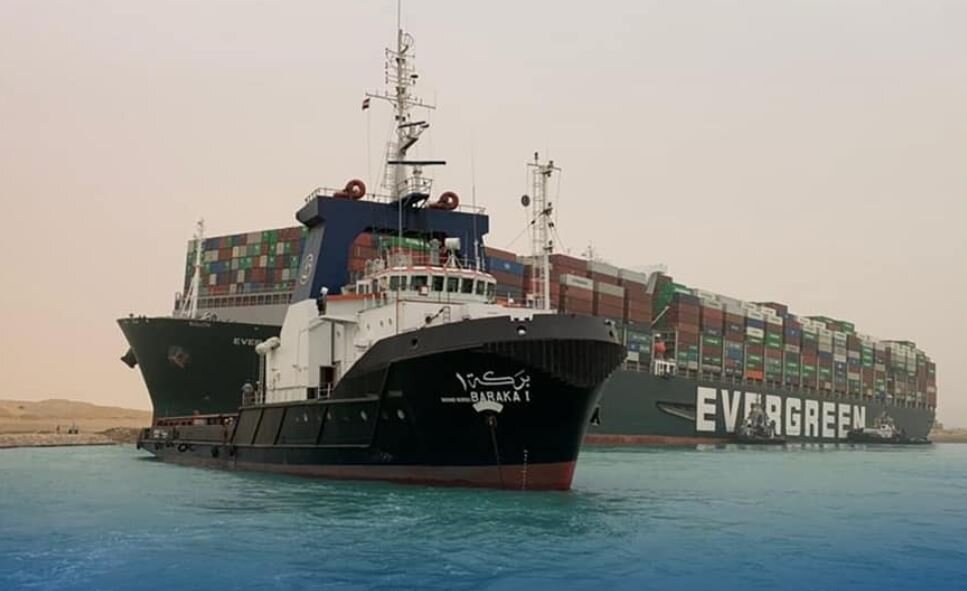
Tug boats assisting the stranded vessel (Image Credit: Suez Canal Authority)
The recently-freed ship had come from the eastern Chinese coastal city of Ningbo, just over two hundred kilometres outside of Shanghai, via Malaysia, with a final destination of Rotterdam, in the Netherlands. With a length equivalent of the Empire State Building lain sideways across the Suez Canal, the Ever Given immediately prevented any form of container ship from passing by.
Before the painstaking operation to free the vessel succeeded in the early hours of the 29th of March, almost a week after it became stuck, maritime experts publicly spoke out about the possible consequences of this unexpected situation. They feared that it could take several days, even weeks, for the canal to resume ‘business as usual’. Either way, Dr. Sal Mercogliano told the BBC that the incident could have ‘huge ramifications for global trade’, whilst Ranjith Raja consolidated that the shipping industry would experience a knock-on effect, despite the fact that the ship is now on the move again.
Worries had also been raised in the media surrounding those onboard the boats currently waiting in the vessel queue. Crew members and livestock alike faced possibilities of waste build-up and food shortages due to an expected delay to their final ports of call.
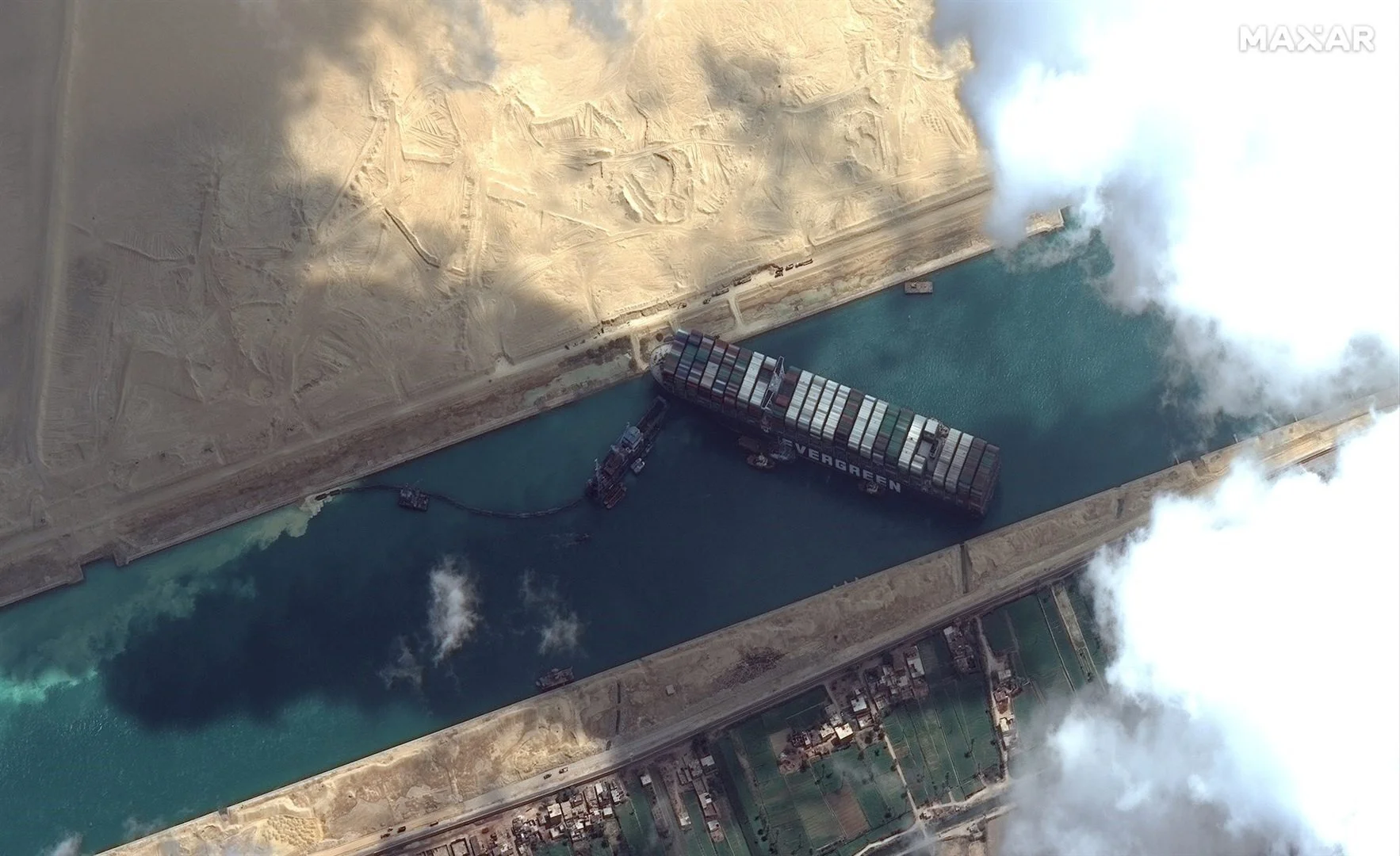
The Ever Given as seen by satellite (Image Credit: Maxar Technologies)
The importance of this man-made waterway located in northern Egypt is proved simply by the imminent global coverage by international news outlets of the lodged boat. The Ever Given situation therefore provides another uncanny, almost humorous reminder that global trade logistics are paradoxically indispensable, yet easily debilitated. One powerful gale has seemingly been the cause of maritime chaos, continuous news coverage, and an abundance of internet memes.
Connecting the tropical Red Sea with the extensive Mediterranean, it is estimated that 12% of all global trade passes through the Suez Canal, with an average of 51.5 ships transiting the river in both directions daily.
Before the opening of the Suez Canal, the ‘Cape Route’ was the only viable shipping path from Europe to India and the Far East. The inauguration of the two-hundred kilometre long Egyptian waterway, however, reduced the maritime distance from London to Mumbai by over eight thousand kilometres. The arduous route by boats setting sail from the Atlantic Ocean, and then around the Cape of Good Hope in modern-day South Africa, was in turn made mostly redundant; until now, where dozens of container ships have already decided to reroute southwards in a bid to avoid the backlogging caused by the Ever Given.
Precursors of the Suez Canal are mentioned as far back as Aristotle’s classical writings, in which he describes how ‘one of [Egypt]’s kings tried to make a canal’ over 3500 years ago. Another ancient source writes of a waterway, the Canal of the Pharaohs, existing 600 years before the coming of Christ. A fully navigable canal was also in usage in the eight century AD, linking the Egyptian capital, Cairo, with the Red Sea. The Suez Canal may seem an innovation strictly created for modern-day globalised trade, but in reality a canal connecting the two influential oceans is a tale as old as time.
The French, who kickstarted the construction of the modern-day Suez Canal, must therefore not take full credit for the original idea of the waterway. In 1858, The Universal Company of the Maritime Suez Canal came into fruition, after receiving concessions from Sa’id Pasha, leader of Ottoman-controlled Egypt, to both build the waterway and operate it for 99 years.
Construction took ten years, 1.5 million labourers and was even hampered by an outbreak of cholera in 1865, not least because of poor working conditions enforced by the imperial power.
Just six years after the canal was opened, Britain bought the entirety of Egypt’s shares, placing the whole river under direct Anglo-French rule. Before this, Britain favoured sponsoring the Cape Route instead, having gained exclusive prowess and advantageous maritime relations from it.
The British continued to increase their control of the Suez Canal. Their success in the Anglo-Egyptian War of 1882 and the subsequent Convention of Constantinople resulted in the waterway being declared a ‘neutral zone’ for international trade, all whilst being under complete British protection. This, naturally, furthered their imperial control and epithet as ‘commander of the seas’, bringing more extensive wealth to the crown.
The United Kingdom and the independent Egyptian state again came to loggerheads in 1956 when presidential demagogue Gamal Abdel Nasser nationalised the entirety of the canal. Nasser’s parallel closure of the Straits of Tiran to Israeli ships in turn led to the invasion of the Arab state by a tripartite force of the UK, France, and Israel. The result of this battle was the introduction of United Nations Emergency Force peacekeepers to the Sinai Peninsula, a move bitterly unpopular with Nasser. It was clear, in the Western countries’ eyes, that the canal still reaped enough benefits to rationalise the invasion of an Arab state.
The Suez would be at the centre stage of future battles with neighbouring Israel, such as the Six Day War and the Yom Kippur War in 1967 and 1973 respectively. Scattered wreckage of destroyed tanks, bullet magazines and other wartime paraphernalia serve as a heavy reminder of the geopolitical strife that is, quite literally, surrounding the canal, even today.

Israeli tanks cross the Suez Canal in the Yom Kippur War in 1973 (Image Credit: Wikimedia Commons)
Contemporary issues involving the Suez Canal are now, however, mostly concentrated on the growth and financing of a century-and-a-half old waterway which holds dramatic geopolitical relevance over maritime and global shipping affairs. Egyptian president Abdel Fattah el-Sisi, for example, ordered for the costly expansion of the Suez Canal in 2014, in a bid to further its global pre-eminence. Egypt carries out toll collections from every ship that passes through the canal, garnering the country a revenue totalling almost 10% of its national GDP.
Although this expansion of the Suez Canal has brought with it economic benefits for Egypt, this growth of relevance is perhaps now a double-edged sword. The risks involved in executing such economic success in a narrow waterway cannot be overlooked; especially when looking at the serious backlog of freight ships still anchored and waiting in the Middle Eastern state’s waters. The pressure is on to free both the Ever Given and the significant chunk of global trade being indefinitely held up.
Hazards associated with the Suez Canal do not end with economics. Marine biologists have often expressed major concerns about the biodiversity of the surrounding waters caused mainly by the artificial carving out of the Suez. The canal’s existence, for example, has meant that invasive species originally found in the Red Sea are now swimming up and dispersing into the Mediterranean, adversely impacting the ecosystems of both bodies of water. Named after the French engineer who pioneered the construction of the canal, the ‘Lessepsian migration’ continues to threaten the age-old fisheries of Lebanon, Syria, and Greece, to name a few.
Container ships must also pass through the Gulf of Aden, a large stretch of sea located between the precarious nation states of Yemen and Somalia, before entering the Red Sea and finally the Suez Canal. Here, occurrences of piracy are not unheard of: hijackings reached an all-time high in 2011, numbering 275 instances off the coast of Somalia alone. These still occasionally occur today, such as in December of 2020, when a cargo ship was targeted by an unknown group of fighters after having ended up just off the coast of eastern Yemen.
The captivating nature of the Suez Canal has never waned. Its advantageous existence for both classical and imperial powers lent itself a huge historical relevance that has lasted until today, and economic globalisation still seems to be its main importance. What must be remembered, however, is how easily this man-made canal can be the location for adversity. Sometimes, it is where species of invasive fish slowly destroy local economies. Other times, it is where freak desert winds run the risk of suddenly pausing global logistics. More than anything, it’s clear how much the globe truly relies on this thin passage of water.