News Round-up Archive
Reykjavik Iceland
Week of 9 November 2020
AUSTRALIA: Australia Post to encourage optional use of Aboriginal place names – following a grassroots campaign, Australia Post has announced that they will support the optional inclusion of Aboriginal place names in addresses. Rachael McPhail is the woman behind the campaign – she is of Gomeroi heritage and has been encouraging the wider acceptance of First Nations place names in addresses across Australian institutions and businesses that operate in the country, such as Uber. It is a step in the right direction with regards to decolonising important aspects of Australian society, such as the recognition and awareness of the First Nation Country in which Australians themselves live, or likewise the Country to which they’re sending their post.
CENTRAL AMERICA: Second storm on track to batter the region – following in the path of Hurricane Eta, which killed 200 people earlier this month (read the CLC News Round-up from week commencing 2/11 for more), Hurricane Iota is expected to make landfall in Honduras and Nicaragua on Monday. Forecasters have said the storm is growing rapidly stronger and the National Hurricane Center has warned that the recent effects of Hurricane Eta could worsen any flooding and mudslides. People in the region have been told to expect ‘life-threatening’ flooding. This would be the thirtieth storm to sweep across the region this year, a record-breaking figure. The Guatemalan president has accused industrialised nations of being ultimately responsible for the increased number and intensity of hurricanes. He highlighted that the effects of climate change are felt strongly in his country’s region, among the most impoverished in the world, and that industrialised nations provide very little in the way of aid and support.
GERMANY AND UNITED STATES: Covid vaccine found to be highly effective – one of the only good-news stories of the past months has been Pfizer and BioNTech’s announcement this week of a Covid-19 vaccine with astounding 90% efficacy. However, the big name of the American multinational pharmaceutical company which has made it to the headlines, in fact, overshadows the other half of the story. The vaccine has actually been produced through a collaboration of Pfizer and a lesser-known German biotech company, BioNTech, which had been working on a mRNA-based flu vaccine before the arrival of the Coronavirus pandemic, but noted its potential with regards to providing immunity from Covid-19. The company is based in Mainz and was founded by a Turkish German husband-wife duo; BioNTech is leading the breakthrough scientific research and development of the vaccine, whereas Pfizer is lending its weight as a huge multinational to run trials, clear the relevant regulatory hurdles and, in the process, garner much of the immediate media attention. Although, BBC News is reporting, as one of its leading stories this weekend, that BioNTech CEO Prof Ugur Sahin affirms normal life will be back by next winter. Reading deeper into the story of BioNTech, however, helps us to understand just how pioneering this new technology is and the exciting future it may have ahead of it.
UNITED STATES: Election drama drags on as Trump refuses to concede – Election Day may feel a somewhat distant memory in a world of ephemeral news cycles. However, the aftermath – despite a now clear Biden win – is, as predicted, still only beginning to play out. Legal challenges have been launched by the Trump campaign across the US, although few, if any, are expected to see much success in the courts. Thousands also descended on Washington DC this Saturday 14 in support of Donald Trump at the Million MAGA March. Nevertheless, Trump’s long game is beginning to become clear: maintain support among his base, potentially for another presidential run in 2024. No doubt, however, that the sowing of doubt surrounding the integrity of democratic processes will serve to only weaken the foundations of American democracy, which, after four years of a Trump White House, already finds itself on increasingly unstable ground.
Week of 2 November 2020
AUSTRIA: Vienna terrorist attack – terrorists launched a gun attack on the Austrian capital, Vienna, on Monday night. Four were killed and 23 others were left wounded, many seriously. The 20-year-old attacker was shot dead by police nine minutes into the attack. In the days following the attack, it has come to light that the attacker had travelled to neighbouring Slovakia to attempt to buy ammunition for an AK-47 assault rifle. The Slovakian authorities informed their Austrian counterparts of this fact, although the Austrian Interior Minister has admitted that there were failings in communication. A commission will be set up to investigate.
CENTRAL AMERICA: Tropical storm batters the region – Hurricane Eta swept through the Caribbean and Central America earlier this week, killing three in Nicaragua and Honduras. When the storm made landfall in Nicaragua on Tuesday, it was categorised as a Category Four hurricane with winds of up to 140mph. Torrential rains have led to significant flooding in many areas. The storm has since been downgraded, although the National Hurricane Center (NHC) in the US warns that life-threatening flash flooding is still possible in the, albeit weakened, storm’s path.
FRANCE: Macron calls boycott ‘shameful’ and ‘unacceptable’ – President Macron has stood firm in his rhetoric on radical Islamism and his calls to protect of the values of the République, despite the sharp backlash in many Muslim countries and communities in past weeks. Anger towards France among Muslims has surged in the wake of the terrorist attacks in Paris and Nice, with old tensions surrounding the caricaturing of the Prophet Muhammad once again at the fore. Many Muslims are boycotting French products, the scale of which has alarmed the French government. Turkish President Recep Tayyip Erdogan also weighed in, seemingly suggesting that Macron seek medical help. In an interview with Al Jazeera, the French president defended a free press and strongly criticised the boycott of French products. This protest has been called in a number of countries in response to some of Macron’s earlier comments, seen by many as an attack on Islam.
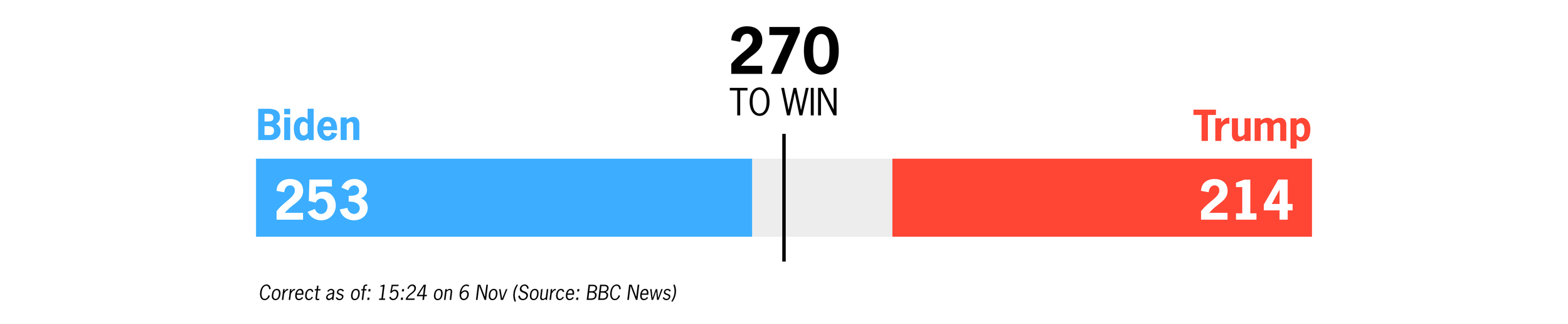
UNITED STATES: Biden leads in an unprecedented election – Americans have elected their next president, all that’s left to do is count the votes to discover who that is: former Vice President Joe Biden or President Donald Trump. Counting the votes is, however, proving to be the most controversial aspect of this election. Donald Trump has been tweeting misinformation about unproven voter fraud in an apparent attempt to undermine the democratic process. Meanwhile, Joe Biden has expressed confidence that he will win the key, remaining battleground states and, consequently, the presidency. However, the former vice president has notably not claimed any election victory as of yet, unlike his opponent. The reason the election has not yet been called lies in both the unexpected closeness of this race and the historically high levels of absentee voting, given the Covid-19 pandemic. Biden has importantly flipped the states of Michigan and Wisconsin; some networks have also projected a Biden win in Arizona. With only a handful of states left to finish their counts, Trump’s path back to the White House now seems extremely complicated. The Trump campaign have, however, already launched legal challenges in a number of states, so the results of this election could be far from decided for weeks to come.