News Round-up Archive
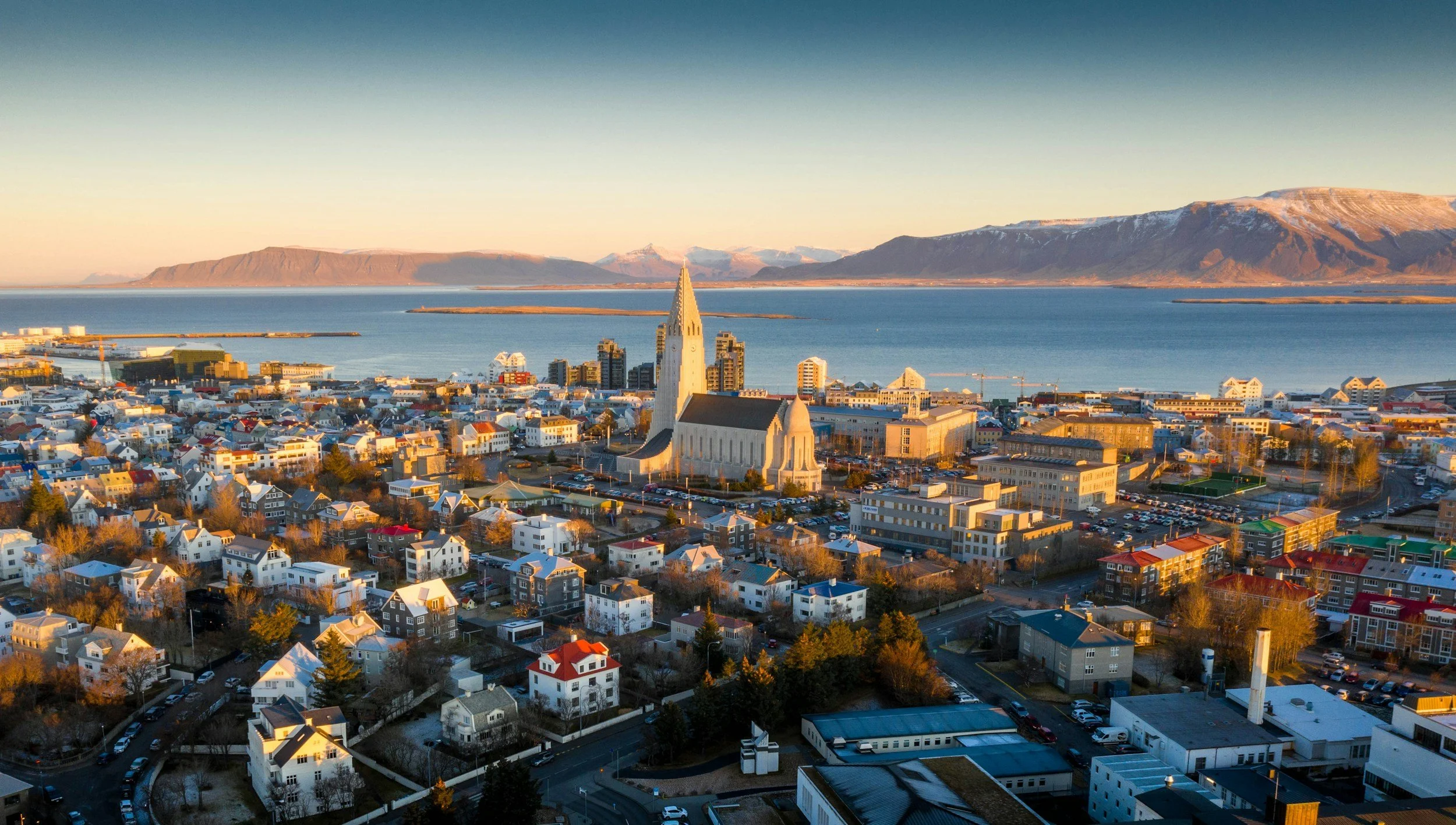
Reykjavik Iceland
Week of 2 November 2020
AUSTRIA: Vienna terrorist attack – terrorists launched a gun attack on the Austrian capital, Vienna, on Monday night. Four were killed and 23 others were left wounded, many seriously. The 20-year-old attacker was shot dead by police nine minutes into the attack. In the days following the attack, it has come to light that the attacker had travelled to neighbouring Slovakia to attempt to buy ammunition for an AK-47 assault rifle. The Slovakian authorities informed their Austrian counterparts of this fact, although the Austrian Interior Minister has admitted that there were failings in communication. A commission will be set up to investigate.
CENTRAL AMERICA: Tropical storm batters the region – Hurricane Eta swept through the Caribbean and Central America earlier this week, killing three in Nicaragua and Honduras. When the storm made landfall in Nicaragua on Tuesday, it was categorised as a Category Four hurricane with winds of up to 140mph. Torrential rains have led to significant flooding in many areas. The storm has since been downgraded, although the National Hurricane Center (NHC) in the US warns that life-threatening flash flooding is still possible in the, albeit weakened, storm’s path.
FRANCE: Macron calls boycott ‘shameful’ and ‘unacceptable’ – President Macron has stood firm in his rhetoric on radical Islamism and his calls to protect of the values of the République, despite the sharp backlash in many Muslim countries and communities in past weeks. Anger towards France among Muslims has surged in the wake of the terrorist attacks in Paris and Nice, with old tensions surrounding the caricaturing of the Prophet Muhammad once again at the fore. Many Muslims are boycotting French products, the scale of which has alarmed the French government. Turkish President Recep Tayyip Erdogan also weighed in, seemingly suggesting that Macron seek medical help. In an interview with Al Jazeera, the French president defended a free press and strongly criticised the boycott of French products. This protest has been called in a number of countries in response to some of Macron’s earlier comments, seen by many as an attack on Islam.
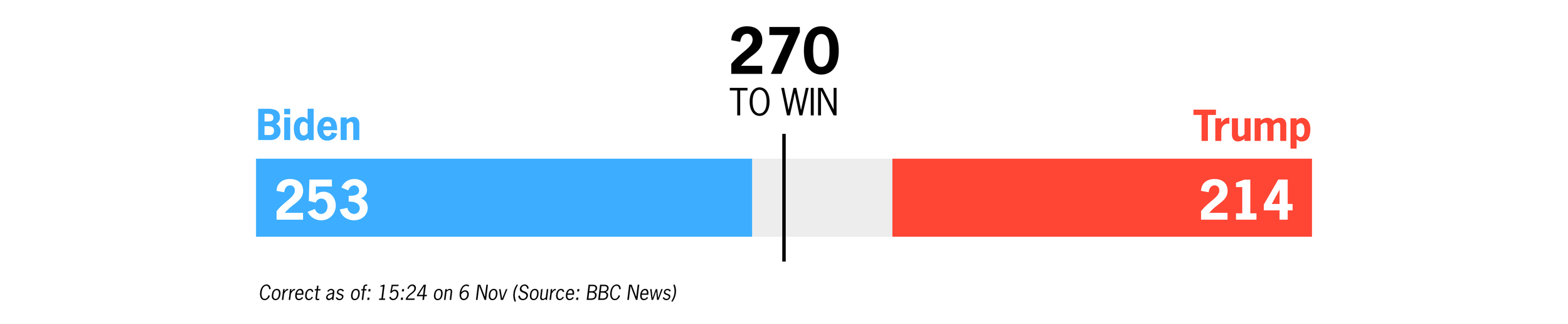
UNITED STATES: Biden leads in an unprecedented election – Americans have elected their next president, all that’s left to do is count the votes to discover who that is: former Vice President Joe Biden or President Donald Trump. Counting the votes is, however, proving to be the most controversial aspect of this election. Donald Trump has been tweeting misinformation about unproven voter fraud in an apparent attempt to undermine the democratic process. Meanwhile, Joe Biden has expressed confidence that he will win the key, remaining battleground states and, consequently, the presidency. However, the former vice president has notably not claimed any election victory as of yet, unlike his opponent. The reason the election has not yet been called lies in both the unexpected closeness of this race and the historically high levels of absentee voting, given the Covid-19 pandemic. Biden has importantly flipped the states of Michigan and Wisconsin; some networks have also projected a Biden win in Arizona. With only a handful of states left to finish their counts, Trump’s path back to the White House now seems extremely complicated. The Trump campaign have, however, already launched legal challenges in a number of states, so the results of this election could be far from decided for weeks to come.
Week of 26 October 2020
ARMENIA AND AZERBAIJAN: On Friday, representatives from the two warring countries arrived in Geneva for a round of peace talks. Representatives from France, Russia and the U.S. will also participate in this latest attempt to solve the largest military confrontation in the area since the Nagorno-Karabakh War of 1991–94. In a potential breakthrough, Russian President Vladimir Putin said on Thursday that Russia would accept a return of the disputed Nagorno-Karabakh region (currently occupied by Armenia) to Azerbaijan, recognising that ‘there are no simple solutions’ in sight.
FRANCE: It’s been quite a difficult week for France. On Wednesday, French President Emmanuel Macron announced a new nationwide lockdown to last at least until the end of November, hoping to curb the rapid spread of COVID-19 in the country. Under the new rules, all non-essential businesses will close but factories and schools will remain open. This is in addition to the curfews which have already been in force in most French cities since last week. Then, on Thursday, a man killed three people with a knife in the city of Nice in what has been described as a terrorist incident, prompting Mr Macron to raise the terror alert level to ‘maximum’.
GERMANY: On Saturday, Berlin’s long-awaited new international airport will finally open its doors to travellers. The delays and ballooning costs of the project have caused ample debate in Germany over the years: the airport was first scheduled to open in 2011 and construction costs have exceeded initial estimates by over €4bn. It is believed that the decrease in traffic due to the pandemic will make the opening easier: when fully operative, the airport will be able to handle 58 million passengers per year, but currently Berlin’s other two airports are serving as few as 2,500 passengers per day.
NIGERIA: The Financial Times has published a detailed special report to celebrate the sixtieth anniversary of Nigeria’s independence. Nigeria became an independent state on 1 October 1960, as had been agreed with the British government two years prior, and underwent long periods of ethnic tension and military rule in the following decades before emerging as a stable (if flawed) democracy. Its booming economy is Africa’s biggest, having overtaken South Africa in recent years, and its growing population – now exceeding 200 million – is the seventh-largest in the world. The Financial Times’s report sheds an interesting light on the African superpower’s strengths and challenges going forward.
USA: Hopefully, by the time you’ll read our next weekly digest, we’ll know the name of the winner of the U.S. presidential election. President Donald Trump currently trails former Vice President Joe Biden by about nine points and might become the first sitting president to lose re-election since 1992. At the time of writing, more than 82 million early votes had already been cast in what is on track to become the highest-turnout U.S. election in a century.
Week of 19 October 2020
CYPRUS: On Sunday, Ersin Tatar won the second round of the presidential election in Northern Cyprus against incumbent Mustafa Akıncı. Cyprus has been divided since 1974, when Turkey invaded the island and occupied its northern third in response to a Greece-backed coup; in 1983, the Turkish-occupied area declared independence as the Turkish Republic of Northern Cyprus. The Turkish Republic is recognised only by Turkey: according to the rest of the world its territory legitimately belongs to Cyprus, which is a member of the EU. The election attracted wide attention because while the constitutional powers of the Northern Cypriot president are relatively limited, he is customarily in charge of the negotiations regarding the Cyprus dispute. Mr Akıncı was generally seen as a moderate in favour of a federal solution and a gradual reunification process, whereas Mr Tatar – a right-wing, pro-Turkey nationalist – has repeatedly declared his support for a two-state solution.
FRANCE: Seven charged after teacher is killed near Paris – last Friday, Samuel Paty, a teacher in a school near Paris, was beheaded in an attack after teaching a class in which he showed caricatures of the Prophet Muhammad as part of a discussion on freedom of speech. The killer, 18 year-old Abdullakh Anzorov, who has been linked to a jihadist in Syria, was shot dead following the attack. Subsequently, seven people, including a parent of one of Samuel Paty’s students and two pupils, have been charged with conspiracy in a terrorist murder. The attack shocked France, with Emmanuel Macron calling Paty a ‘quiet hero’ at a memorial event this week. The images he showed were the controversial caricatures published by the magazine Charlie Hebdo that led to the 2015 terrorist attack on their offices. The circumstances surrounding the killing have exacerbated an already heated debate in French society about Islamic extremism in the country.
LEBANON: Saad Hariri chosen as PM once again, a year after quitting – after resigning as prime minister a year ago, Saad Hariri has been chosen by other parties to lead the Lebanese government once again. Lebanon’s complex confessional system complicated the process of voting in Mustapha Adib and his non-partisan, technocratic cabinet, which ended up not receiving sufficient support. Hariri now has the difficult task of enacting profound economic and political reform in Lebanon ahead of him. Following the devastating explosion in the Beirut port area in August, French President Emmanuel Macron promised billions of euros in aid on the condition that serious changes are brought in to curtail corruption and political inertia in the country.
NIGERIA: Protests intensify after police open fire on protesters – recent protests against police brutality in Nigeria turned deadly on Tuesday, when security forces opened fire on demonstrators, killing six, according to Amnesty International. The army denies killing protestors. Those campaigning for an end to police brutality under the hashtag #EndSars achieved the abolishment of the Special Anti-Robbery Squad (Sars) earlier this month, but protests have continued. Demonstrators have since been calling for wider reforms and the movement has garnered support internationally on social media, including from celebrities.
POLAND: Majority of abortions banned, prompting protests – Poland’s top court has passed a ruling which limits the cases in which an abortion is allowed according to law. The country already has some of the strictest rules surrounding abortions in Europe, but it is now only possible in cases of rape or incest, or if the mother’s health is in danger. Various rights groups and other organisations, including the Council of Europe, have spoken out against restricting access to abortions and the effects on women’s rights and wellbeing. The court has a majority of judges appointed by the ruling, right-wing Law and Justice (Prawo i Sprawiedliwość) party. On Thursday night, police used pepper spray against protestors outside the Deputy Prime Minister’s residence who were aiming to make their objection to the ruling heard.
Week of 12 October 2020
ARMENIA AND AZERBAIJAN: Last weekend, the governments of Armenia and Azerbaijan struck a ceasefire to suspend fighting over the contended region of Nagorno-Karabakh. However, fighting has quickly resumed with both parties blaming the other for breaking the truce and launching attacks on civilians. Many countries around the world, including Russia and Turkey, have urged the two countries to respect the ceasefire and initiate talks, with little success so far.
CHINA: A long article on The Atlantic investigates how milk tea has become a symbol of anti-China sentiment and pro-democracy activism in East Asia. It started when Thai actor Vachirawit Chirawee liked an Instagram post suggesting that Hong Kong was not China. This sparked a heated debate on identity and democracy, and Thai, Taiwanese and Hong Kongese activists began to use their respective signature drinks as symbols of identity – Thai tea (made with condensed milk), Taiwanese bubble tea and Hong Kong–style milk tea, all characterised by the use of milk as opposed to the Chinese habit of drinking tea without milk. The hashtag #milkteaalliance is now extremely popular on social media.
FRANCE: President Emmanuel Macron has announced a curfew in Paris and eight other major French cities, with a total population of nearly 20 million, to curb the rapid increase in COVID-19 cases in the country. The curfew will be in place from 9pm to 6am for a minimum of four weeks, starting at midnight on Friday. During curfew, people are generally expected not to leave their homes unless they have cogent reasons to do so, such as health or professional reasons; curfew breakers are subject to a €135 fine. France registered upwards of 30,000 new COVID-19 cases on Thursday and is the second hardest-hit European country so far after Spain, with a total of more than 800,000 registered cases.
KYRGYZSTAN: President Sooronbay Jeenbekov resigned on Thursday, in a new dramatic development in the crisis following Kyrgyzstan’s 4 October general election. The election result was annulled on 6 October amid mass demonstrations and protests due to alleged electoral fraud. The annulment prompted the resignation of PM Kubatbek Boronov, who was replaced by nationalist activist Sadyr Japarov. Following Jeebenkov’s resignation, the new PM Sadyr Japarov became acting president as well.
USA: The confirmation process of Donald Trump’s nominee to the Supreme Court, Judge Amy Coney Barrett, is drawing to a close. Senate hearings began on Monday and Republican leaders, who can count on a 53–47 Senate majority, expect to complete this stage by the end of next week and get a final vote before the 3 November election. During the hearings, Judge Barrett has refrained from answering some questions about her political convictions, stating that as an ‘originalist’ she will bring no political agenda to the Supreme Court. According to some observers, a Justice Barrett could potentially be key in overturning Roe v. Wade, the 1973 Supreme Court decision that legalised abortion in all 50 states.
Week of 5 October 2020
FRANCE: Macron announces plan to outlaw ‘virginity tests’ – French President Emmanuel Macron is looking to introduce legislation which would impose jail terms and heavy fines on doctors who issue ‘virginity certificates’ for traditional religious marriages. The legislation forms part of Macron’s attempt to strengthen France’s secular values and his recent round of swipes at what he calls ‘Islamist separatism’, having controversially described Islam as being ‘in crisis all over the world’. The WHO deems the practice of virginity tests a human rights violation. However, ANCIC, a French organisation which provides support on contraception and abortions, while supporting the government’s intentions, has called for a different approach – namely, ensuring an educational provision. The fear is that the practice will continue within communities, although it’s existence will be denied, and this poses a real risk to certain women, the organisation explains.
GREECE: Courts convict leaders of neo-Nazi party Golden Dawn – the Appeals Court in Athens convicted members of the neo-Nazi political party Golden Dawn of heading up a criminal organisation in an important ruling which provoked intense protests in the capital. The case centred on the murder of anti-fascist rapper Pavlos Fyssas, who was chased down and killed by thugs in 2013, as well as other violent attacks on migrants and left-wingers. The Greek president called the day an important one for democracy.
ITALY: Outdoor mask law announced – Italy joins various other regions around the world, including Paris and a number of Spanish autonomous communities, in mandating the wearing of face masks in all public spaces, indoors or out. This new law comes as case numbers have been steadily on the rise for several weeks in the country. Although, the WHO does not currently recommend the mandated wearing of face coverings outdoors. Italy stands apart from most other places, as the outdoor mask law is effective nationwide; unlike in Spain, for example, where it is up to the regional governments to mandate the measure (although, only one autonomous community out of 17, Canarias, has not imposed this rule). In Italy, the fine for not wearing a face mask stands between €400 and €1000.
MIDDLE EAST: Growing numbers in the region want out – the recently conducted Arab Youth Survey 2020 shows that just under half of young Arabs want to emigrate from the region, with the sentiment most strongly felt in the Levant. A lack of economic opportunities – exacerbated by the Covid-19 pandemic – has prompted many to consider routes to emigrate. Also, the BBC are reporting that a number of expats in the UAE are leaving, or are considering leaving, because of the effects of Coronavirus. Many young people in the region are feeling exasperated with the widespread corruption and ineffectiveness of their governments to provide security and opportunities. Most would, however, struggle to emigrate, given the visa requirements in many destination countries.
USA: Coronavirus blazes through the White House – after announcing that he and the First Lady had tested positive for Coronavirus earlier in the week, The Guardian has reported that as many as 22 of President Trump’s close associates and advisers in the administration and the GOP have also come down with the virus. The president has been criticised for his recklessness since testing positive, including a trip out to wave to supporting onlookers and the risk his infection posed to White House staff upon his return. Trump has this week tweeted: ‘Don’t be afraid of Covid. Don’t let it dominate your life.’ This prompted a backlash from public health officials.
I will be leaving the great Walter Reed Medical Center today at 6:30 P.M. Feeling really good! Don’t be afraid of Covid. Don’t let it dominate your life. We have developed, under the Trump Administration, some really great drugs & knowledge. I feel better than I did 20 years ago!
— Donald J. Trump (@realDonaldTrump) October 5, 2020
Source: Twitter