Nuevas Navegaciones II - Recuerdos de la Alhambra
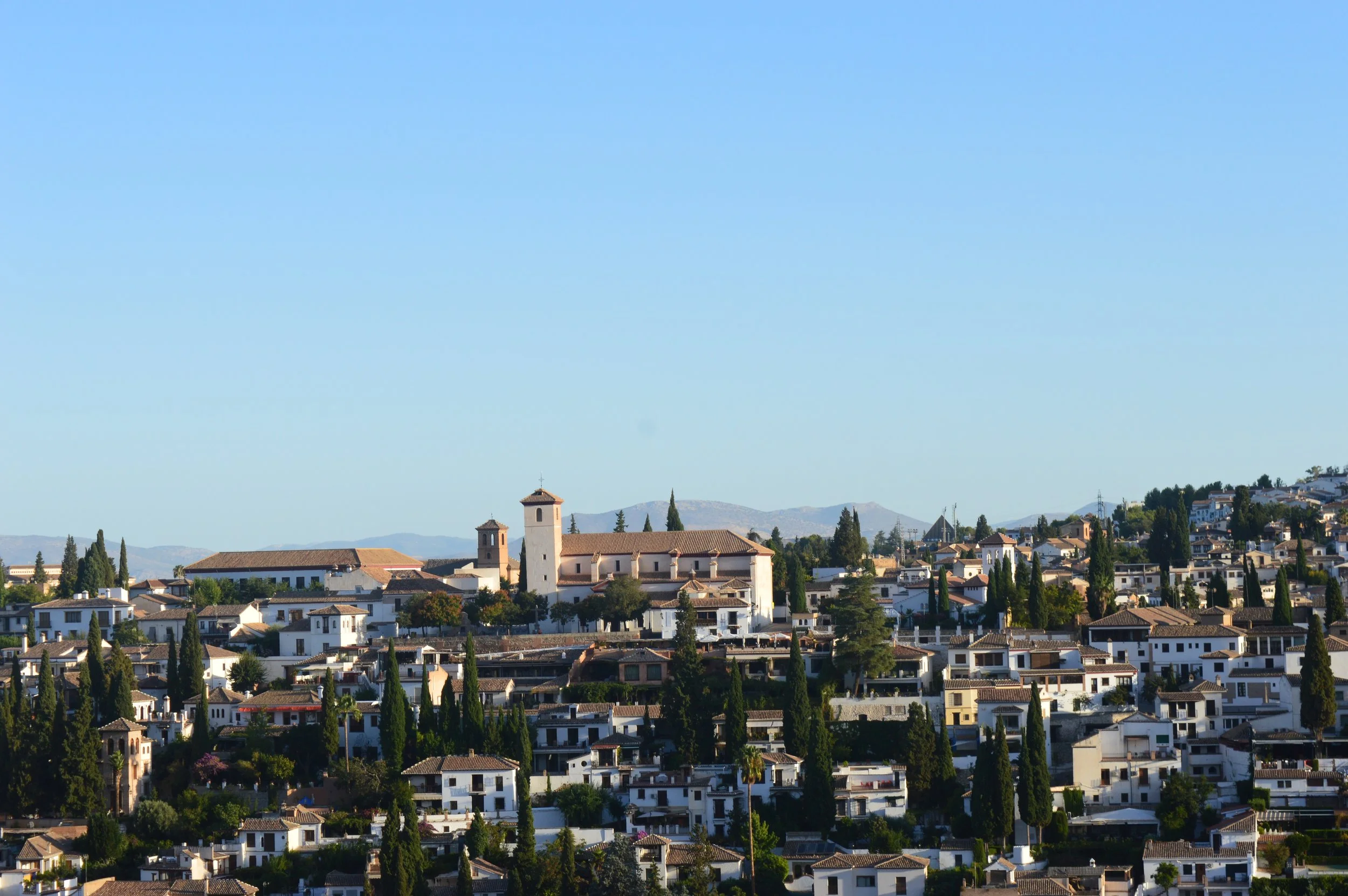
A mountain-top view of the Granada skyline
“Nuevas navegaciones, pensó. Y así hasta el final.” – Isabel Allende, ‘Largo Pétalo del Mar’
If Málaga had stood with a bad reputation in my mind, Granada stood as its foil. Growing up playing classical guitar, Spanish words and names had flitted into my imagination and taken root. One of the most iconic pieces is ‘Recuerdos de la Alhambra’ by Francisco Tarrega, an homage to the great Moorish fortress cum Christian palace which stands vigil on one of the many mountains of Granada.
It was thus with lilting clips of Spanish guitar and childlike imaginings of this fairytale land that I continued onward. A beautiful train journey slid through an arid landscape of olive plantations and dusted white towns in the clefts of the undulating landscape before scaling upwards to Granada. I trek to my hostel, and I really mean trek with those damn backpacks under the incessant sun, and eventually check in. The corporate vibe of Málaga had been exchanged for Thailand trousers, weed and a suspicious hippie lurking in the doorway. This, I can work with. By now it was early evening, and felt like the ideal time for exploring the city, so I set off for a quick look around. Granada sits isolated in the mountains, two thousand four hundred feet above sea level, and was one of the final strongholds of the mythic Muslim caliphate of Al-Andalus almost eight hundred years ago. Indeed, it was the final Moorish taifa, or city state, who – facing the Christian armies advance – peacefully surrendered the keys of the Alhambra to the reyes católicos, and left the peninsula. It marked the end of the reconquista, the end of Moorish influence on the peninsula, and the end of a remarkable coexistence of Christians, Jews and Muslims in a kingdom which had once been known as the ‘ornament of the world’.
The city lies like a wizened vizier around the Cathedral, with streets of orange trees which unravel around this monumental centrepiece. Andalusia is a land of myth and legend, the confluence of so many ancient societies - Romans, Muslims, Christians - and Granada is one of the places where this veil to history is thinnest. The tombs of Ferdinand and Isabella, the architects of the Reconquista, lie just next to the Cathedral, which in turn sits by an ancient Moorish university, as well as the Alcaicería – a historic Muslim marketplace - whose streets are draped in carpets and echo with the aromas of roasting nuts. Across a more modern main road sits the Albayzín, the old Jewish neighbourhood of the city, itself a Unesco World Heritage Site. It’s a sprawl of narrow streets and white houses (designed to inhibit an army’s march up to the Alhambra), whose roads occasionally plateau to a mirador, small squares which hang like leaves off the urban vine and provide incredible views of the city and the Alhambra.
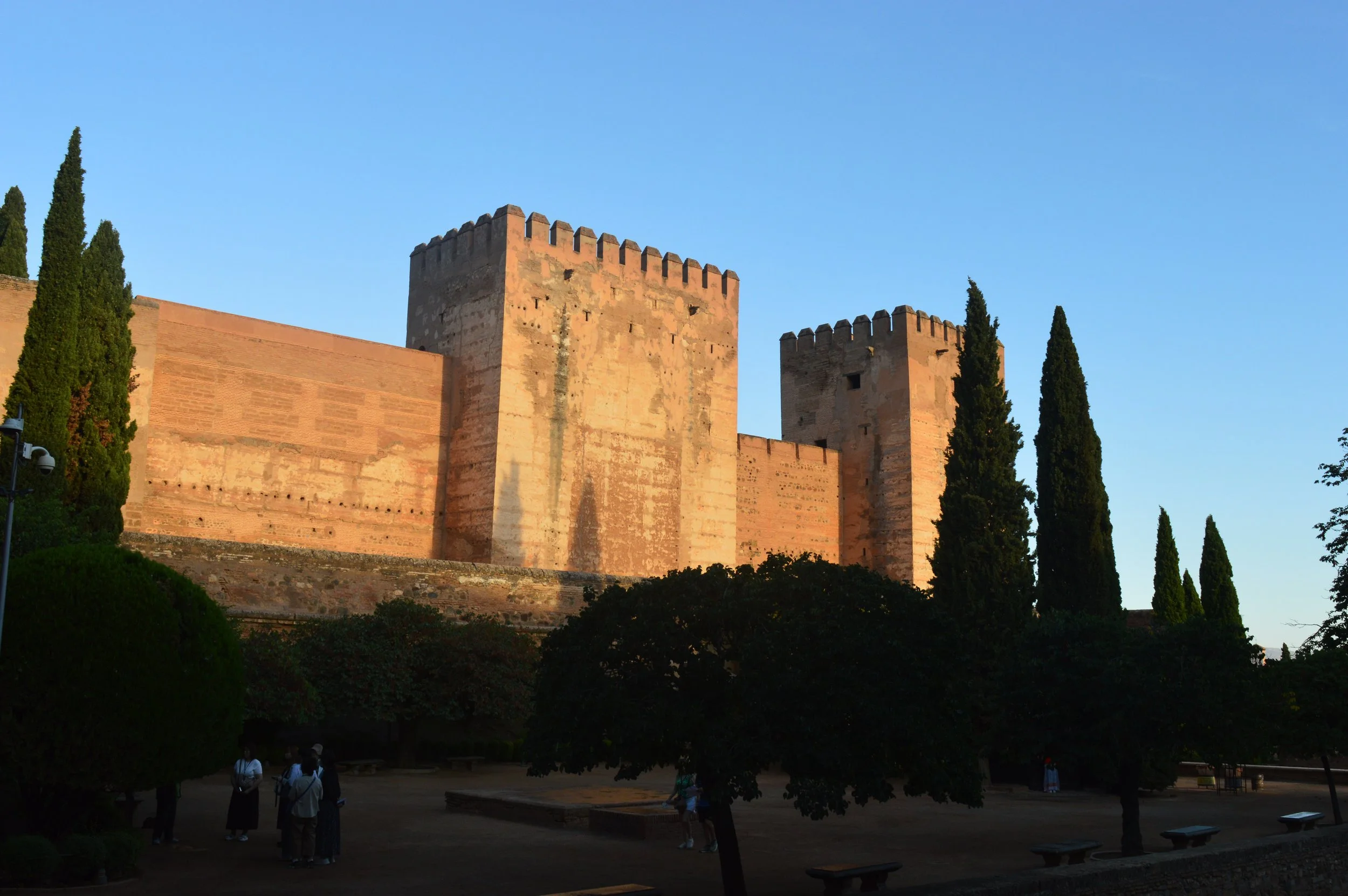
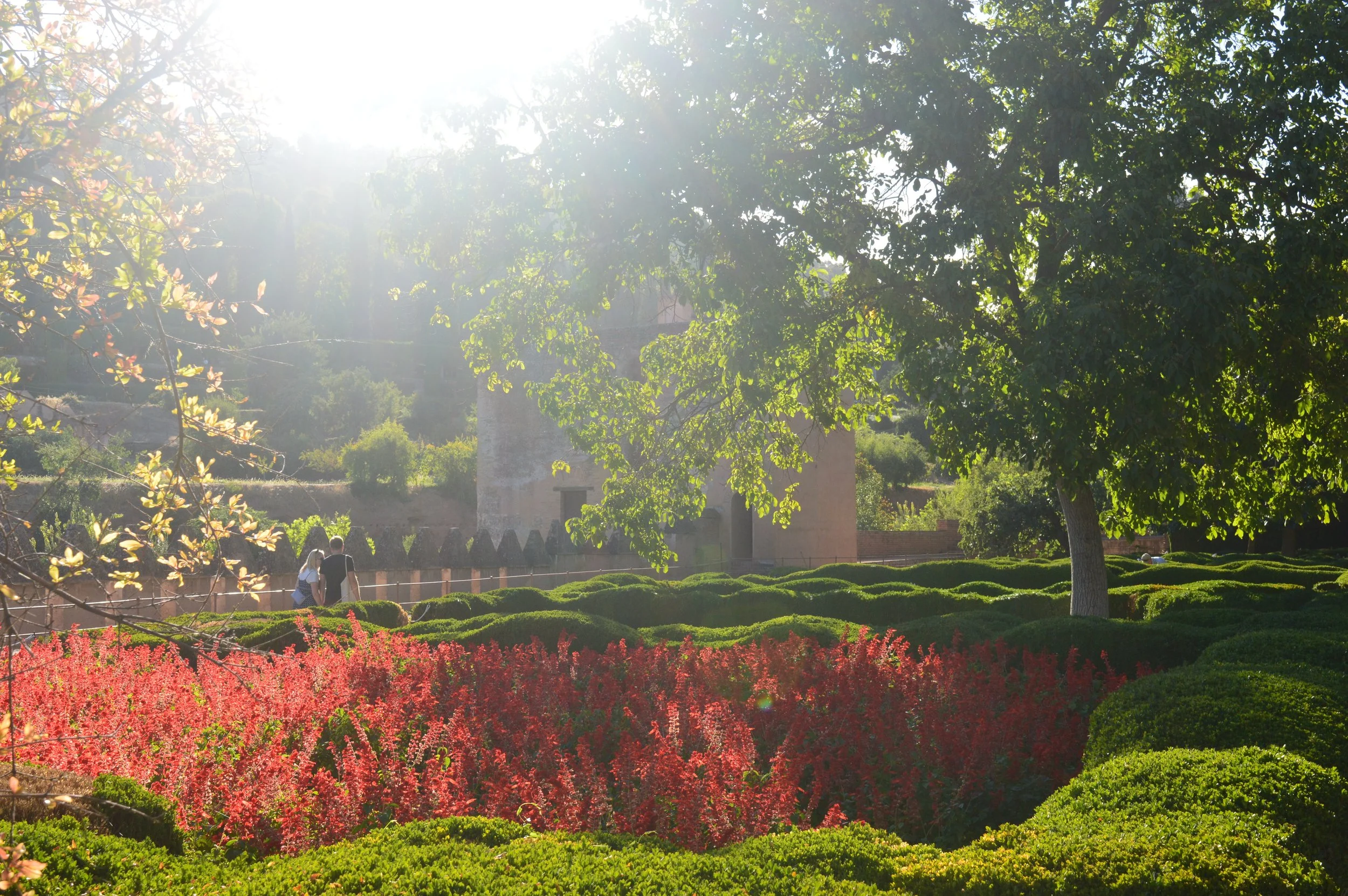
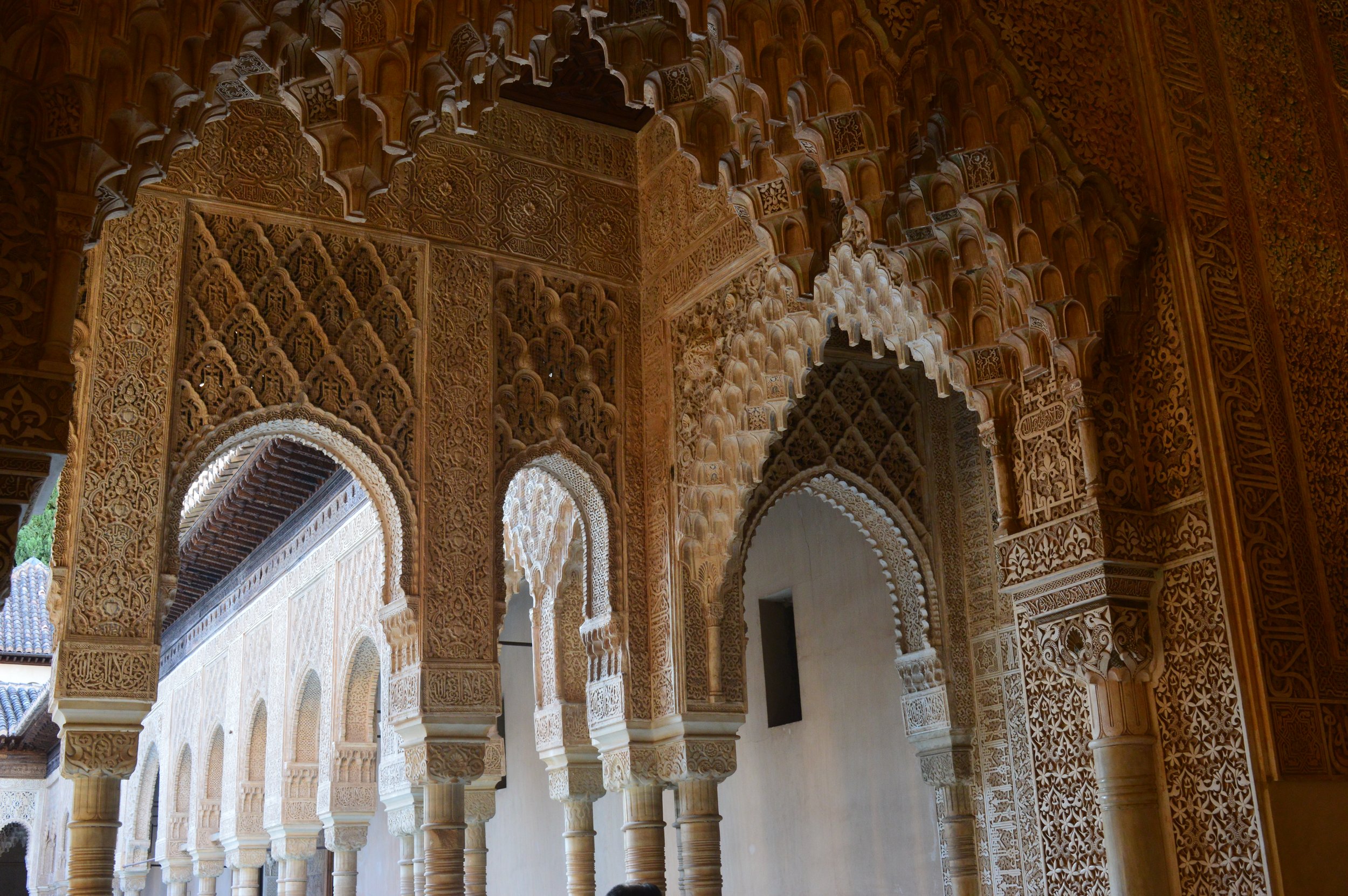
The imposing walls of the Alhambra, A young couple in the Nasrid palace gardens and some of the unbelievable detail in the courtyards of the Alhambra.
Famously busy, I had booked tickets for the palace long ago, and so at eight o’clock the next morning, I hiked through the Albayzín and followed the mountain path up with Tarrega’s piece playing in my headphones. Ancient castellated walls and towers frame the mountaintop, made of that monolithic stone architecture which seemed transplanted from ancient Arabia. These walls and the Nasrid palaces are the main inheritance from the Moorish period, and were probably the first time I’ve ever felt a culture shock. Italian architecture is stunning, but the Roman and Renaissance forms are so rooted in the British cultural psyche that they didn’t seem unusual to me. But this Muslim architecture was unlike anything I had seen before: walls of chiselled calligraphy and cloistered courts of vaulting archways around sunken gardens, which led into ceremonial halls whose crystalline roofs glistened like artisanal stalagmites.
After the palaces lie the ornamental gardens, stretching along the mountain face like a druid’s finger and buttressed by the great walls. Running parallel to the gardens on a sister mountain is the Generalife, the summer hunting palace of the Moorish leaders, which likewise bustles with formal gardens and a postcard view of the Alhambra. I scribbled in a journal entry from a bench in the Generalife, and gawped at the fortress for almost an hour, trying to etch the lines of its walls into my memory. It was perhaps the most beautiful thing I’ve ever seen.
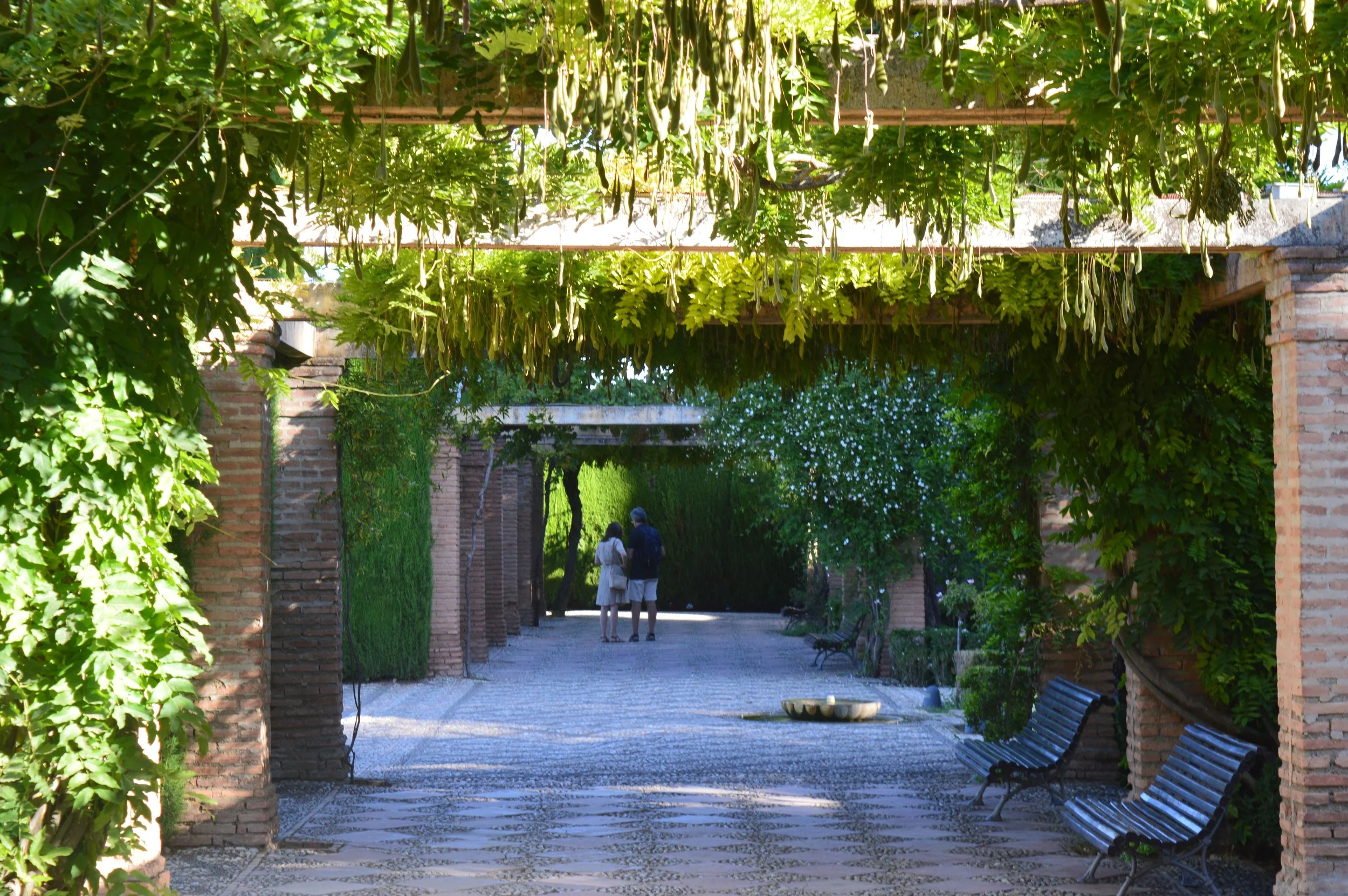
The gardens of the Generalife
By midday I began my descent back into the city and paused in a plaza near the hostel for lunch. Unbeknownst to me, Granada is famed for its tapas, and so my simple order of huevos rotos (fried eggs and jamón ibérico on a bed of chips) quickly became a multi-course meal of a complimentary arroz caldoso with chicken, a beer, and then an espresso afterwards. A sad ham and cheese sandwich eaten guiltily whilst walking to your next lecture doesn’t fly in Spain – meals are a ritual one-to-two-hour affair, and the lethargy of good food and the Spanish sun force you to go a little bit more tranquilo. All, by the way, for under ten euros – viva España.
I headed back to the hostel and chatted for a while to people in the kitchen, eventually ending up talking to two young looking British guys. Both of them were about eighteen, and giddily tell me that they’re on their first holiday together after finishing A levels. One of them is going to Imperial while the other is keen on Cambridge, and they pick my brain about the application process and what it’s like to study here. With bright eyes and bushy tails, they then explain to me their plan for Granada – they’re going to hike up into the mountains and walk 20 kilometres a day for three days. I looked at them baffled,
“In this heat? Have you boys hiked before?”.
They nonchalantly responded that they’ve never been hiking, but one of them assured me that he goes on family holidays to Keswick so how different can it really be. I tried to dissuade them from their madness – they had one meal deal water bottle each, no backup battery, one tent and no suncream – but my pleas fell on deaf ears. I tell them to at least share their location with some of their friends in case they get lost, then wash my hands of it. I was half expecting to see them in the Spanish local news a few days later, but oddly enough, the tale of their adventure reached me in a much more roundabout way - but that’s a story for the next issue of Nuevas Navegaciones.
I headed down to my room and ended up having one of those awkward hostel interactions when you can’t quite tell if someone wants to speak to you or to be left alone. Turns out this Aussie girl was in fact not speaking to other people in the room, but to her friend on the phone, so when I confidently introduce myself she looks at me baffled and apologises, saying that she’ll be done with the call in a second. Tierra trágame. After we laugh off the awkwardness, we hit it off chatting – she’s also solo travelling, having just finished the first leg of her Euro summer with her friends in Greece, and now off for a solo venture through Spain. Another girl comes back to the room, a Canadian, and we all agree to meet on the rooftop bar that evening for some drinks then to head into town. No phone numbers exchanged, names half remembered from brief introductions, but bonded over our common adventure; it was how I can only imagine making plans was like in my parents’ uni days.
I spent the afternoon on a free city tour, which I learned over the course of the trip was a pretty solid way to get to know a city and speak some Spanish. After about two hours and an awkward encounter with a Spanish grandpa who had interrupted the tour to argue with the guide that the inquisition actually didn’t do anything wrong, I was back in the hostel. In the room I found the girls waiting for me before we headed up to the bar, and also half speaking to a new roommate who had just arrived. He was Martín, an Argentinian who didn’t speak a word of English. I quickly realised that I was about to become a translator for the evening. We headed up to the roof, which housed a tiki bar with views of the cathedral, and got into a funny rhythm of me chatting to the girls, translating to Martín and chatting to him, then turning back to rinse and repeat. I was the conversational equivalent of the odd sliver in the middle of a Venn diagram. A couple of sangrías deep, we headed into the centre to find something to eat, ending up at a tapas place in the Albayzin. The language barrier by this point had pretty much dissolved, and it was cool to see how the girls and Martín would understand the vibe of what was being said through body language, then check in with me for the translation. A couple of memorable translation mistakes cropped up from my first experience of the hardcore Argentinian accent, for instance my scandalized exclamation to the girls that his ex-girlfriend was four years old, before swiftly realizing my mistake and correcting that he broke up with her four years ago. Probably could’ve figured that one out had I had one less sangria.
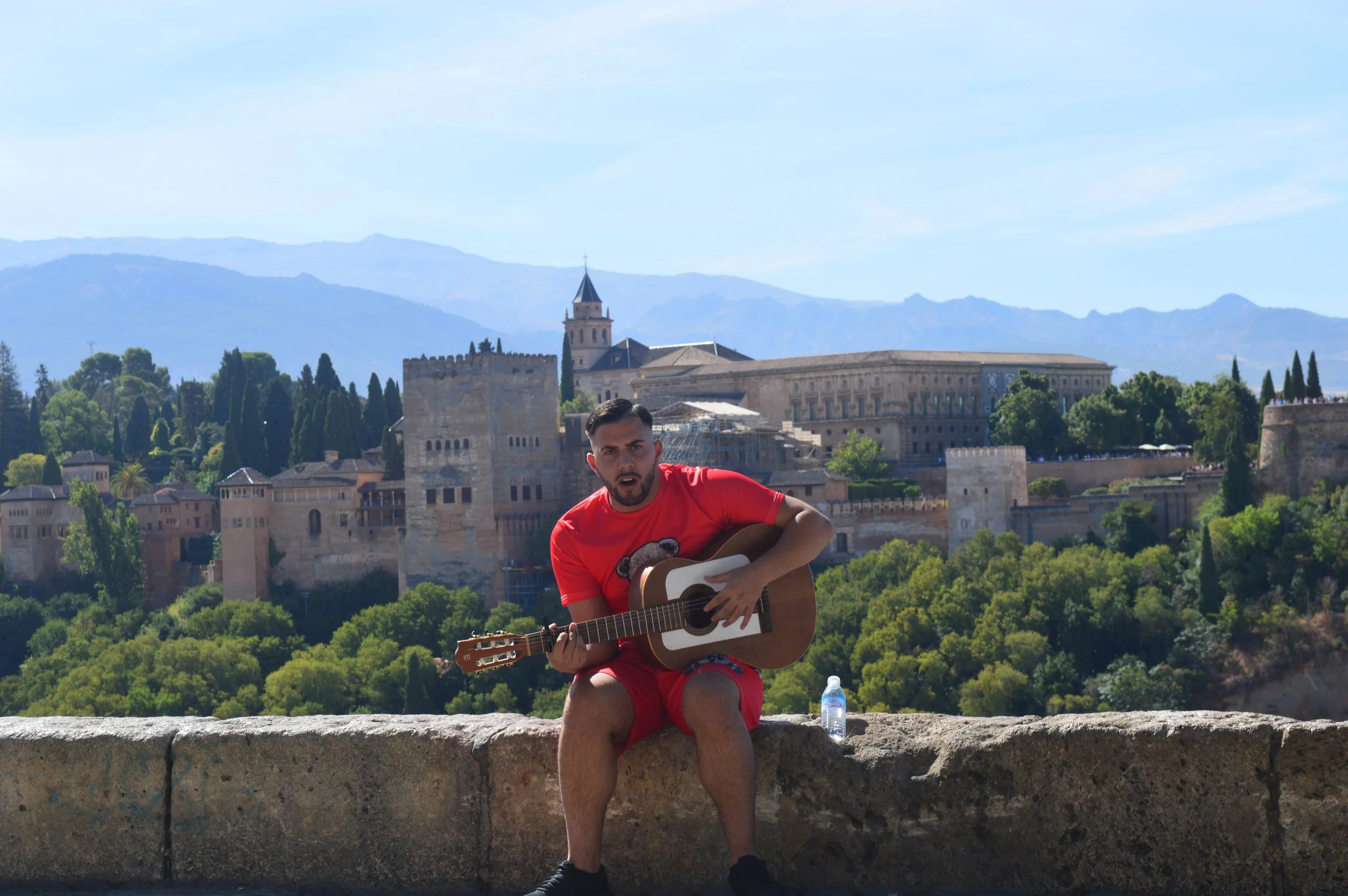
The flamenco guitarist in the Mirador San Nicolas, the Alhambra in the distance.
Having slept off the festivities, I packed my things and figured out what to do with my morning before I got my train to Córdoba. I wandered up to the mirador San Nicolas, completely by chance, which turned out to be one of my favourite memories of the trip. The mirador faces the Alhambra at the same height, giving this gorgeous panoramic view of the castle. At around midday it was fairly quiet, apart from a guitarist perched on a ledge playing Bamboleo. A tap on the shoulder draws my attention away from the guitarist to none other than a slightly out of breath Martín. He also was heading off that day, and had decided to do a route through the Albayzin and see all of the miradores, randomly spotting me from a distance. We chat again for a while to the sound of flamenco guitar, we hug, and he tells me to drop him a message if I’m ever in Argentina. I have a quick lunch at the gorgeous café cuatro gatos, a cappuccino with the timeless pan con tomate (crispy slices of baguette with olive oil, garlic and tomatoes – food of the gods) then wander back to the train station. Onwards and upwards.
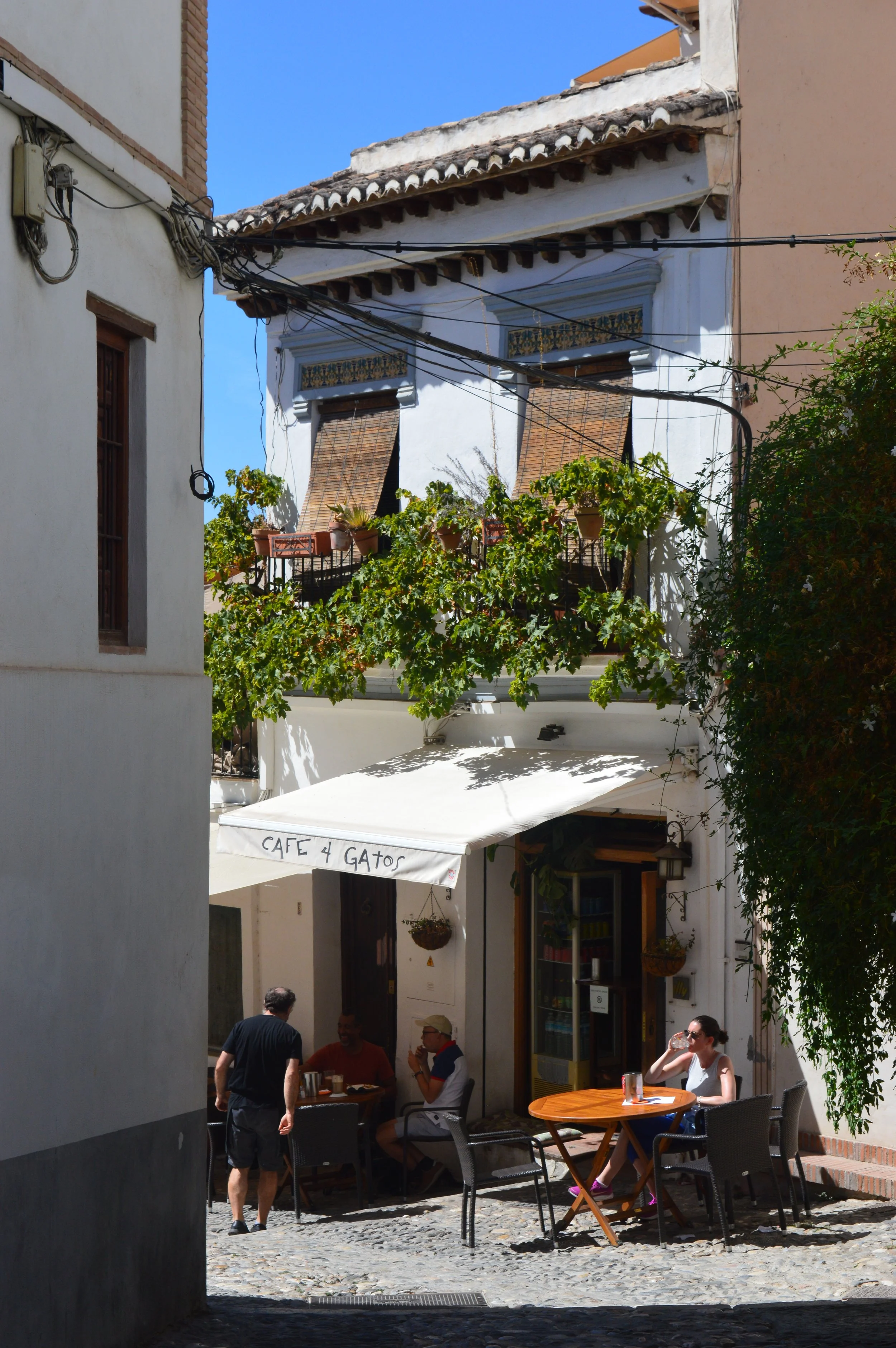
The Café 4 Gatos in the Albayzín
All photos belong to Asher Porter, unless otherwise stated