Apuntes del fin del Mundo I: Modern Musings on Buenos Aires
Buenos Aires is a site of confluence. Between European façades, literary phantoms and the city’s raw, present-day contradictions, it reveals itself as both a setting and a character in an unstable yet strangely familiar novella. This column wanders its streets and myths, tracing the tension between the imagined past and the realities encountered, and the stories of Argentines themselves.

Buenos Aires Rooftops, Illustrator: Anne Katharina Osiander
Buenos Aires was the only city I had been where I had absolutely no idea what to expect. The disconnect between the gushing prose of the travel guides, with their glossy photographs of reassuringly European landmarks, and the hermetic, sinister vision suggested in the novels I had read, pulsated in my head like the turbulence as we crossed the coast of Brazil. Having arrived across ‘a sea that was five moons wide’, to quote Borges, I wondered which incarnation was right as I walked out into the dawn air of Ezeiza on one of the coldest winters the capital has ever known… in August.
The streets of Buenos Aires beckon like a maze. After having realised that my aim of walking every street in the city was a fatuous pursuit, I resorted to dawdling. This also became a demoralising task. From what I saw, and contrary to what most guidebooks insist, I initially found it hard to believe that Buenos Aires was the ‘Paris of the South’. There is very much a Latin American reality at play; high-rise buildings, insurmountable inflation, shacks and villas miseria scattered across the city and outskirts. The splendour of Retiro, parks designed by Carlos Thays and the Plaza San Martín are only a small snapshot of a glorified past. I began to realise that the architectural heritage was not merely physical, but psychological, functioning as a portal through which identity, status and better times were both conjured and sustained, ‘the story dreamed up’ of Borges’ ‘Fundación Mítica de Buenos Aires’. Contemporary Argentine literature has portrayed the city as ephemeral, evanescent and decidedly slippery - a chimera whose landscape is unstable, mutable and untrustworthy. In ‘The Tango Singer’, by journalist-writer Tomás Eloy Martínez, the protagonist Bruno Cadogan observes,
‘I had hallucinations in which photos of early twentieth-century Buenos Aires would superimpose themselves on images of reality. I would lean out the balcony of my room and, instead of the vulgar buildings across the street, I'd see the terrace of Gath and Chaves, a shop that disappeared from Florida Street forty years ago’.
I can’t help thinking that Argentina’s failure has become a self-fulfilling prophecy. Take a look at Edificio ‘No Hi Ha Somnis Impossibles’. It seems ironic that such a quote was emblazoned on the building after it was restored, to a somewhat less dilapidated state, in 1999. You only have to look at the building to see that it is completely parodic. This ‘Paris of the South’ is the chamuyo of Lunfardo - a deceit, a fraud. There is pointless symbolism in architecture; the vestige of the past is a double-edged sword for porteños, it is something they are so proud of yet have been unable to sustain. Contextually, this fascination with the architectural language of Paris, mostly Beaux-Arts, had its roots in the fin-de-siècle when more mansions per family were built in Buenos Aires than anywhere else in the world.
El Palacio Barolo is an intricate allegory of Dante Alighieri's Divine Comedy, with its 22 floors representing the 22 stanzas of each canto, the edifice’s three sections (Hell, Purgatory, and Paradise) mirroring the poem's structure. Not only has architecture been of great importance in this city, but also theatre, opera and film. One only needs to look at El Teatro Colón to see the impression of the European opera tradition. Here lies the porteño's complete indifference to their own ‘Latin Americanism’ and thus total dis-investment in any real engagement with the social, cultural, political and economical development of the continent, instead looking North East towards Europe, their historical and largely demographic origin. Buenos Aires functions as both landscape and character, its slippery, serpentine nature complicated further still by a reliance on facade and show - Europe-facing - and by the years of Dirty War and dictatorship which subverted truth.
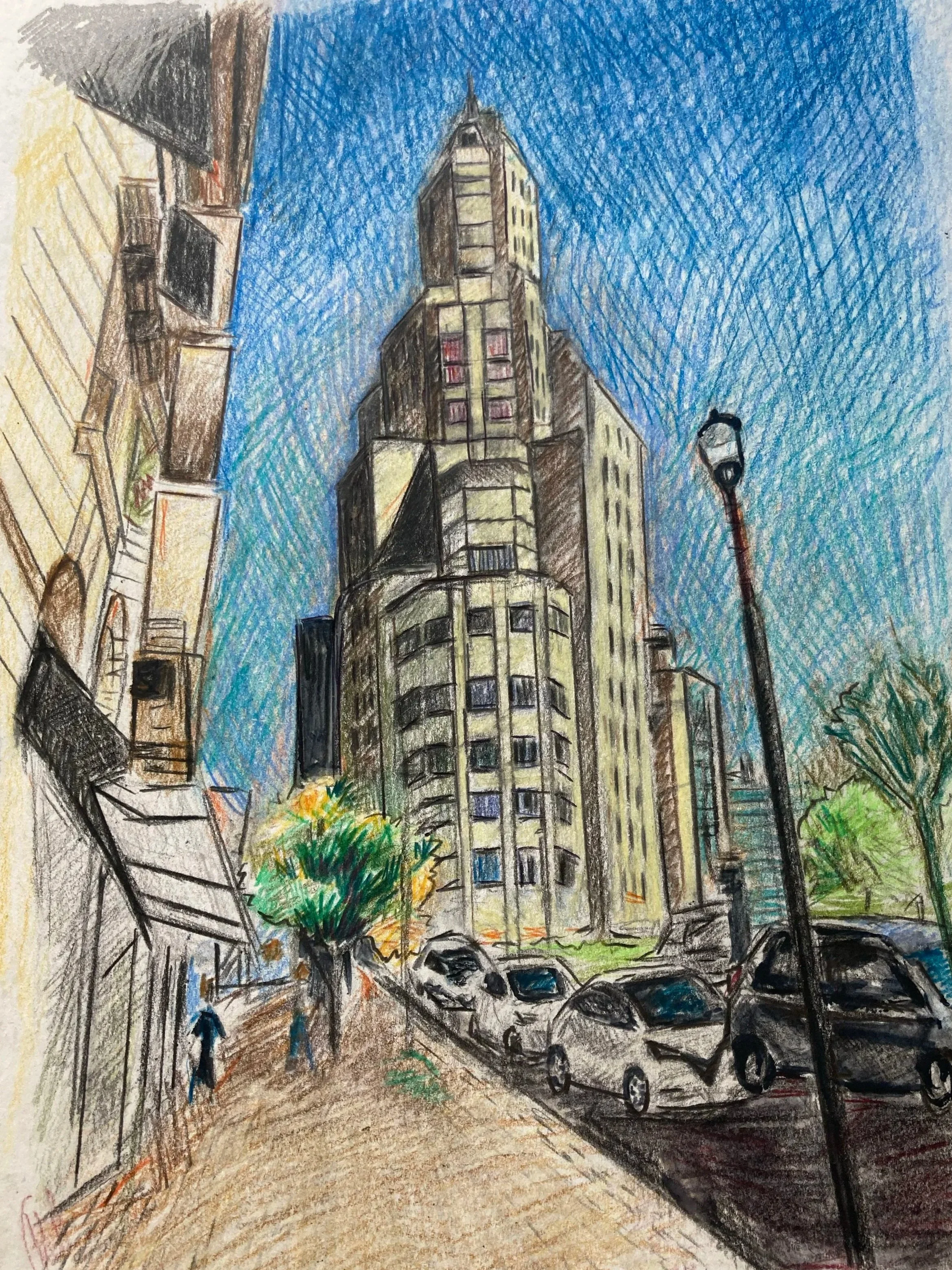
Edificio Kavanagh, Illustrator: Anne Katharina Osiander
The actor Ricardo Darín is a returning guest on our Netflix’s recently watched – to my flatmate’s utter horror, “Jesus, is he the only actor in the whole of Argentina?” Admittedly, he is one of the most prolific ones (think young-er Anthony Hopkins). If an Argentine were to walk into our flat, I’m sure they’d sit down, kick off their shoes, and join us for a Darín sesh no doubt. Well, we certainly can’t invite Argentinians over if our toilet flush isn’t working… or can we? It hasn’t been working for a while now, in fact, most toilets in the city have duct tape and toilet tissue embellishing bowl, valve, handle and tank. How Buenos Aires became a toilet cemetery I’m not sure, but all I know is that they are not in a hurry to fix them. The schism between a dysfunctional present and the excesses of an extravagant past is nowhere more visible than in the Palacio de Aguas Corrientes - a fabulous, fairy-tale confection of a building, an 1887 water pumping station dolled up in typical porteño style as a palace, complete with Royal Doulton glazed tiles. I am sure that the British and Scandinavian engineers who built it never envisioned a day when it would house toilet pans through the ages whilst every toilet in the city blocked quicker than a tango cross-step.
Another idiosyncrasy of Argentine society is the dissemination of news reports. It is obvious that the years of the Dirty War and dictatorship have subverted truth. Forget concerned broadsheet editorials about appeasement in the face of Putin or the recent Alaska conference, the news here is delivered by orange people dripping in sponsorship jewellery, making gauche comments in garish outfits. The reports are even more concerning: murder after murder, tacky jewellery adverts, and “LATEST: Philanthropist Kevin Costner frees seal”... wouldn’t Lao Tzu be proud.
It makes you think where Argentine priorities lie, does the war in Gaza matter? What about starving children in Ukraine? I would even be happy with a short sequence on what Trump is up to at this point. It’s clear to see that Argentinians are living in a silo of their own. After having spoken to other foreigners who are living in the city, they admit that because Argentines have never trusted the system, they instead resort to idealising the past. That old Roman chestnut, pan et circenses, comes to mind – feed the masses thus silencing them – this lack of decent, germane news and an established broadcast and print journalism reinforces these trifling and madcap news stories. It feeds the narrative of everlasting splendour and dignity on the continent, yet fails to look at its own gnarly reflection in the mirror. Some days I feel very much at the bottom of the world.