Trump’s Invasion of Venezuela and the New Age of Imperialism
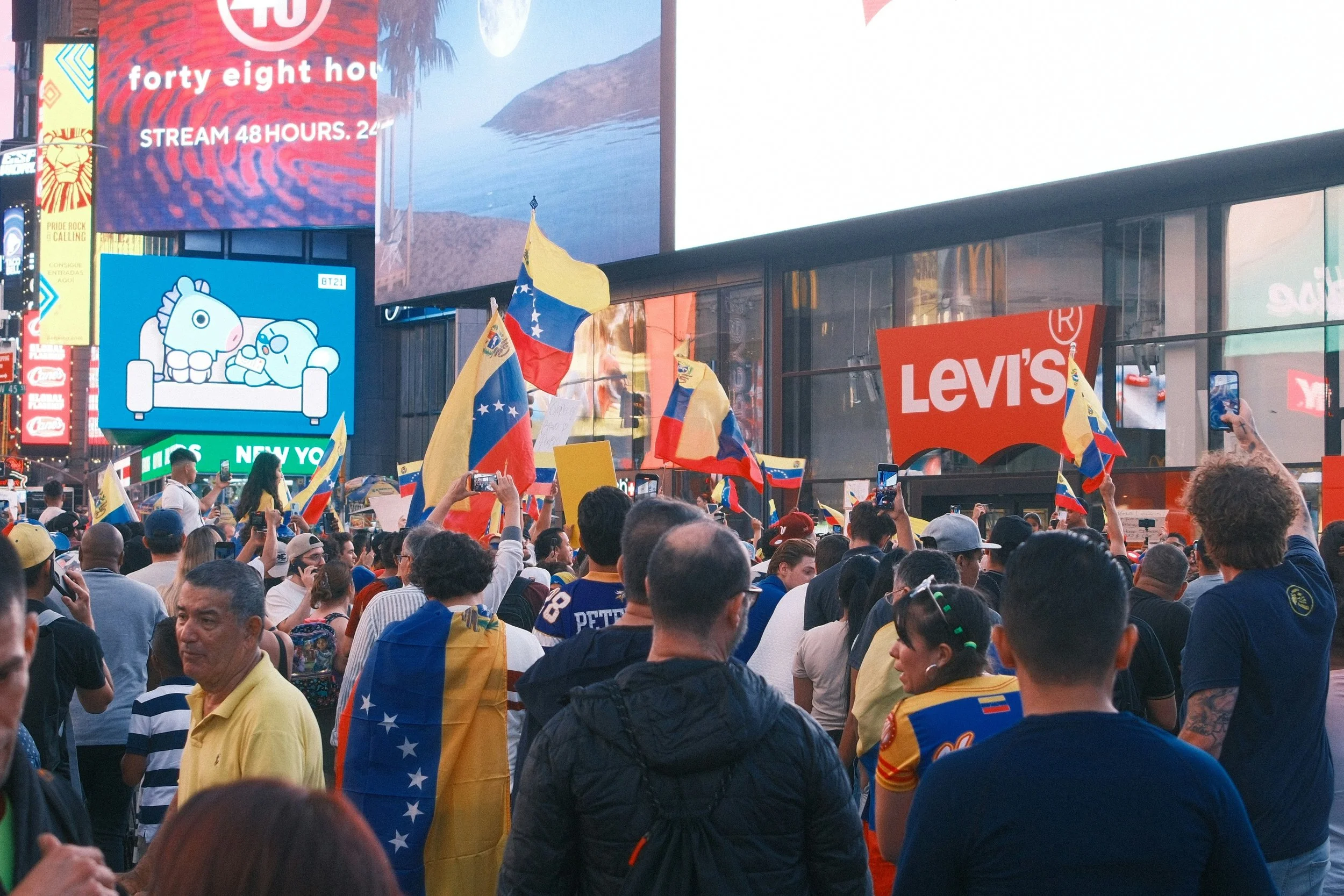
A crowd of Venezuelan protesters in Times Square, New York (Photo: claire dea adh, via Unsplash)
America’s dormant imperialist dream has finally awoken. This feels like the beginning of the end: raw, unadulterated violence. A sight so shocking yet so painfully familiar for the tortured bodies and land that the Latin American continent cannot manage to forget. No matter how hard they try, the scars endure.
The Trump administration's capture of Venezuela’s president Maduro in the early morning of January 3rd comes at a time of increased threats of outright US imperialist claims over Latin America. The renaming of the Gulf of Mexico to the Gulf of America became a ‘teaser’ for what was to come. This marks a major shift in US foreign and defence policy, signifying a break from previous diplomatic practices where American interests would be disguised through the use of scapegoats and ambiguous rhetoric. We are in the new era of ‘naked imperialism’.
But these acts are not completely new; in fact it is hard not to feel a sense of deja vu: echoes of the Cold War era and the 1823 Monroe Doctrine that preceded it. This Doctrine warned European powers to not interfere in the so-called ‘Western Hemisphere’, covering the whole of the Americas, and was used to justify American interventionism. The US has repeatedly intervened in Latin America by leading military coups, backing opposition movements, and seizing control of natural resources. The pillar that Trump’s expansionist policies stand on, cementing the USA’s sphere of influence in Latin America, is rebranding the Doctrine from Monroe to "Donroe”. In a recent press conference Trump claimed “American dominance in the western hemisphere will never be questioned again”.
Trump has threatened a host of other Latin American countries including Colombia, Mexico and Cuba. Trump’s next victim Cuba held close ties with Maduro’s government and has been suffering from US sanctions since the 1960s. This threat arises against the backdrop of the US striking boats in the Caribbean and eastern Pacific since September, claiming, without evidence, they were carrying drugs. A new War on Drugs has been fabricated as the justification for America’s colonialist policy. Drug trafficking and narcoterrorism have become the markers of this new era of colonialism.
Despite the clear historical context that informs America’s actions, these recent events still mark a radical shift: this is the first time the U.S. military has directly intervened in South America to effect regime change. Other regime changes had only been carried out in smaller countries in Central America and the Caribbean: Guatemala in 1954 and Panama in 1989.
Although Nixon's presidency in 1970 may have undermined Allende’s socialist government in Chile, it did not directly orchestrate the coup against it.
The entire framework of international law has now become meaningless, raising fears that other global authorities could follow the United States’ lead and openly intervene in any country they view as a ‘threat’.
The primary goal of Maduro’s capture was always to take hold of Venezuela’s prized-possession: oil. Venezuela had spent the last few years moving away from the US dollar in their trade deals, and through Maduro’s capture, Trump makes the point that any attempt to bypass the US currency will be met with outright aggression. Venezuela has the largest proven oil reserves in the world; it is the treasure that is seemingly worth the pain and suffering of millions of people. Yet again mother nature is violated and terrorised for the profits of the US government. Land owned by indigenous peoples has once again been ripped away from them, stolen: an echo of an endless cycle of persistent recurring themes since Spanish colonialism.
Of course, there are a mix of feelings amongst the Venezuelan diaspora: the attack targeted Maduro’s repressive and corrupt government which had caused perpetual suffering and austerity for millions of Venezuelans. Finally, a sigh of relief. However, a deep uncertainty lingers as Venezuelans question whether US intervention will lead to a better future. There is a possibility of finally returning home, but will this home be destroyed even further?
The people of Venezuela deserve democracy. Latin America deserves true freedom from the shackles of colonialism and imperialism, it has suffered from perpetual cycles of US imperial intervention framed as ‘liberation’ and justified in the name of ‘democracy’. Trump’s intervention in the country will not establish true democracy or freedom; it is instead an act of outright invasion, a continuation of two centuries of imperial expansion and obliteration. The US isn’t ‘spreading democracy’ in Venezuela, it’s enforcing empire. Latin America is tired.
But how can we make sense of Venezuelans’ joy, despite the aggression and violence of the US’s intervention? There are tears of joy since thousands of Venezuelans have been fleeing for years. Today Venezuelans celebrate, the streets of Caracas are filled with hope. This has to be validated too. Condemning US invasion and its colonial roots does not mean endorsing Maduro, as these are not contradictory positions. As Raphael Tsavkko Garcia so eloquently puts it “Both can be true: Maduro is a dictator who caused immense harm to his people, and US military intervention is an illegal act of aggression that will not resolve the crisis of democracy in Venezuela.” We have to invite nuance and let go of rigid black-and-white perspectives if we are to make sense of the chaotic and violent time we live in, and to prevent the deepening of humanitarian suffering.
Most importantly, we must stand in solidarity with Venezuela and the wider Latin American community, where the people themselves must be free to decide their own future.