Illustration by Rachael Aina
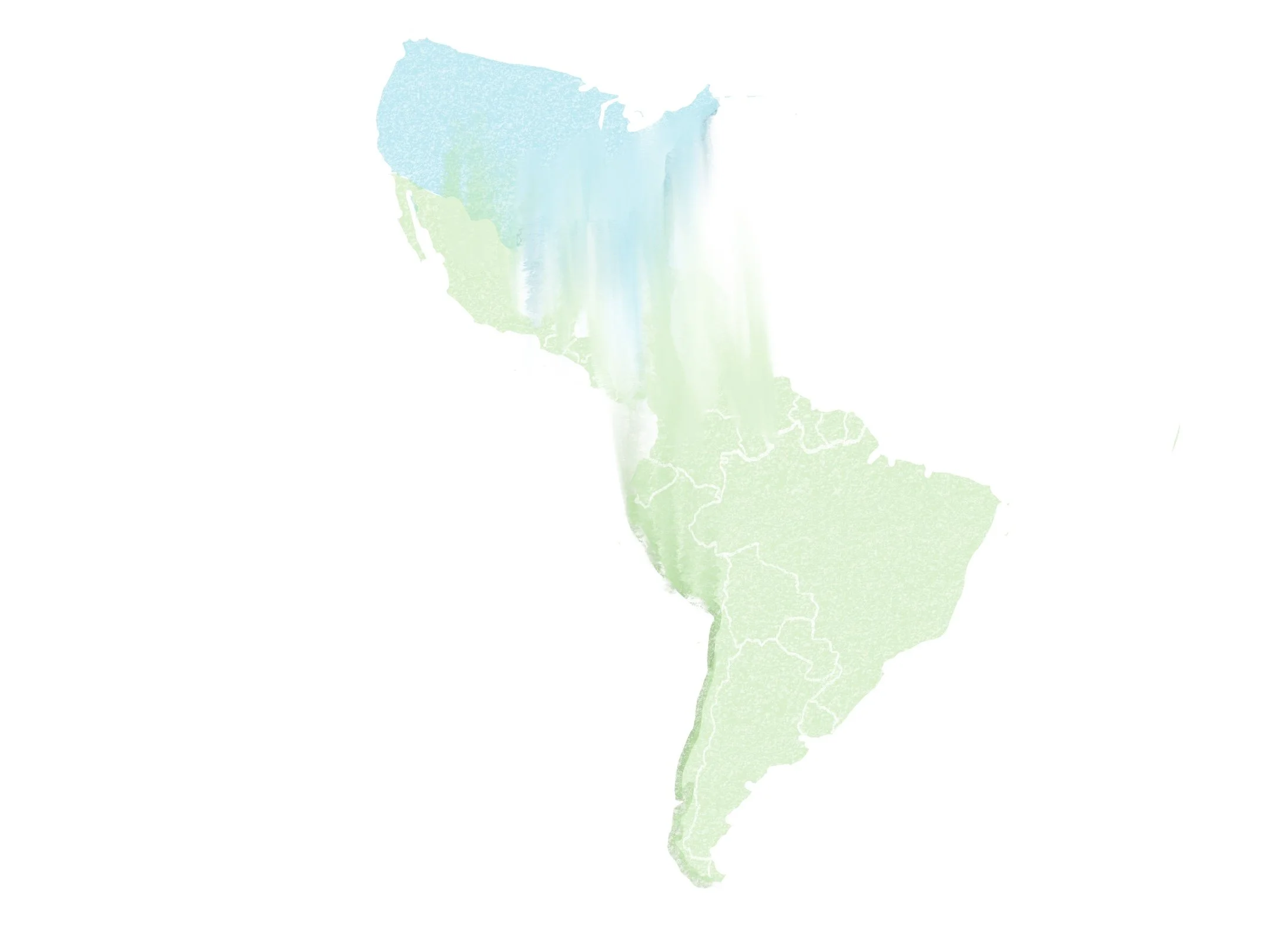
Symbiosis is the long-term biological interaction between two organisms of different species. It can be divided into three branches: commensalism, when one species benefits from the relationship and the other is neither benefitted nor harmed; mutualism, when both benefit; and parasitism, when one species benefits at the expense of the other. I believe that it would be interesting to conceptualise the continents of North and South America as different organisms and use the branches of parasitism and mutualism as metaphors to reveal patterns of symbiosis in late twentieth-century U.S.-Latin American diplomacy. To what extent are these biological notions transformed in political discourses in the past as well as nowadays, particularly with respect to Latin American immigration to the U.S.? Together we can try to reframe the notion of symbiosis and question its place within the future of U.S.-Latin American political relations.
Although the topic of U.S.-Latin American relations is a considerably complex one, I believe that the Cold War period marked a clear case of parasitism, in the sense that the USA acted unilaterally, driven by the Truman Doctrine and a desire to contain the threat that communism posed to its national security. Yet, to what extent did this cause genuine harm in the short and long term for South America? Well, U.S.-backed coup d’états catalysed not only the formation of right-wing authoritarian regimes, but also the substitution of left-wing leaders with military juntas and dictatorships in Bolivia, Cuba, Chile, Brazil and Argentina, among others. State terrorism thrived in these volatile social and political environments, as seen during Argentina’s Guerra Sucia, where an estimated 30,000 people were killed or forcibly disappeared, and during Pinochet’s Chilean military dictatorship, where approximately 30,000 people suffered systemic human rights violations, according to the Commission of Truth and Reconciliation (Rettig report). The detrimental effects of U.S. interventionism in Latin America’s domestic affairs pose the question of whether positive symbiosis — mutualism —could ever be a long-term possibility between the two powers.
Why is the past so vital when discussing present-day U.S.-South American politics, specifically the political climate surrounding immigration? The past provides a framework for interpreting contemporary political narratives which can be seen as degrading Latin American citizens, discursively echoing these past interventionist tactics. We must first remember that national identities are partially formed from the vestiges of a country’s history; I find it particularly intriguing that US President Donald Trump weaves biological concepts within his political rhetoric to influence the portrayal of Latin American cultural identities. For example, during his second term, Trump promised to undertake the “largest deportation programme of criminals in the history of America”. However, by early June 2025, it appeared that “the president ha[d] widened the scope of his mission, targeting not just criminals, but migrant workers, some student activists and even tourists with visa issues”. Now, one in five Immigration and Customs Enforcement (ICE) arrests are Latinos with no criminal past or removal order, “detained based on the location, their occupation, their physical appearance”. I cannot help but notice how this demonstrates a pattern of street profiling, where phenotypic traits — physical markers of Latin American identity — are being used as indicators of suspicion or guilt. The same sense of biological essentialism — the belief that innate qualities, determined by biology, dictate a person’s identity and behaviour, rather than environmental and social factors — can be recognised in Donald Trump’s speech on the 7th October 2024. The President referred to the presence of “a lot of bad genes” in the United States whilst referring to murders allegedly committed by immigrants residing illegally there. This language seems to craft a biopolitical logic which attempts to shape and regulate the identities of Latin Americans in the US, as it can be seen as labelling some diasporic communities as inherently suspicious. Here there is a weaponisation of biological models in political narratives, which has a parasitic effect on the perception of Latin American citizens in the US. The parasitism which defined past U.S.-Latin American relations during the Cold War is reflected once again, but this time it gains further biological dimensions within the sphere of immigration.

Illustration by Rachael Aina
Perhaps rearticulating the term “symbiosis” in the context of U.S.-Latin American diplomatic affairs, so that it prioritises the branch of mutualism rather than parasitism, could counteract a demeaning political narrative surrounding Latin American immigration. Let’s not forget that the foundations of the United States — including when the Thirteen Colonies united to form the USA and its constitutional federal republic as we know it today — were defended by immigrants. This fact is celebrated in popular culture through works such as the musical Hamilton, which dramatises the life of Alexander Hamilton, an immigrant born in the Caribbean who played a pivotal role in the drafting of the Constitution, as well as its ratification. Today, Latin American diaspora communities continue this legacy, functioning as a vital component of US economic growth. According to the Congressional Budget Office, immigrants (including the undocumented) are projected to contribute $7 trillion to the economy over the next decade, with nearly (47.6 percent) of the foreign-born workforce being Hispanic. Why would we not acknowledge and make the most of such a mutually beneficial partnership?
Mutualism must be re-centred and preserved as a foundational value of US-Latin American diplomacy. Acknowledging the importance of mutual dependence — economically, socially and diplomatically — could pave the way for longstanding cross-hemispheric solidarity between these two major powers.