
Legalmente rubia at the Teatro Liceo in Buenos Aires. Image belongs to author.
Mass-produced Hollywood films litter and enchant the literary imagination of Manuel Puig, renowned Argentine novelist, pioneer of Latin American postmodernism, and lover of all things camp. Far from mocking these films, Puig uncovers the hidden political potential that lies within contemporary mass culture. Surely, Legally Blonde would be no exception.
We all know the story: Elle Woods transforms from a clueless sorority girl into a successful law student while still maintaining her girly charm. The iconic 2000s chick-flick is mass culture par excellence. However, its narrative conclusion in which Elle manages to simultaneously embrace her unwavering femininity and her intellectual aptitude – using her knowledge of chemical perms to ensure legal justice in the courtroom – might be read as a self-reflexive commentary upon the film’s own message about pop culture: that its hyperfeminine surface does not equal lack of intellectual depth.
The novels of Manuel Puig are similarly known for challenging the traditional view of mass culture as the enemy of political consciousness. Inspired by his love of the Hollywood films that he’d watch at his local cinema theatre while growing up in the rural Buenos Aires Province, the characters in Puig’s novels turn to Hollywood films for a variety of reasons: escape from oppressive reality, queer identification, and inner psychological reflection. These films might be handmaidens of North American cultural imperialism, but Puig’s characters transform them into strategies of survival and sites of unconscious political resistance. Just as Elle Woods resists misogynistic stereotypes about blondes, Puig’s novels refuse patronising understandings of mass culture as mind-numbing consumption and ideological submission.
What’s more, the globalisation of mass culture can also be appropriated, translated and reworked by local cultures as a subtle strategy of resistance to cultural imperialism. During my Year Abroad in Buenos Aires, I had the chance to see the Argentine production of the Legally Blonde musical: Legalmente rubia. The production had been advertised all around the city on bright pink billboards and was performed at the Teatro Liceo, located on the very same plaza as the Palace of the Argentine National Congress.
I’m unashamed to say that the musical was one of the best cultural experiences of my Year Abroad. Apart from the general vibrancy of Buenos Aires’s cultural scene, which never disappoints despite the struggles it faces, what made the musical particularly meaningful for me was its tongue-in-cheek Argentine cultural adaptations…
The snarky sales assistant who tries to scam Elle by overcharging her for a dress from last year is registered within the context of Argentina’s hyperinflation, where the dress will have literally doubled in price since last year.
Elle is no longer a valley girl from Beverly Hills but a milipili (Argentine for “posh girl”) from the private neighbourhood of Nordelta in the outskirts of Buenos Aires. Founded in 1999 amid Argentina’s neoliberal era and emerging economic crisis, this gated community serves as a symbol of the country’s widening social inequality and spatial segregation.
Even parts where the script remains unaltered might be understood differently in an Argentine context. Paulette’s affinity with Irish culture, Elle’s profession of Swiss ancestry, and the song ‘Gay or European’ not only translate well in Argentina but generate new meanings when one considers the country’s complicated relationship with its European heritage.
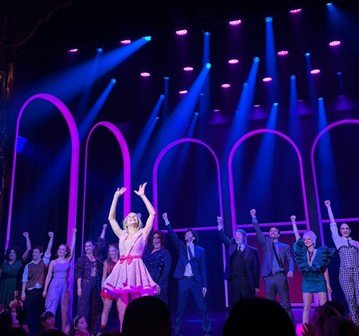
The cast of Legalmente Rubia, image belongs to author.
The camp Argentinisation of Legally Blonde seems to me like more than just a cheesy attempt to appeal to its audience, in the same way that Puig’s integration of Hollywood films into his novels is more than just a commercial move. Through its cultural adaptations, Legalmente rubia simultaneously assimilates to global capitalism and the audience’s demands for Western imports, yet resists it through the playful self-awareness of a South American translating a North American text from below. To suggest that these cultural adaptations are political statements would be an overstatement, but they certainly hint at the potential of mass culture to form resistance from within the system of global capitalism rather than imagining some utopian outside space that does not exist.
Mass culture can therefore function as a way of adapting political resistance to the dominant culture that we already have in front of us. Puig’s literary politicisation of mass culture; Elle Woods’ demonstration that blondes can also be lawyers; and Legalmente rubia’s mediation between the local and the global, all have one thing in common: they negotiate between assimilation and utopianism, expressing their identities in a liminal space which is, above all else, pragmatic.