La Mercè 2020: a Barcelona festival like no other
Will Kirby, News Editor
Last week, Barcelona celebrated La Mercè – the city’s festa major – and, this year, it was unlike any other. No extra points for guessing the reason why, unless you have somehow missed the global pandemic we’re all living through.
However, as many other cities around the world are either contemplating or enacting a new wave of lockdowns and restrictions, various outdoor spaces around Barcelona have played host to concerts, exhibitions and performances. With the Barcelona Public Health Agency (ASPB) placing the R rate in the city as hovering above 1 for the past few weeks and around 33,000 accumulated positive test results, it seems only natural to question whether a major city-wide festival should have gone ahead.
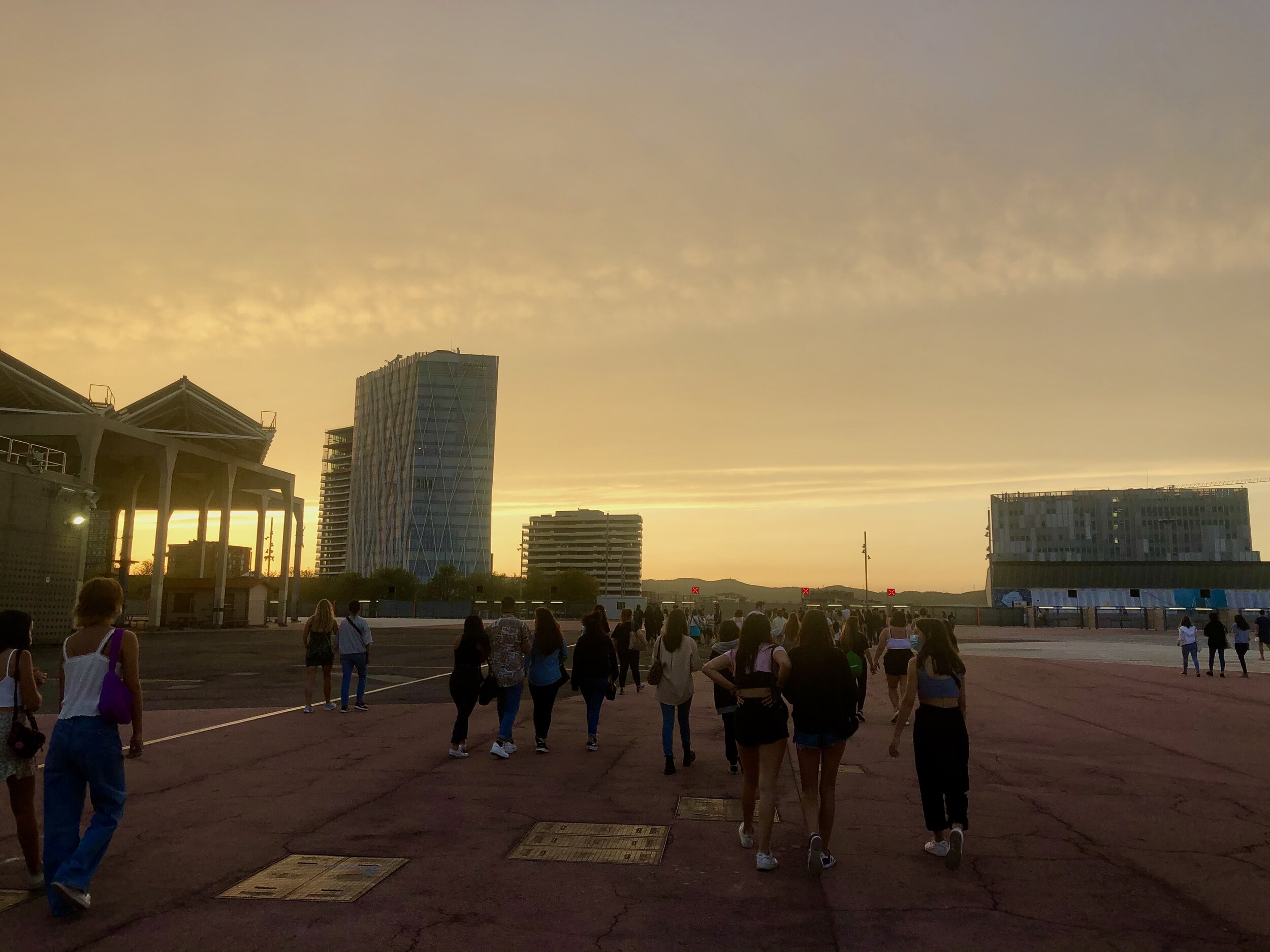
Concertgoers returning home after Lildami’s performance at Parc del Fòrum (Photo: Will Kirby)
The day of the festival itself, Thursday 24th October, was a public holiday in the city and it was marked by artistic exhibitions and musical events throughout the day and night. Various interiors d’illes – the small public gardens which occupy the centre of a number of blocks around the city – turned into local exhibition spaces for the day.
Meanwhile, high-capacity venues in larger parks and performance spaces hosted different musical events. Artists ranged from up-and-coming DJs and bands from the city to Maria del Mar Bonet – the illustrious Mallorcan singer, synonymous with music of the Mediterranean – and Catalan-language trap artist Lildami.
Tickets were free and concertgoers were limited to just two per reservation. The events were all held outdoors, seated, with the chairs arranged either in pairs or individually and social distancing was strictly enforced from the moment you passed the ticket check.
Lildami, on stage at the waterfront Parc del Fòrum, expressed his deep appreciation at being able to continue performing in front of a crowd, in spite of these peculiar times. Spectators were limited in their number, confined to their chairs and more subdued than a usual concert audience. Although, this did little to limit the artist’s infectious energy on stage, and the crowd responded as the set went on.
The Piromusical brought festivities to a close on Sunday night at 10pm. The fireworks and music display against the backdrop of Montjuïc is a yearly fan favourite and it certainly gives even Trinity and St John’s may balls a run for their money.
This year, to avoid large numbers of people gathering along the avenue leading away from Montjuïc, four different firework displays were held simultaneously. Their strategic placement in four corners of the city made it possible to watch the show from almost any balcony in the city. The soundtrack accompaniment was broadcast over local TV and radio for the full Piromusical experience.
Needless to say, this current phase of the pandemic, teetering on the precipice of a second wave, is being met with a distinctly different response in Spain as it is in Britain.
The number of cases began to climb significantly again in Spain in the middle of summer. On 25th July, the UK government took the decision to reimpose a 14-day quarantine for all arrivals from the country, only fifteen days after Spain was initially placed on the government’s list of quarantine-exempt travel corridors.
Restrictions have tightened in Spain. Nightlife venues have been forced to close, after a short period in which they were allowed open. Bars must close at 1am and must stop allowing in new customers from midnight. Also, in the past week, the Catalan government has brought in a ruling for the region which limits people to socialising in groups of a maximum of six, down from ten.
Against the backdrop of high cases and the need to limit community transmission, the decision to go ahead with the programme of events for La Mercè festival does seem a risk-laden one. Authorities did take steps to mitigate those risks, including limiting capacities by requiring reservations, recording details of attendees, enforcing social distancing and a focus on ‘the local’, making it so barcelonins would not have to travel far from their front door to enjoy some part of the festival.
It is also worth noting Barcelona’s temperate climate at the very end of summer, which makes it ideal for hosting a programme of entirely outdoor events. Many experts have noted the apparent reduced transmissibility of the virus in open, outdoor spaces. The British weather, on the other hand, certainly presents some challenges in terms of organising something similar, even if it were in the height of summer.
However, the effectiveness of these measures is still to be seen and will only become apparent in the coming days and weeks. It is promising that, so far, there is nothing to show a significant spike following the celebration of the Diada de Catalunya, just two weeks earlier on 11th September.
That day, the regional holiday, is usually dominated by acts in support of Catalan independence and this year was no different, except for the social distancing measures and the much lower numbers of people who took to the streets.
It does seem certain, though, that a large-scale event similar to La Mercè won’t be taking place in the centre of London, Newcastle or Birmingham any time soon. Is the UK approach too heavy-handed and has Spain struck the right balance between lockdown and a semblance of ‘normality’ (whatever that means anymore), or are they pushing their luck and risking too much? No one can really know for sure, only time will tell.