The case of Pablo Hasél and Spain’s struggle with freedom of speech
Natacha Maurin
Since 2011, Pablo Hasél, a Catalan rapper, has been writing music and finding himself in trouble with the law both over his lyrics and his tweets. Yet, until the start of February 2021, Hasél did not know fame.
Arrested after barricading himself inside the University of Lleida, his hometown in western Catalonia, on February 16, Pablo Hasél saw himself finally reach infamy.
Three years after being sentenced in 2018 for the glorification of terrorism, slander of the crown, and defamation of the Spanish defence forces, the artist’s time came. Hasél refused to turn himself in within the 10-day agreed time frame ordered by the Spanish courts, thus leading to the Mossos d’Esquadra (the Catalan police force) breaking into the rectory to take him to prison.
Night after night, ever since his incarceration, protesters have taken to the streets, amounting to a week’s worth of disturbances.
The charges against the rapper have sparked up a debate in Spain, and more specifically Catalonia, about freedom of speech. Amnesty International, the global human rights organisation, has called his arrest ‘unjust and disproportionate’, classifying it as an abuse of human rights.
Night after night, ever since his incarceration, protesters have taken to the streets, amounting to a week’s worth of disturbances. These protests have become the main news story about the country for media outside of Spain. Photos of looting and fires raging in the streets are what can be witnessed on the BBC and Le Monde’s website, as the world catches up to what has been happening.
The musician’s arrest has struck a chord throughout Spain, but he is more the spark that has set an inevitable fire in motion.
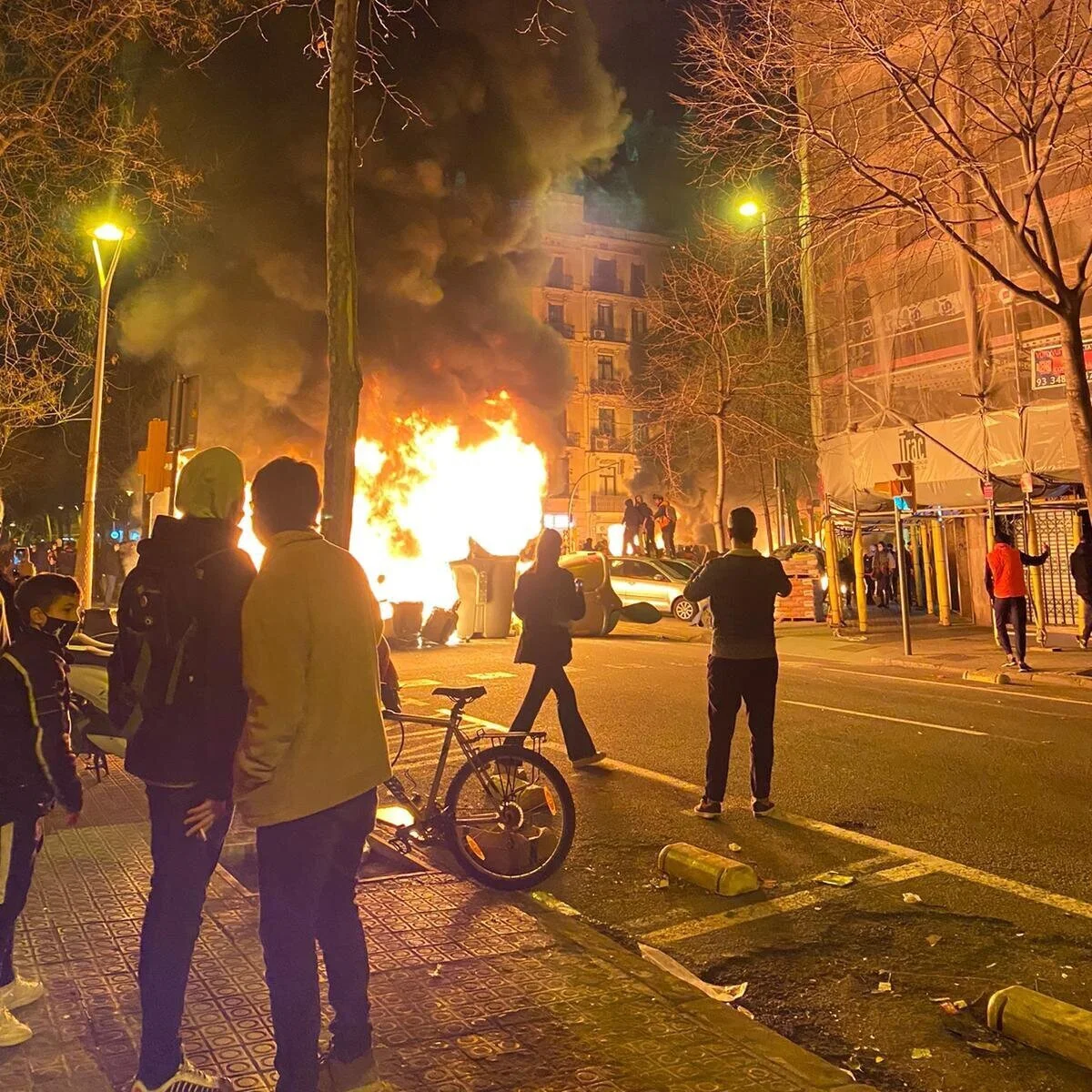
Rubbish bin fires burn in the middle of the street in Barcelona (Photo: Natacha Maurin)
Hasél’s case
Pablo Hasél, real name Pablo Rivadulla, is far from an angel. Although two of his convictions broach this topic of free speech, he also attacked a journalist in 2016 and he was also involved in an attack of a witness in a police brutality case.
Nonetheless, despite the court cases taking place for these incidents of violence, the tweets and song lyrics which have landed Hasél in prison remain, as reported by the Spanish news outlet Público:
27.03.2014
La policía asesina a 15 inmigrantes y son santitos. El pueblo se defiende de su brutalidad y somos “violentos terroristas, chusma, etc.”
The police murder 15 immigrants and they’re saints. People defend themselves from police brutality and we’re called ‘violent terrorists, a mob, etc.’
27.12.2015
Miles de ancianos pasando frío y sin un techo seguro mientras monarcas dan lecciones desde palacios.
Thousands of old people are suffering the cold and without a roof over their heads, whilst monarchs give lessons from palaces.
11.03.2016
Sí nos representan (Incluye una imagen de Ignacio Várela Gómez)
These are who do represent us (With a photo of Ignacio Várela Gómez, who belonged to the Spanish Communist armed group GRAPO)
Begging the question, why does singing call for quicker sentencing and condemnation than outright violence?
Since the reform of the Spanish penal code in 2015 under the right-wing Partido Popular (People’s Party), the Ley Mordaza, or simply the ‘gag law’, has drastically changed what is considered an offense and what is not. A lack of respect or consideration towards police officers is a criminal offence, for example.
Amnesty International has released a report saying it ‘does not respect international human rights standards and hurts freedom of speech.’ This law includes Article 578, regarding the ‘glorification of terrorism’ being prohibited, of which Hasél was found guilty.
The current Spanish government even told Hasél’s lawyers they had plans to reform the law, although this was a year ago now.
History repeats itself
Hasél is far from the only individual to have suffered from these laws or repression of speech. Another rapper was sentenced just two weeks apart from Hasél in 2018.
Valtònyc, a Mallorcan artist, found himself charged with slander of the crown and defamation, amongst other allegations.
This musician decided to take a different path by finding refuge in Belgium. His extradition has been delayed since 2018, as Belgian courts have protected him, championing his freedom of speech.
Yet, Hasél chose to remain and face his time, arguing he could make more of an impact by remaining in Spain. As the week of disturbances shows, he definitely has shaken Spain.
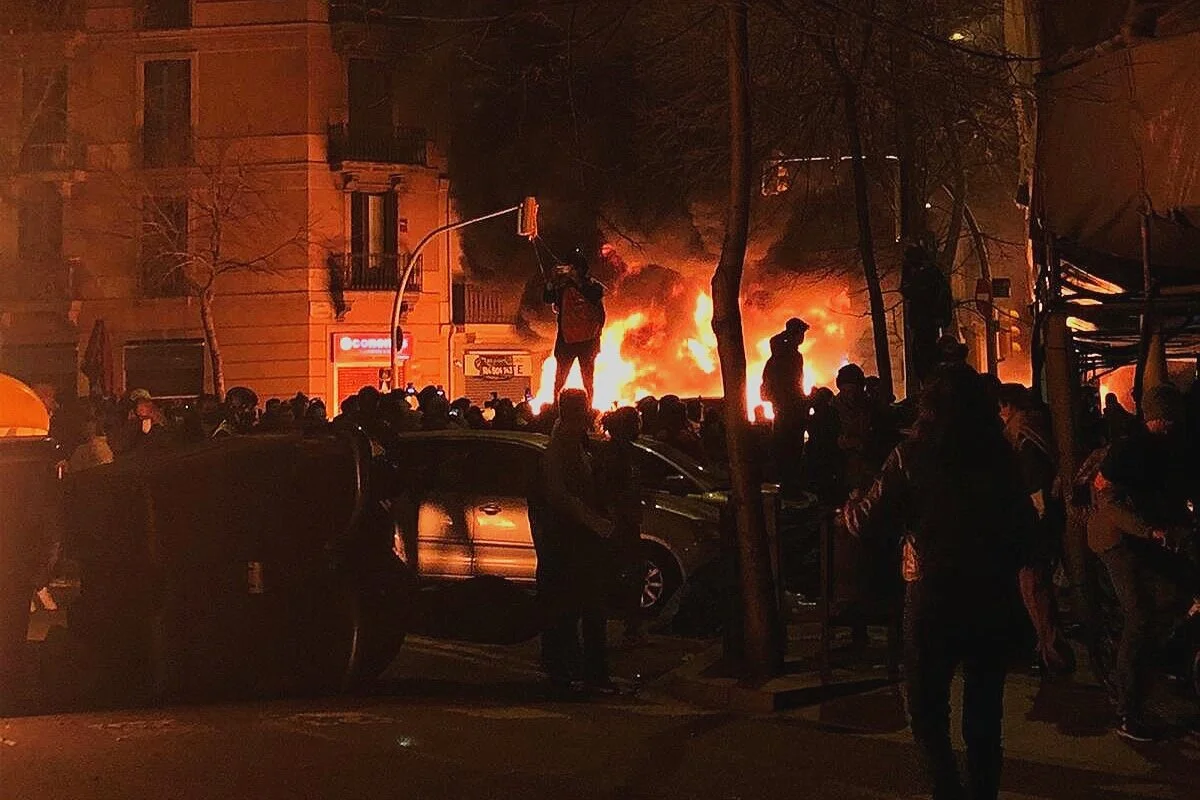
A fire burns on the streets of Barcelona’s Eixample neighbourhood (Photo: Natacha Maurin)
Catalonia is at the centre of this growing unrest, and the correlation between the reaction to this and its location is undeniable. Known by many for its attempted referendum in 2017 to separate from Spain, Catalonia has a long history of being stifled by the Spanish state. Following the independence push, the Spanish state sentenced organizers to prison terms, with some, such as Carles Puidgemont, a current Member of the European Parliament, seeking refuge abroad.
In fact, Quim Torra, the president of Catalonia until the end of September 2020, was ousted for displaying banners and yellow ribbons in support of the jailed leaders on the outside of the Palau de la Generalitat (the seat of the Catalan Government). The Junta Central Electoral (the Central Electoral board) had deemed them ‘political symbols’, and Torra was found guilty of disobedience.
As well as this, presidential elections took place only a few weeks prior on February 14, 2021. The region has felt the rift between a prominent pro-independence political movement, and one pushing for unionism with Spain only deepen. Far-right party Vox is the most extreme end of that scale and this election, they entered parliament for the first time with 11 seats. Candidate Ignacio Garriga toured the country both in person and through Zoom, spouting anti-immigration and islamophobic retorts. Despite high-media coverage of the campaign, the candidate received little opposition for his use of free speech.
At the crux of this issue is much more than just Hasél’s case. Recent memory in the region shows an unjust, uneven and pointed application of limits to freedom of speech. It beckons the question: what is allowed to be freely expressed and what isn’t?
Young people
Many protesters are young, disillusioned and growing up with these events around them. Many of them have lived through what is called el procés, the period since around 2012 in which Catalonia has tried to gain independence. Juliana Canet, a young Catalan YouTuber, told the channel TV3 with reference to this process, that people have been trying to achieve change ‘peacefully for 10 years, and nothing has happened’.
‘If we wait there is no future,’ she added, ‘the future full of misery we’re faced with isn’t worth it.’ Indeed, the situation for young people in the region is difficult, especially economically. Catalonia has a youth unemployment rate of 38.1% amongst those between 16 and 24, much higher than the region’s overall rate of 13.9%.
For young people in Catalonia, Hasél is so much more than a rapper with some risqué lyrics, he is them.
Pushed to the streets, young people have also found themselves to be particularly badly affected by the protests. On the first night, a 19-year-old girl lost her eye due to the use of foam projectiles from the police forces, whilst others have been arrested for public disorder. Lawyer Eduardo Cáliz expressed to Catalan News his belief that ‘the arrests have been arbitrary with a clear goal: scaring people’.
When you talk to young people here, they are tired of being misinterpreted by the media. Meeting my friends a few nights into the protest, one of them took me aside thanking me for sharing a post on Instagram: ‘People need to understand we are fighting for our rights.’
For young people in Catalonia, Hasél is so much more than a rapper with some risqué lyrics, he is them. He is a symbol of what occurs when politics stagnate and change is stemmed. In protesting against his arrest the youth of Catalonia are telling politicians that they will no longer tolerate their demands falling on deaf ears, they refuse to wait any longer for the change that has been promised to them for the past decade.
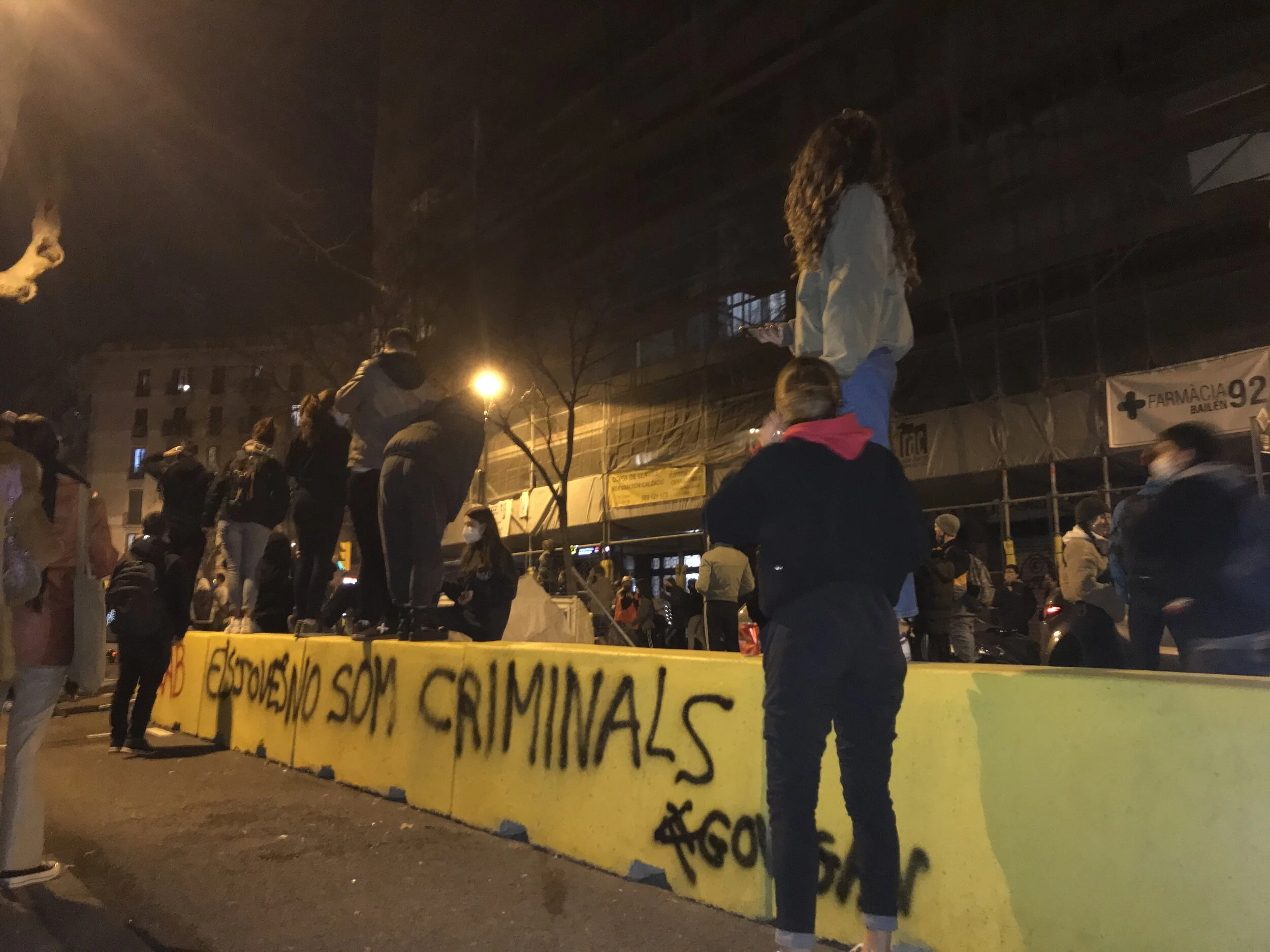
‘Els joves no som criminals’ (‘Young people aren’t criminals’) (Photo: Natacha Maurin)
The perfect storm
With all this in the background, Pablo Hasél’s arrest was only ever going to lead to a fiery reaction. In Barcelona, the atmosphere can only be described as tense.
Thousands of people turn up at every protest, at around 7 pm they assemble at a meeting point and walk pacifically echoing the words ‘Llibertat Pablo Hasél’. They then crescendo to some main event: bins on fire, stones thrown at police, charges from the Mossos towards protesters, a store looted.
Every night, the same repeats. Every night, pure anger and disappointment against the government is unleashed onto the streets. Despite this, little seems to change.
More and more politicians, such as the head of the pro-independence party Esquerra Republicana (Republican Left), Pere Aragonès, have come to speak out against the violence in the protests. Condemning rioting but failing to mention peaceful demonstrations that have taken place only feeds the feeling that people are being ignored.
Thumbnail photo: Natacha Maurin
