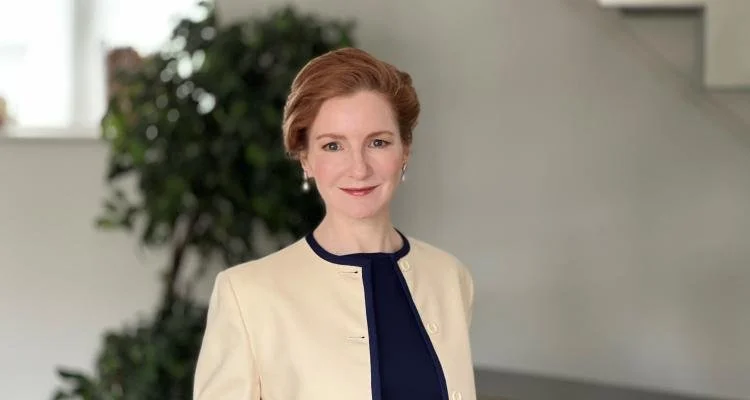
In this interview with Gwilym Walters, Elisabeth Kendall (President of Girton College) talks about her career, Yemen, and conflict in the Middle East. Photo with permission from Girton College.
Dr. Elsabeth Kendall, the President of Girton College since 2022, has been involved with the Middle East since she studied Arabic at Oxford. In her subsequent career, Dr. Kendall – who specialised in Arabic poetry and literature – has held academic positions at Oxford and also directed an UK government-sponsored Centre to create advanced Arabic language expertise. Dr. Kendall has worked extensively in Yemen, a country she is often invited to speak about in the media, where she researched jihadi groups and their propaganda, as well as working with NGOs and advising international organisations.
Gwilym Walters:
What drew you to studying Arabic?
Elisabeth Kendall:
I was at high school in the 1980s, at a time when there was considerable conflict in the Middle East region. I was always seeing it in my parents’ newspaper and thinking I'd love to know more about how this region works, how people live here, what their aspirations are, why does it seem so troubled… And to do something that wasn't just a school subject. I went to a state school and there wasn't anything that exciting on the curriculum in terms of languages. It was French and German, but nothing much beyond that, and I thought it would be really exciting to branch out and get to know a region through the language. I thought that this would be the best way of doing it, to be to be able to go there to speak to people, to read primary source materials and explore.
GW: Your work now is largely based in the current issues of the Middle East, but there was a period when your focus was Arabic poetry. What drew you back to the contemporary Middle East?
EK: I got drawn into the literature and the poetry because it was so beautiful, so different and so challenging, and incredibly varied. But as time drew on, and particularly after 9/11 happened in 2001, I felt an urgency to use my deep cultural and literary knowledge, to make more of an obvious impact and contribution beyond academia. With such incredible fast-paced developments happening after 9/11, and the hunt for al-Qaeda and the war on terrorism, I started to get more interested in looking at the culture, and the cultural production, of terrorist groups in Arabic. Fast forward one more decade and the Arab Spring erupted around 2011. At that point I decided to go back into the field, because the developments were happening so quickly and I wanted to be on the ground to really absorb how people were thinking, how they were moving, where they were going…. And so, I took myself off mostly to Yemen, a little bit to Egypt, and took it from there.
GW: What drew you to Yemen? Had you been to Yemen before? Had you had experience working in Yemen?
EK: No! Yemen had always appealed to me as a location for, well, for many reasons. Many would hold it to be the birthplace in Arabic poetry, and not that many students or researchers were working on Yemen – it was a bit of a wild card - and I felt that it was a real flashpoint. It brings together a lot of important issues and geostrategic concerns. The waterways it sits on, its borders with our allies, Saudi Arabia and Oman, a maritime border to the dysfunctional state of Somalia, just across the Red Sea from Africa, and the real melting pot inside Yemen itself, a whole tapestry of incredibly diverse interests, cultures and even languages, with a lot of competition for dominance politically and religiously. I knew this was also a safe haven for al-Qaeda in the Arabian Peninsula, which after about 2009 was the most active and aggressive of al-Qaeda's branches. So it seemed like a good place to go and hang out and find out how the whole thing worked.
GW: You say Yemen was something of a relative blind spot of international interest, a “wild card” – do you think that there is still a lack of understanding of Yemen?
EK: Yes, absolutely! There really is. Partly because we just don't have a lot of people on the ground there, for obvious reasons. It’s pretty dangerous and it's hard to get in unless you're on an organised tour, which normally means getting the permission of one or other Gulf regime, in which case it's fairly well curated - the people whom you speak to, the places you can go, the information you can get is monitored. How could you really know what's going on? Plus, there have always been other priorities. I think we're really sensing now that a lot of intelligence on the region was focused on entities like Hezbollah or Hamas, and not very much on the Houthis. And after 2014, a lot was focused on ISIS and less so on al- Qaeda. And yet it was there, and it put down roots. It's still there. It's not a massive issue now, but it could be, it could resurge. It's like pulling out weeds. You can pull them out, but unless you get the roots, they grow back. All you need is the appropriate amount of rain, and we could now be in a situation where we're getting an appropriate amount of rain!
GW: Do you think complex dynamics in Yemen are often overlooked or misunderstood?
EK: When you do a military summary, you're trying to get some information across to a military office high up, you're going to try and squeeze it into eight lines. Now, how can you squeeze a complex tapestry, like the Yemen conflict, into eight lines? You're going to have to be incredibly generalist about it. The problem with that is that all of the solutions lie in understanding the nuance.
GW: Do you think foreign powers, outside of the region, have a place in the future of Yemen?
EK: I think they have a place in helping to mediate Yemen towards a peaceful future. I don't think they have much of a place in it, but helping mediation efforts towards it - definitely. The international community definitely has a role to play there. It doesn't have a role to play in picking the winners or deciding who the elites are. It's more about trying to support transparent mechanisms towards a transition for Yemenis being able to control their own future.
GW: In terms of the Houthi strikes in the Red Sea, targeting Israel, there are some people who would say that this is the only form of active solidarity with Palestine from Arab nations, or indeed anywhere. Do you think the strikes can be understood in this light?
EK: It’s certainly the case that no other Arab regime or formal state actor is leaping to actively defend Palestinians against Israeli attack, although we don't know what's happening behind the scenes. We do know that no one else is taking warlike action to - allegedly - defend Palestine. Now the Houthis of course are non-state actors, so they can afford to be a bit more out-there. And whilst we can't dismiss their ideological motivation completely - this is very much in accordance with what they have been claiming to believe, with their “death to Israel, death to America” slogan - at the same time, the Houthis are clearly very aware that this is an opportunistic time for them. They know that they will gain huge popularity by claiming to be the sole defenders of the oppressed people of Gaza. At the time when their base inside Yemen was becoming war-weary after almost 10 years of conflict, that was quite helpful for them. It revived their fortunes a little, and actually, their popularity spread. They were able to gain more support domestically, gain more support regionally, and gain more attention internationally, so it didn't just work for them ideologically, it worked for them politically.
GW: Do you think the future of Gaza will have lasting implications for the wider Middle East, in terms of wider politics and also military conflict?
EK: Well, it's going to be interesting to see how history reflects on this time through the telescope of history, seeing how opinion has started to switch from being overwhelmingly sympathetic to the state of Israel after the brutal attacks by Hamas, to thinking, hang on a second, how can this possibly justify what is now happening to the ordinary civilian population of Gaza? I think perhaps history will reflect on many Arab regimes as not having perhaps played as active role as they could have. Of course, the same goes for Europe and America etc. And it’s worth noting that many people inside Israel are very aware of the fact the way things have gone with Gaza risks making them all a lot less safe in the future.
GW: A lot less safe from what?
EK: In the region, from future repercussions. I think that if your ultimate aim, as the current Netanyahu government claims, is the security of Israel, this is a pretty odd way of going about it. Maybe it wasn't from the very beginning, you can understand the backlash. But at this point it's not clear how either making the Israeli state more secure or getting the hostages back alive is going to be served by expanding military operations against the population of Gaza. How's that going to work?
GW: So do you question what the Netanyahu government claims is their aim in this war?
EK: Yes. I question everything, I'm an academic. Questioning is what academics do. And I particularly question this.
GW: Initially, and certainly from even America and Britain, a lot of the discourse was about “defeating” Hamas. Do you think this was misguided?
EK: It depends on what you mean by defeat. Talk of “total defeat”, or “the complete defeat”, the total annihilation of Hamas - that won't be possible. Or if it is possible, it will just change its name and spring up as something else. I think it’s appropriate to point out here that you're killing people, you're not killing ideas. The ideas stay and sometimes they get stronger.
GW: Are you optimistic for Yemen?
EK: No. What can I say? No, I think it's looking really bad.
GW: What do you think can be done from a from an international perspective?
EK: I think the main thing to be done is to align the regional actors behind a single vision for Yemen. It’s going to be very hard to get the domestic actors together to think about a power sharing arrangement and the UN road map if you've got powerful regional actors all wanting different things. The second problem is that even if you get elites to sit down and agree to collaborate, how would that translate to people on the ground? Because there's not a lot of credibility in these leaders. There's not a lot of trust.
GW: What will be next for you? Will you return to Yemen in the future?
EK: Yes, for sure.
GW: And is poetry still there in the background?
EK: Of course! It’s a beautiful way of interacting with people. I think it's really important to listen a lot and figure out what it is that motivates and moves communities at a local level. If you're going to help people to repair their country, you have to do it their way. What you can't do is barge in with a preconceived idea of what you think they should have, force it on them and roll it out really quickly, as per what you think. That’s a mistake we've made in other places around the Middle East. We need to listen more. Listen more, and barge in less.