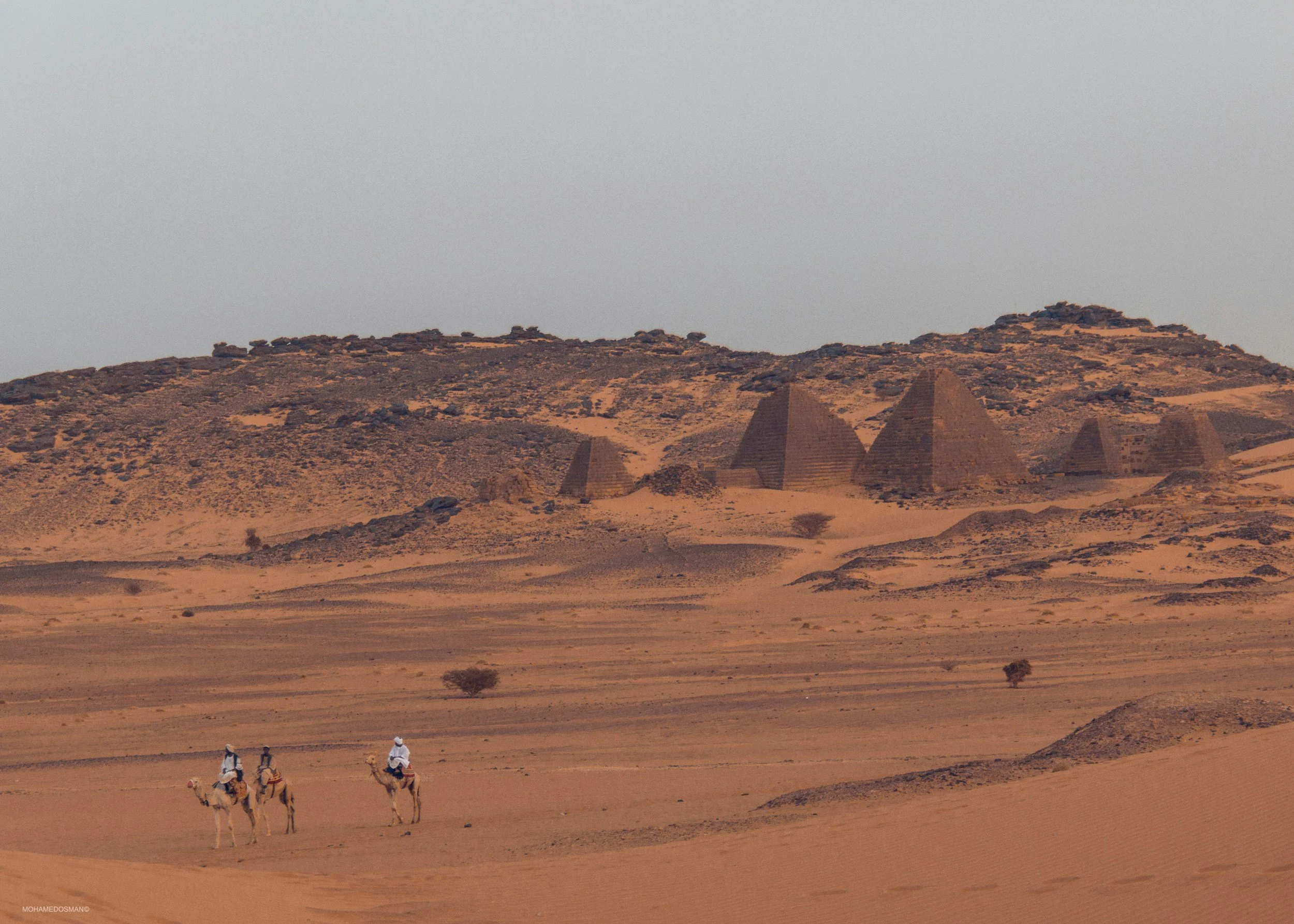
Credit: Mohamed Osman / Unsplash
On the 15th of April, 2023, Sudan’s capital did not slip quietly into war - it was torn asunder by it. The sky over Khartoum blackened with smoke as fighter jets screamed overheard and machine gun fire was spat across residential neighbourhoods. The Rapid Support Forces (RSF), a paramilitary group born out of the Janjaweed militias of Darfur, launched a preemptive strike against their rivals in the Sudanese Armed Forced (SAF), turning government buildings, hospitals, and homes into targets. Khartoum, a city once brimming with the hope of post-revolutionary construction, became the front line. Inside it’s cracked apartment blocks, families crouched in hallways as shelling pulverised their streets. Bodies lay unclaimed on sidewalks; no one dared retrieve them.
There was a photo in a family album somewhere. My grandfather, a British Neurologist, stands in the dry light of El Fasher sometime in the 1980s, arms draped over the shoulders of two Sudanese Doctors. They are smiling - tired, proud, unguarded. He had just helped establish a clinic in Darfur. Back then, it wasn’t impossible to imagine Sudan as a place of progress, a crossroads of cooperation rather than conquest. That version of Sudan - tentative, aspiring, intact - feels almost mythic now. El Fasher, where that photo was taken, is today a war zone. The RSF has seized neighbourhoods, and the hospitals have been hit so many times Medecins Sans Frontieres have been forced to withdraw. I look at the faces of the Doctors in the photo - at what they thought they were building - and I wonder how a country gets unmade.
But the war didn’t begin in 2023. It began the moment the 2019 revolution was betrayed. When millions of Sudanese marched to depose Omar al-Bashir after thirty years of brutal rule, they envisioned a civil state - governed not by generals but by the people. For a flicker of time, it seemed possible. A transitional government formed, composed largely of civilian technocrats, many Western-educated, many committed to a vision of democratic reform. But beneath this promise simmered resentment, power-hunger, and a military establishment unwilling to relinquish control. In October 2021, General Abdel Fatteh al-Burhan - head of the SAF - staged a coup. Prime Minister Abdalla Hamdok was kidnapped and placed under house arrest. The military reasserted dominance, cloaking it’s ambition in the language of stability. The RSF, under Mohamed Hamdan Dagalo - known as Hemeti - used the chaos to amass weapons, wealth, and political capital. By 2023, there were two armies and no nation. What happened in Khartoum was not a surprise. It was a detonation years in the making.
In El Fasher alone, Medecins Sans Frontieres has endured eleven separate attacks, before being forced to withdraw entirely, leaving hundreds without care, Medical workers have been abducted, beaten, and killed. Ambulances are shelled. Pharmacies looted. The RSF and SAF have shown a shared contempt for the civilian body, treating medical neutrality as an obstacle to conquest rather than a principle of war. This isn’t collateral damage, it’s deliberate - and that silence that follows is damning. For every strike on a children’s hospital in Gaza or a maternity ward in Ukraine, there are headlines, hashtags, high-level condemnations.There have been no failings to anchor those grand tragedies in individual fates. When the same happens in Sudan, it’s written off as chaos, as though Africans cannot be victims of ideology, only it’s byproducts. This is not just a forgotten war - it’s a war we have chosen forget.
To the outsider, joining the RSF might look like madness. But to many in Darfur, or along the Chad-Sudan border - places long abandoned by any semblance of a central government - it can only look like the path to
dignity. Hemeti, born from camel trading and militia blood, offers more than a paycheck; he offers revenge, identity, and the illusion of power. He tells his fighters they are defending their people, defending Islam, defending their ‘honor’ - a word that in this war, has become synonymous with terror. The RSF taxes drug routes, smuggles weapons across Sudan’s porous borders, and distributes loot as justice. The SAF, for it’s part, trades on nostalgia for military order, for a time when Sudanese institutions - flawed as they were - still existed. For many, it’s not the ideology that fuels the war, but the hollow promise that this time, the winner might remember them. To us in the West, this is unfathomable. To many Sudanese, it is history repeating itself with new uniforms and the same brutal script.
Media coverage is not metered out by the scale of suffering - it’s governed by proximity, race, and geopolitical stakes. Sudanese children, bombed in their homes or dying among the 500,000 refugees in zamzam camp, do not command the same urgency as those slaughtered elsewhere. This is not a failure of information, it's a failure of our moral infrastructure. What motivates the BBC’s blanket coverage of Ukraine and leaves Sudan in dark silence? The uncomfortable answer is narrative utility. Ukraine offers a West-friendly binary of good verses evil. Gaza, at least, is ideologically electric. But Sudan? It’s a war without a headline. The RSF and the SAF are indistinguishable to outsiders. The frontlines are as mutable, shifting daily. The enemy is not clear, and the victims are not politically convenient. So the coverage is quiet, almost embarrassed. It is the passing mention of a cousin who is in crisis but no one knows how to help.
By the time the cholera outbreak hit El Geneina in October 2023, Western outlets had already moved on. A few paragraphs in the back of international papers, mostly cribbed from UN press releases, gave the illusion of coverage. But no cameras followed the trail of untreated bodies bloated in the sun, no photojournalist captured the long queues for water contaminated by corpses. Sudan’s war, cruel and expansive, is happening in the dark. It is in it’s own blackout, it’s own Benghazi without the footage. There are no embedded journalists in Wad Mandani, no documentary crews in Darfur, and no Pulitzer dreams pinned to the suffering of its people. What remains is silence—broken only by the hum of drones, the crack of gunfire, and the unheard cries of those left behind. The world is not short on empathy—it is short on attention. In the global outrage economy, suffering is only valuable when it can be packaged. Pain must be photogenic, ideologically clear, and close enough to be useful. Ukraine was easy to rally behind: a European democracy invaded by an authoritarian regime. Gaza, though bitterly contested, commands coverage through political polarity. But Sudan—fragmented, African, with no clean narrative, no Western allies to vindicate, no ideology simple enough for a chyron—falls through the cracks.
Whilst there is no lack of footage in Sudan, only a lack of interest in looking. Journalists cannot afford the risk, outlets cannot afford the nuance. It’s not a question of journalistic failure, but editorial economy. If a headline won’t convert clicks, if it won’t trend, it vanishes. Conflict is reduced to algorithms, and Sudan does not perform well. It is background noise: too brown, too far, too hard to explain. The result is a silence that is not accidental but systemic—a feature, not a bug.
But absence of coverage does not mean absence of culpability. The media may not be reporting on Sudan, but the weapons still arrive. The RSF’s bullets are bought with Gulf money. The SAF’s airstrikes are enabled
by years of military partnership with foreign powers. This is not a forgotten war—it is a war the world actively chooses to forget, because to remember would implicate too many.
So what can be done? The answer is not simple, but it begins with refusing silence. It begins with refusing to let Sudan be spoken of only in numbers. Share Sudanese voices. Follow Sudanese journalists, artists, and activists—many now in exile, many still reporting through blackouts and bombings. Pressure your governments to halt arms sales to the region, to fund humanitarian corridors, to support investigations into war crimes not only rhetorically but materially.
There is no clean ending to this war - only a series of unfinished deaths. A 142-page dossier detailing alleged war crimes by the RSF has been submitted to the UK's Metropolitan Police, aiming to assist the International Criminal Court's investigation into RSF crimes in Darfur, and ceasefire talks, overseen by the YS, UAE, and Egypt, are underway in Jeddah and Geneva. Yet this is all diplomatic theatre, helped arm one or both sides. The United States, Russia, and the UAE - they all have their fingerprints on Sudan’s broken body, but none show their faces at the funeral. Perhaps there can be peace, but not without reckoning. Not without acknowledging that war was allowed to happen, not because it was invisible but because it was inconvenient. Because the victims are too African, the politics are too messy, the violence has escalated itself into a white noise too boring to sustain the outrage economy. Sudan is what happens when a revolution is gutted, when the military pretends to be the state, when militias are allowed to believe they are nations. And yet, amid the rubble, there are still women marching, still children drawing peace signs on bombed-outwalls, doctors stitching wounds without sutures. If there is a future, it will not come from Geneva; it will come, as it always has in Sudan, by the people who refuse to stop believing in one.