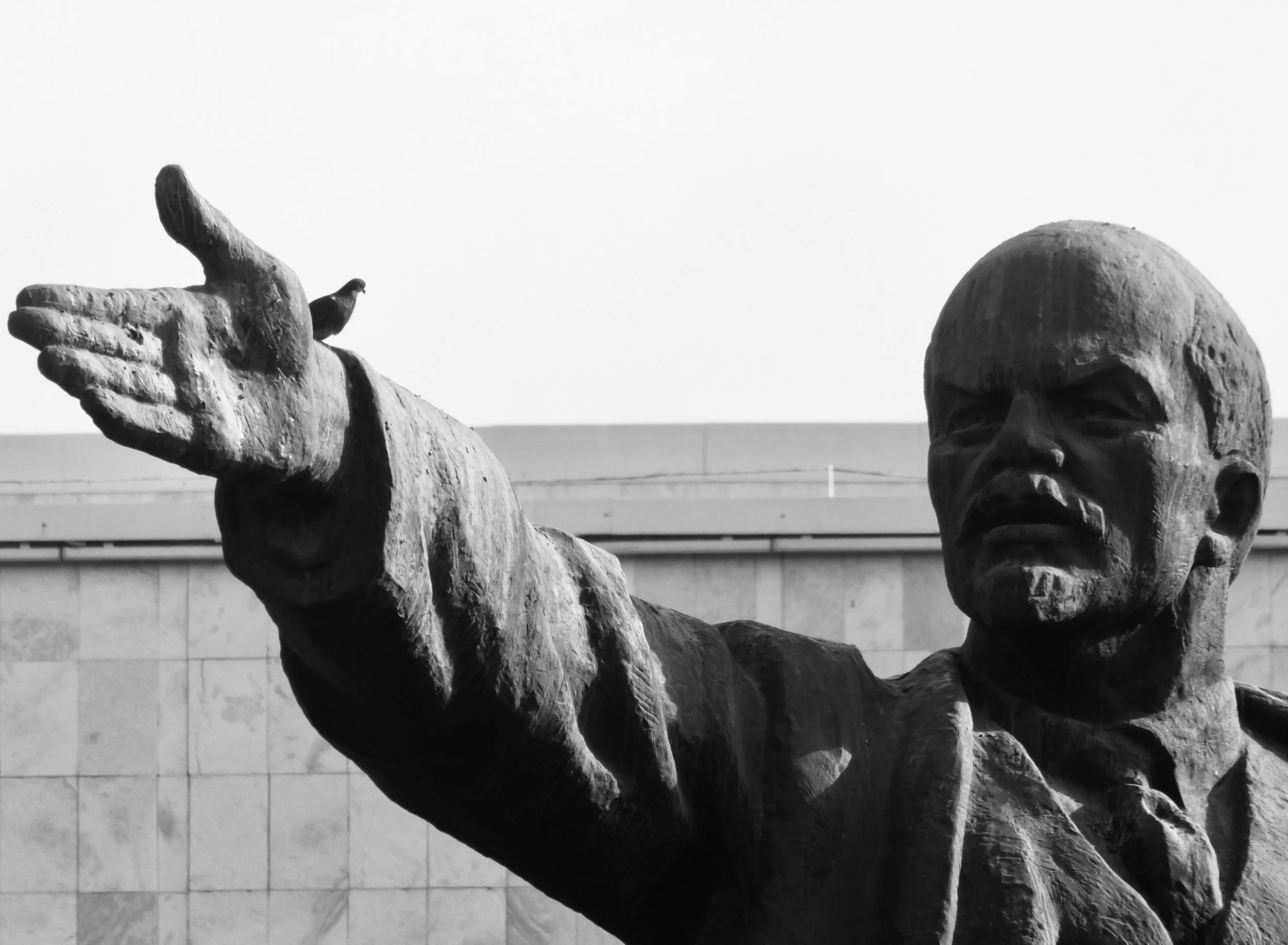
It was a bright cold day in 1984, and the Kirghiz Soviet Socialist Republic was celebrating its 60th birthday [1]. To mark the occasion, a giant likeness of Lenin was erected in central Bishkek. Vladimir Ilyich still harangues passers-by in the Kyrgyz capital, but from a new home, hidden behind the State Historical Museum. No longer the centre of attention, he competes with symbols of a new era: a forty-five-metre-high Kyrgyz Flag, a US funded university, the Kyrgyz Parliament. It’s a scene straight out of Sots-Art [2].
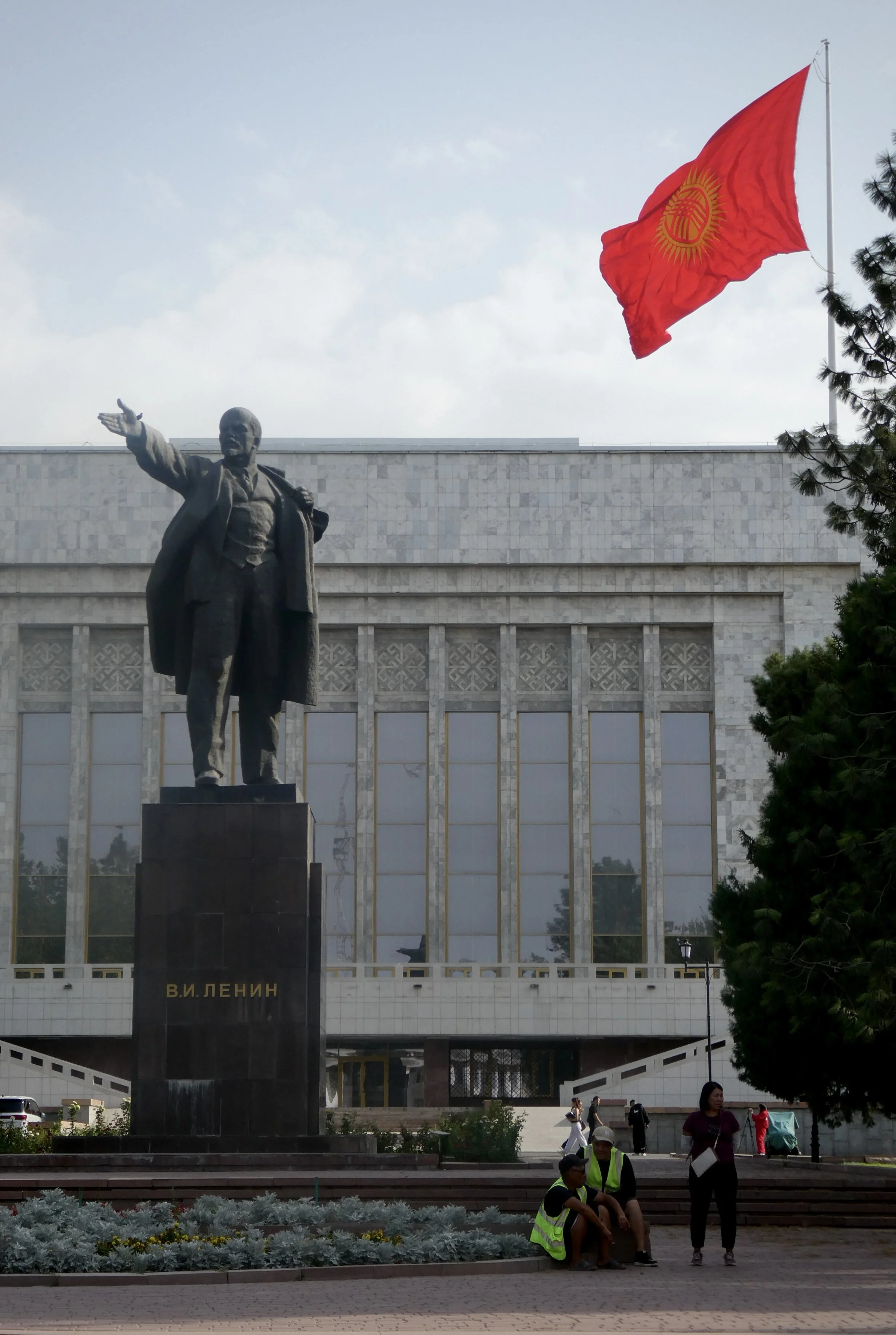
Lenin now lives in Old Square, behind the huge marble cube that is the history museum.
Lenin has always been a controversial figure [3]. Despite this, the Republic of Kyrgyzstan does have reason to honour his memory. Although he never lived to see their success, it was partly Lenin’s ideas about nation-building that led to the founding of universities and cultural institutions, the development of local theatre, ballet, and literature, and the creation of a script, grammars, and dictionaries for the Kyrgyz language. The October Revolution – and therefore Lenin by association – is also credited with ending the ‘Great Ukrun’. When the Tsarist government announced conscription in 1916, peoples across Central Asia revolted, which led to brutal repression by the Russian imperial authorities. Tens of thousands fled to China across the perilous Tien Shan mountains, and it is estimated that as many as 250,000 Kyrgyz alone perished in the process [4].
With all this in mind, in 2000 president Askar Akayev signed a legal decree that declared the statue an architectural-historical monument and granted it state protection. However, less than three years later, Lenin was abruptly shrouded in scaffolding. This was initially under the pretence of maintenance, with some reports claiming that a ‘radioactive condensate’ had been detected. Given the Soviet’s notorious nuclear record, one would hardly be surprised, yet within a few days Lenin was removed. This swift and unexpected decision seemed suspicious, not least because it was conducted in the early hours of the morning and with no public consultation. To many, the removal represented an illegal act of cultural antagonism. The response was at once political and personal: opposition parties called for the Prime Minister’s resignation, while ordinary citizens protested with placards pleading ‘Hands Off Lenin!’. Part of the backlash stemmed from the fact that the revolutionary was to be replaced by a contentious monument entitled ‘Erkindik’ [Kyrg. Эркиндик; ‘Freedom’]. This statue depicted a winged goddess atop a globe brandishing a ‘tunduk’ [Kyrg. Тундук], the top of a yurt, and was interpreted as at best superficial and at worst a pathetic imitation of Western-style models. To the relief of many, in 2011 this Kyrgyz Statue of Liberty was replaced by national folk-hero Manas, a medieval warrior immortalised in an eponymous Epic [5].
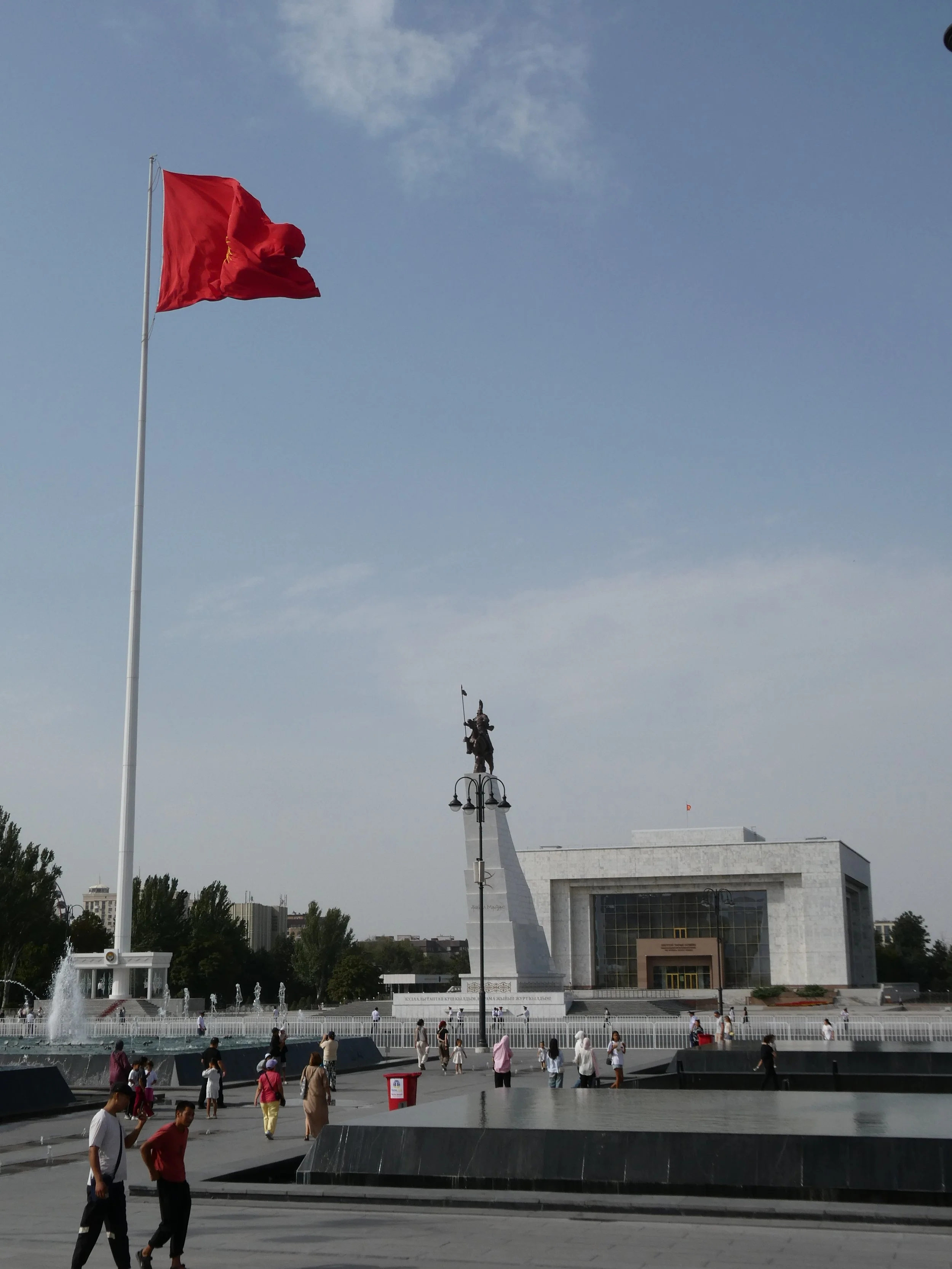
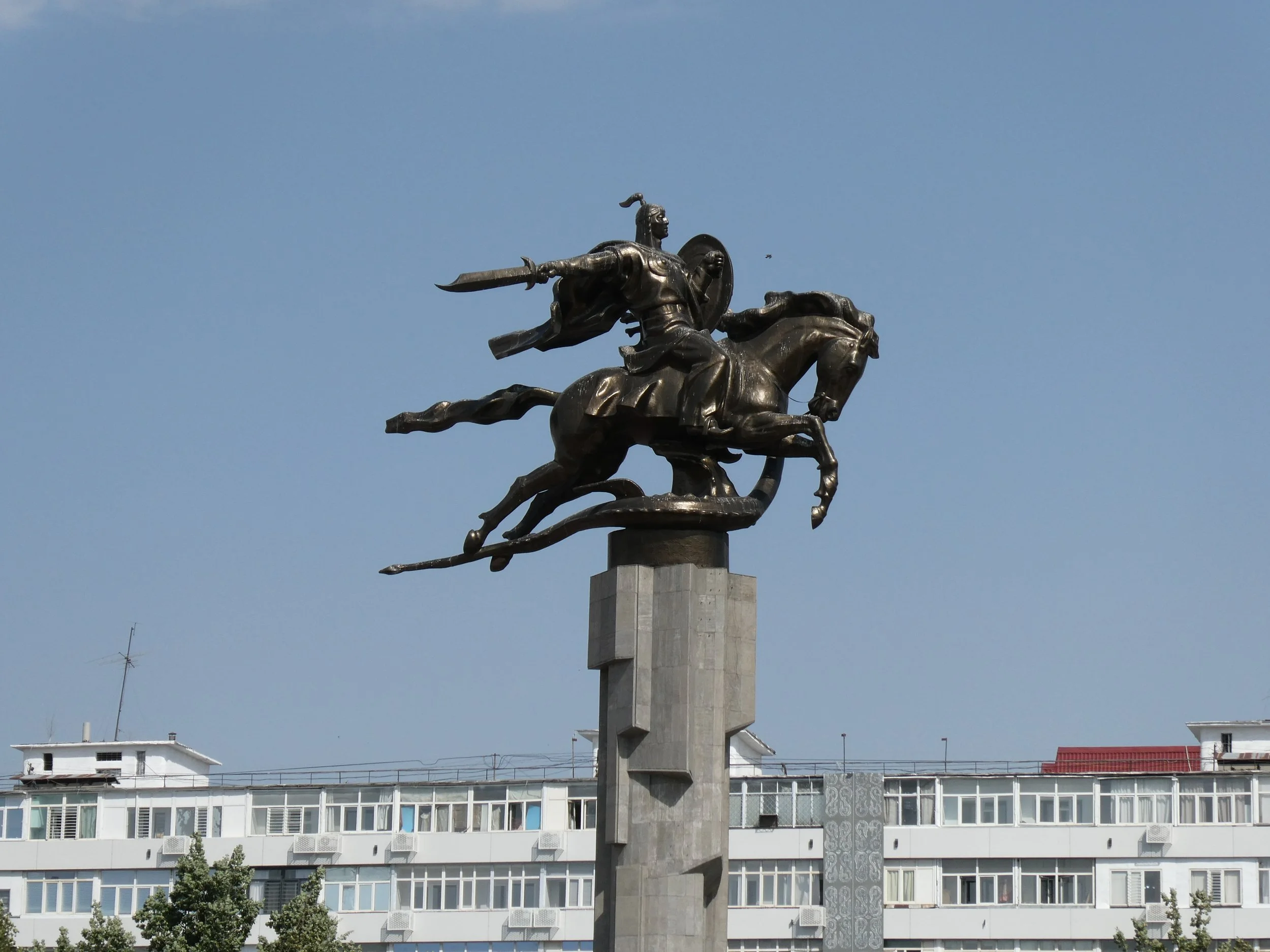
Above: Manas now occupies Bishkek's central Ala-Too [formerly Lenin] Square. Below: There are many other Manas’ throughout the city, including this monument outside the State Philharmonic Hall.
Thus, Lenin was downgraded, but perhaps most remarkable is the fact that he has not actually been demolished. Kyrgyzstan has been rather relaxed about its hundreds of rusting revolutionaries, especially in comparison with some Eastern European countries who began Lenin-levelling even before the Soviet Union collapsed. The republic still boasts impressive monuments like the fifteen-metre-high bust of his head at the Kirvoskii Reservoir, which took sixteen years to complete. Aside from recent controversy surrounding a particularly large Lenin in Osh, the country’s southern capital, his legacy remains relatively stable.
This is indicative of general attitudes towards Kyrgyzstan’s Soviet past. In 1991 referendum on the preservation of the USSR, 94.6% of the 92.9% of the population that turned out voted against its dissolution [6]. There was no equivalent to Eastern Europe’s 1989 wave of popular revolutions. Just as the peoples of Kyrgyzstan had no choice but to submit to Russian imperial and then Soviet rule, so they were also subsequently condemned to independence in 1991. As a result, there was no major effort made to purge national culture of its immediate past, as Lenin himself attempted in 1918 [7]. New policies promoted the use of the Kyrgyz language, emphasised the country’s pre-Russian past, and encouraged a quiet revival of Islam, but Soviet symbols survived. Partly this was due to the dire socioeconomic situation, as well as the will on the government’s part to appease its considerable Russian and Ukrainian populations to prevent a brain drain.
This indifference to the recent past was reflected in a brief conversation with my host family here in the aptly named south-eastern ‘Lenin District’ [kyrg. Ленин району] of Bishkek. For them, there was both good and bad in the past, but after all, it’s in the past now. They pointed out that the country has new priorities and wants to attract investment and international attention, and they are succeeding. Tourism is expanding rapidly, and in September 2026 Bishkek hosted the 25th Shangai Cooperation Organisation conference and the World Nomad Games, the open ceremony of which took place in the brand-new Bishkek Arena. Yet observing this frenzied development is the timeless bronze revolutionary and his doppelgangers across the country.
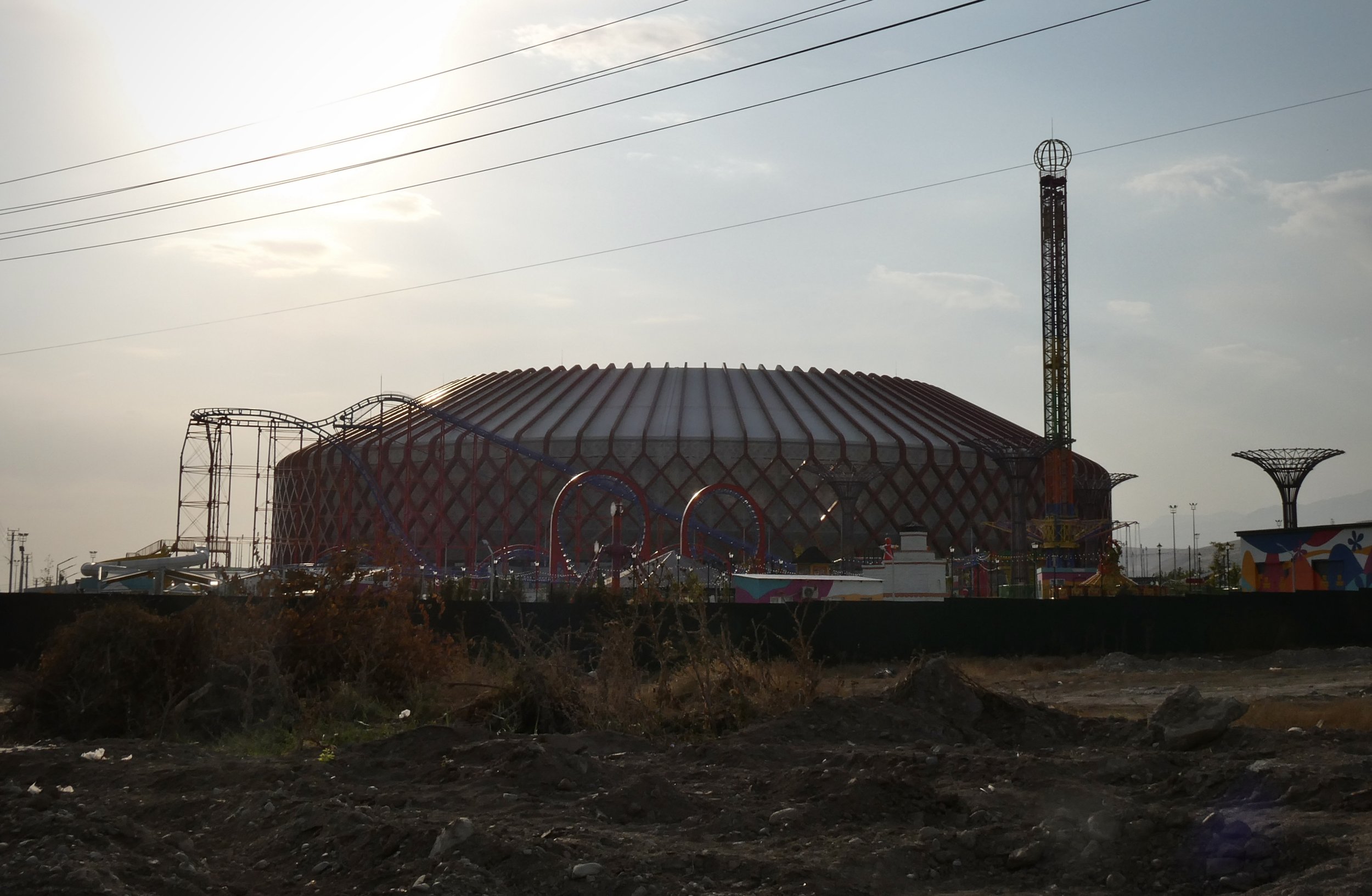
Yurt-inspired Bishkek Arena, which reportedly cost $386 million to build.
Regardless of his real legacy, Lenin symbolised change and progress, and perhaps this continues to resonate with a republic in constant flux. Vladimir Ilyich now stands in the shadow of a new flag, but one that – unlike all other Central Asian republics – remains curiously, well, …red.
Notes
1. Important to note that 1924 was the birth of the Kara-Kirghiz Autonomous Oblast; the Kirghiz SSR was established in 1936, the borders of which are nearly identical to the independent Republic of Kyrgyzstan.
2. Sots-art was a Soviet spin on Western pop-art that emerged in the era of ‘Stagnation’ under Leonid Brezhnev and derived from the official style of Socialist Realism. Here, I’m specifically thinking of works like Vitalii Komar & Aleksandr Melamid’s Lenin Hails a Cab in New York or Erik Bulatov’s Krasikov Street.
3. I’ll let Paul McGann explain it: https://www.noiser.com/real-dictators/lenin-part-1-the-revolution-is-born
4. In August 2016, the centenary of the tragedy, a Kyrgyz public commission declared the Great Ukrun a genocide. The chairman of the Russian State Duma refuted this, saying that ‘все народы страдали сто лет назад’ (100 years ago, all nations were suffering). Read more: https://www.rferl.org/a/kyrgyzstan-urkun-film-russian-massacres-not-approved/27991616.html
5. China, Kazakhstan, and Tajikistan also claim Manas as one of their forefathers, but in independent Kyrgyzstan his cult is particularly pronounced. One finds him in street names, school curriculums, political speeches, cultural events, tourist branding, and students wishing to unlock the ‘Highest Point of Kyrgyz Spirit’ can go on to take ‘Manas Studies’ [rus. ‘Манасоведение’] at university (https://edu.gov.kg/media/uploads/2022/11/01/11-12-2019_sqEHWNM.pdf?utm).
6. See Robert Lowe’s article ‘Nation Building and Identity in the Kyrgyz Republic’, in which he also discusses the conundrum of the non-Kyrgyz peoples that inhabit the territory.
On 12 April 1918 Lenin’s ‘Decree on the Monuments of the Republic’ ordered the destruction of all Tsarist statues and their replacement by depictions of the people, productivity, and progressive cultural and po
All images belong to Lyra Browning, unless otherwise stated.