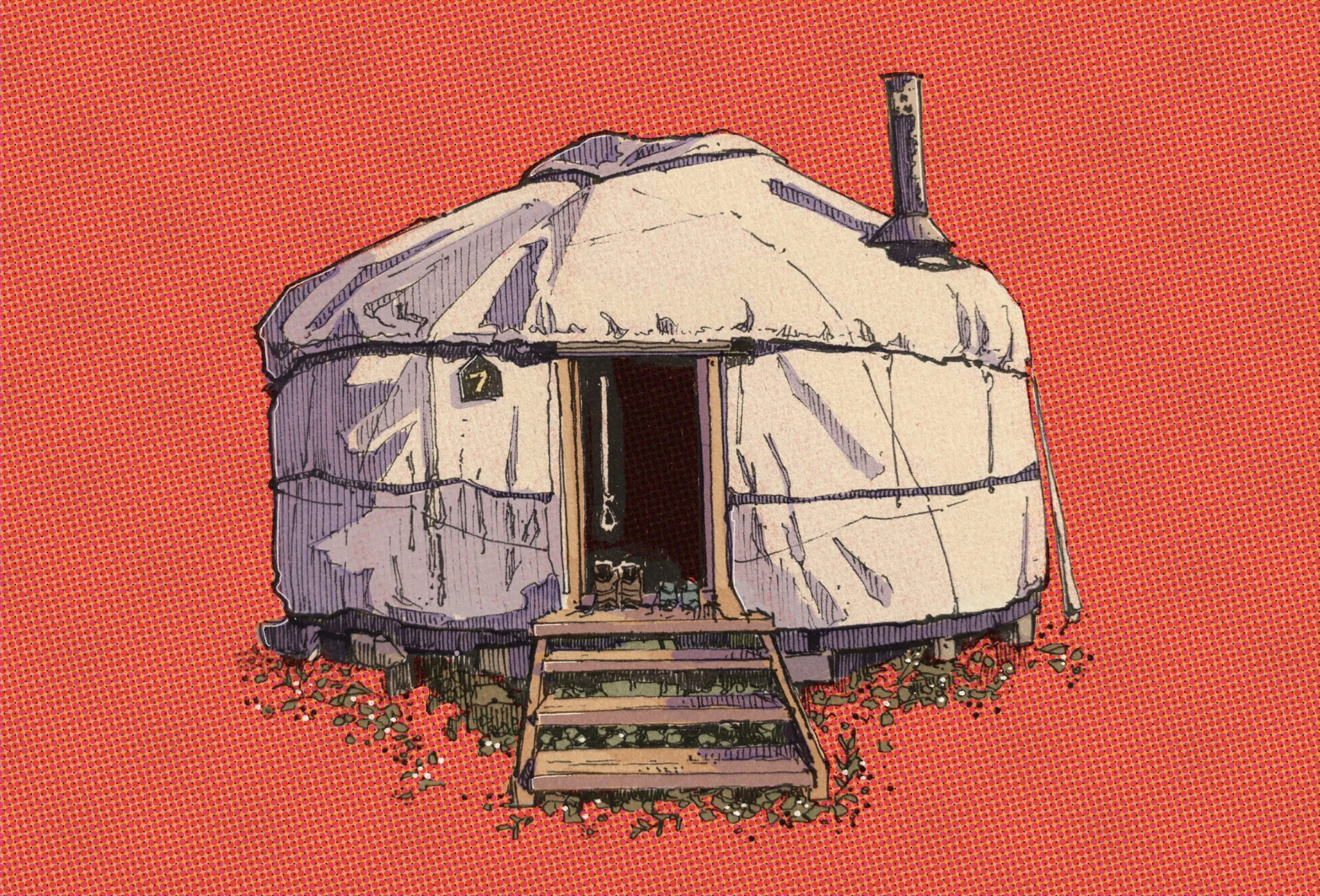
On 5 October 2026, all state-run institutions in the Kyrgyz capital were instructed to close or operate online. Why? The city was celebrating the opening of Bishkek Arena, Central Asia’s newest and largest stadium. Local authorities anticipated such a scale of traffic chaos that trying to get to school or work was officially declared futile [1]. Although we didn’t manage to secure our free tickets, my host family and I streamed the spectacle live, which included performances from renowned Kyrgyz, Kazakh, Uzbek, and Russian artists. The 51,000-seater stadium’s construction has not been uncontroversial. It’s endorsement by Gianni Infantino, disruption to local residents, and suspiciously opaque sources of funding tied to strongman president Sadir Japarov have all attracted criticism. Problematic though the project may have been, the result is undeniably impressive and stands out for one principal reason: its yurt-inspired design.
Yurts are collapsible circular dwellings that have been lived in by nomadic peoples for millennia. Typically lined with layers of felt and animal skins, they are renowned for their remarkable resistance to harsh Central Asian climes. The Kyrgyz yurt, or ‘Boz Üy’ [‘grey house’; kyrg. «Боз үй»], is smaller than its Kazakh or Mongolian cousins, better suited to the mountainous terrain that covers up to 90% of the country.
In Kyrgyz culture, however, a yurt is more than just a home with no corners. Its structure is saturated with symbolism. For example, the banded wooden hoop that creates the central hole in the ceiling, or ‘tunduk’ [kyrg. «түндүк»], serves not only as a skylight and chimney, but also facilitates communication with Tengri, a pre-Islamic supreme deity and personification of the universe [3]. A symbol of unity, the tunduk sits at the centre of the Kyrgyz flag and gives its name to the national digital platform of the Republic, through which most government services are conducted. The interior space of a yurt is also gendered and hierarchical: men sit to the west, women to the east, and the more respect or power an individual commands, the further he or she sits from the door. These spiritual values are a key part of ‘Kirgizchilik’, or what it means to be Kyrgyz. Since 1991 the search for this elusive essence has been a central concern in public discourse. Upon the collapse of the Soviet Union, the Kyrgyz state was abruptly deprived of the all-encompassing teleological narrative of the glorious march towards a communist utopia. Politicians, intellectuals, and businessmen rushed to fill the subsequent ‘ideological vacuum’ with new national symbols, primarily plucked from the pre-Soviet past. The Kyrgyz Republic draws on nomadic tradition, ancient religion and folk heroes like Manas, painting its independence as a rebirth [4].
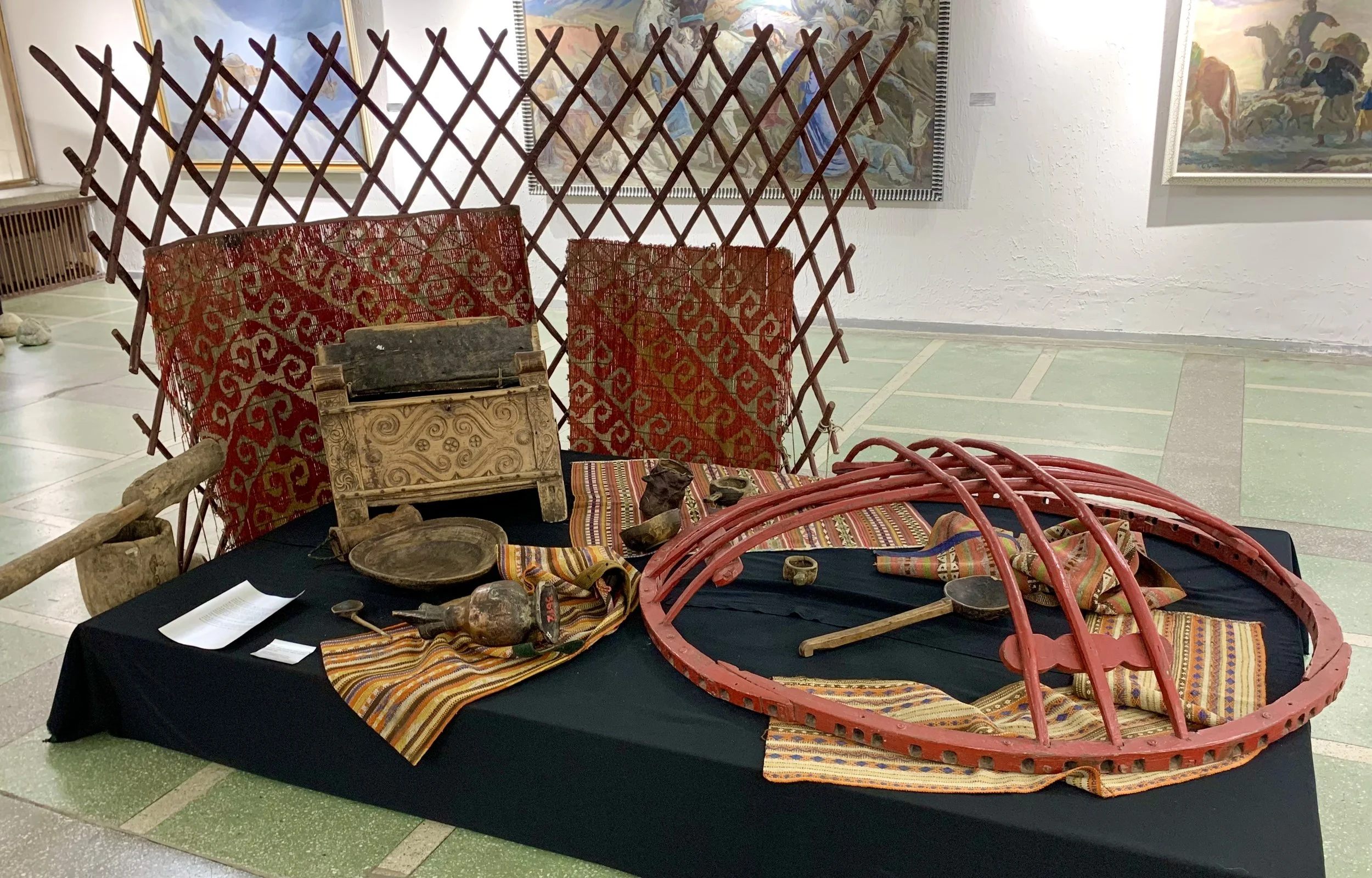
Yurt remains on display in an exhibition commemorating the ‘Great Ukrun’ of 1916 (see Notes From Bishkek I) at the Gapar Aitiev National Museum of Fine Arts, Bishkek. The dynamism of these dwellings may have helped some to survive the perilous journeys made by thousands of Kyrgyz fleeing Tsarist oppression. The round ‘Tunduk’ can be seen on the right.
Though a yurt can be erected in a matter of minutes, as demonstrated during the Speed Yurt Assembly competition at the 2026 World Nomad Games, its construction is a long and painstaking process. The wood, typically Turpan Tal willow, is specially selected, harvested when sap is low, chopped, left to dry in the wind, and then then steamed for up to 20 days so that it can shaped into signature circular form. Unlike the Mathematical Bridge, the most authentic yurts are actually built without nails or screws, and the only instruction manual is generational knowledge [5]. The traditionally female domain of decoration is no less laborious. When felting a Shyrdak or Ala Kiyiz – insulating rugs or wall hangings – the sheep wool fibres fuse together permanently, and therefore the artist must have the whole design envisioned beforehand. Each master must also have an internal dictionary of all the different meanings attributed to specific patterns and know how to deploy them appropriately. The colours, derived from natural pigments, also come with their own connotations. For example, the muted tones of the Boz Üy reflect the ancestral homes of the Kyrgyz tribes: the snowy peaks of the Tien Shan and the dove grey of the River Enisei.
Yurts have also become an economic opportunity for Kyrgyzstan and a key part of their ‘nation-brand’ [6]. It is hard to find a local travel agency that doesn’t incorporate the motif into their marketing in some way. As the tourist industry booms and demand for adventure-holiday accommodation grows, many are concerned that cheaper, Chinese-made metal and synthetic yurts will replace the sustainable practices of domestic businesses [7]. Last month a handful of such yurts appeared on the end of my street in Bishkek. I got excited, naively assuming a wedding or elaborate celebration was in store. I soon discovered, however, that these were mourning yurts, and that the Boz Üy has an important funerary function linked to specific rites and decoration styles. One might therefore argue that these affordable, imported ‘imposter’ yurts are important as they allow urban middle-class Kyrgyz to stay in touch with their roots. Nevertheless, the traditional industry has remained resilient, and the small yet significant international yurt market provides master craftspeople with opportunities to sell their yurts to clients across Europe, the UEA, and the US.
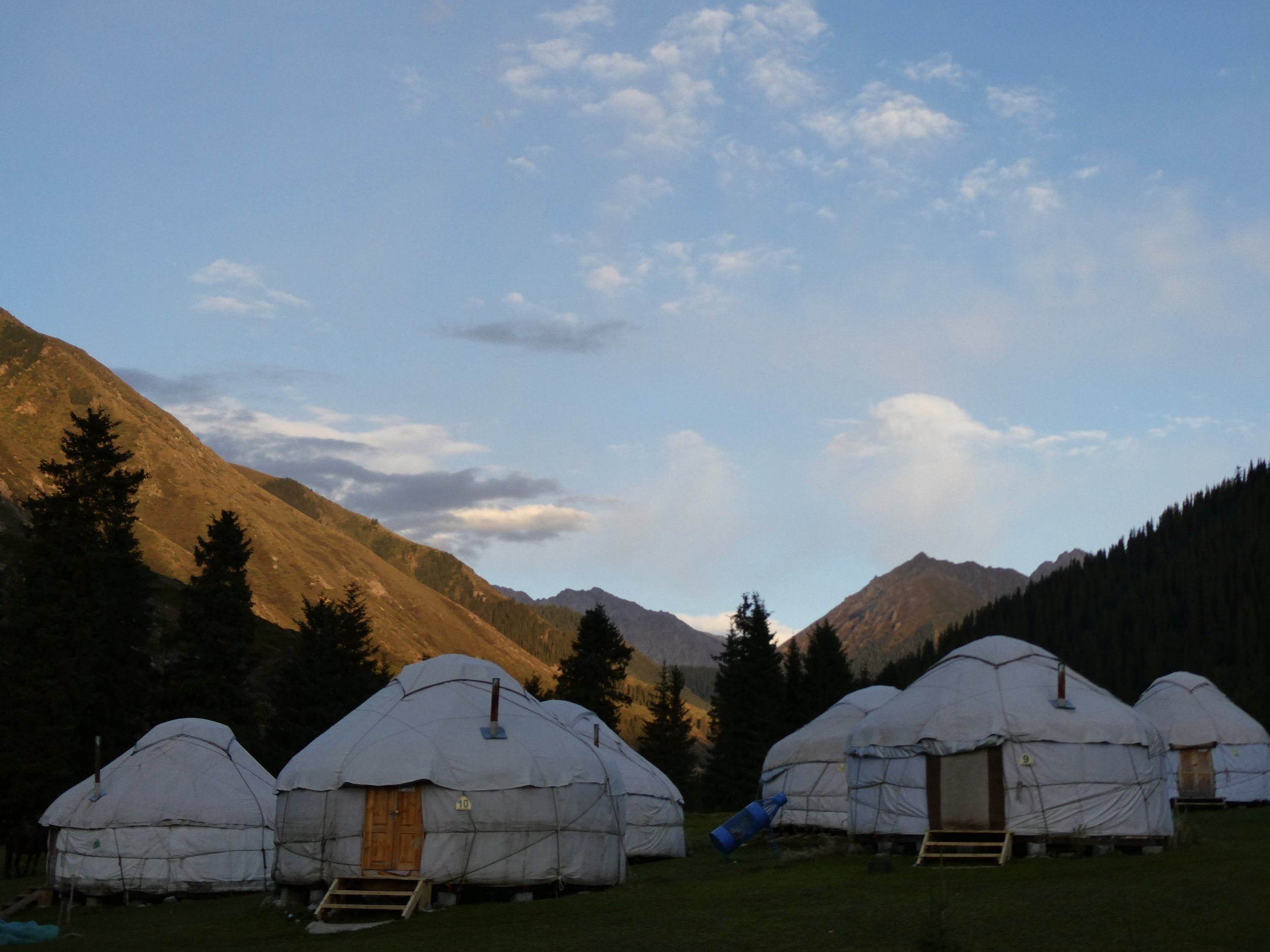
Golden Yurt Camp, near Jeti-Oguz. I spent one night here before a trek through the Tien Shan mountains. Equipped with hot showers, a restaurant, and Wi-Fi, tourists can get their nomadic fix without sacrificing modern comforts.
Let us return to Bishkek Arena. Last night my host family and I paid our first visit to the new stadium. That is, we went to stand in hats and scarfs outside the complex to see if we could hear Shakira, in Central Asia for the first time on her latest world tour. Concert tickets cost a minimum of ~£190, and rumour has it that, unaffordable for locals, most of these have were bought up by foreign fans. Perhaps this new internationalism of the Arena is simply a large scale, modern manifestation of the timeless Kyrgyz tradition of welcoming guests and sharing bread. However, if this ‘yurt’, like its predecessors, symbolises a microcosm of the universe, then we live in a decidedly dystopian reality. The eight-level steel and concrete entertainment complex surrounded by retail space, restaurants, and parking bears little resemblance to nomadic visions of spiritual harmony. A Boz Üy is designed to protect and serve its residents and the environment. If Bishkek Arena continues to prioritise profit over people and planet then it will never truly merit its ‘yurt-inspired’ moniker.
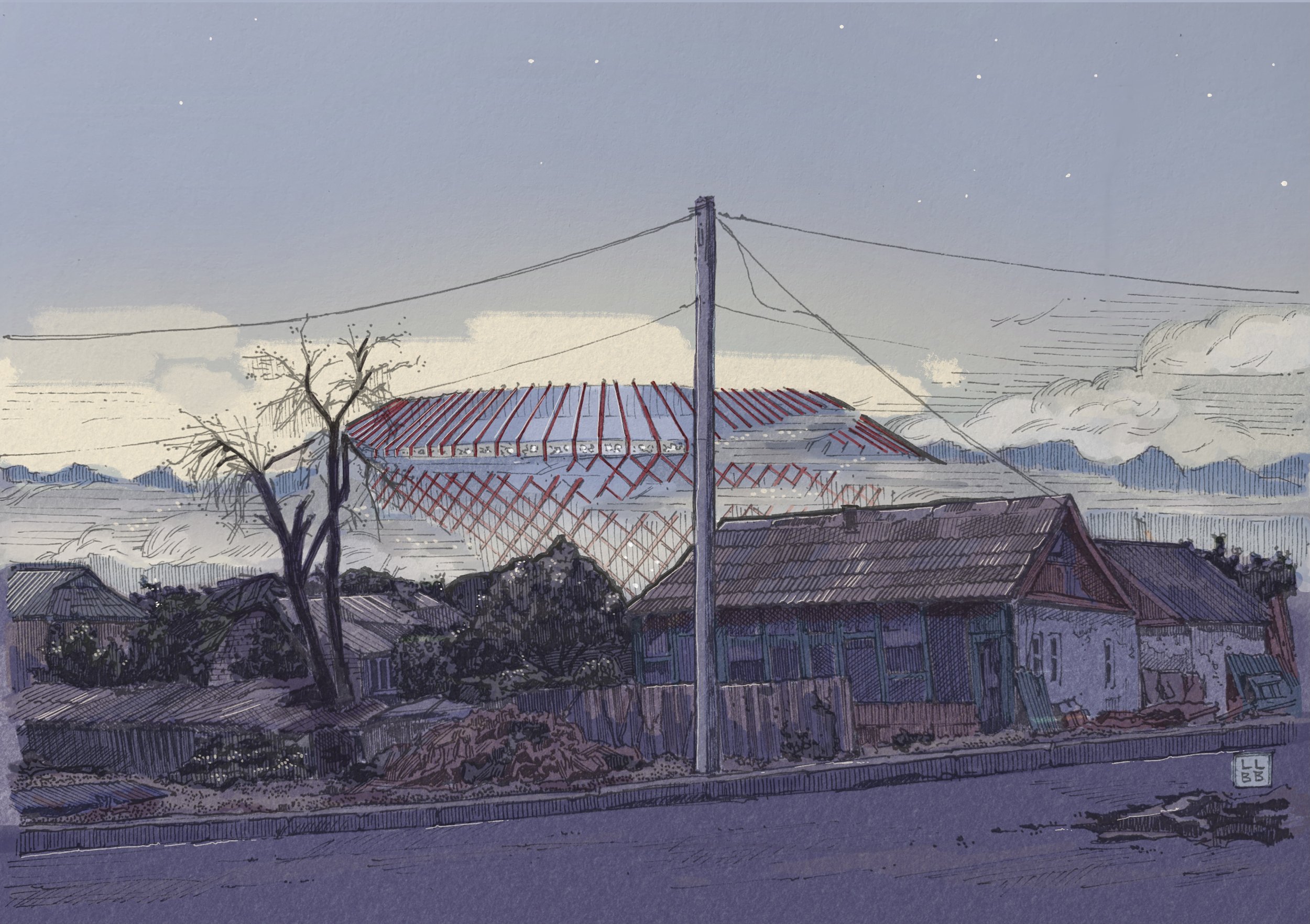
The looming luxury of Bishkek Arena contrasts the surrounding neighbourhood. The southern suburb has suffered severe traffic problems and disruption due to the stadium’s construction.
Notes
1. Bishkek’s ‘probki’ [traffic jams; rus. «пробки»] problem is out of hand. For visuals, check out this local youtuber’s exploration of the issue: https://youtu.be/CvShmyeEfgI?si=FobjORqyJNBmjzXq
2. Read a full report on the stadium’s shady sponsorship, as well as some background on Japarov’s government, here: https://www.occrp.org/en/news/exclusive-company-with-state-contract-building-kyrgyzstan-football-stadium-tied-to-presidency
3. In their 2009 article ‘The Invention of Legitimacy: Struggles in Kyrgyzstan to Craft and Effective Nation State Ideology’ Asel Murzakulova & John Schoberlein highlight that a central concern of contemporary Tengrism, especially in its political manifestation, is to dismiss Islam as something fundamentally at odds with Kyrgyz character. In a majority Muslim country, this has proved controversial.
4. As Damira Umetbaeva notes in her 2012 article ‘National Memory in Kyrgyzstan: Attitudes to the Soviet Past’, some see this ‘rebirth’ as a relapse, lamenting their return of ‘feudal’ wealth accruement, flagrant overspending, and the rise of ‘bai-manaps’ (uneducated, oppressive ruling elites).
5. The heart of authentic Kyrgyz yurt making is Kyzyl-Tuu, a small village on Issyk-Kul Lake almost solely inhabited by yurt-makers. Explore their very slick site for fascinating explanations the building process: https://tunduk.trade/tunduk-craft
6. In a previous attempt to market themselves internationally, the Republic latched onto a throwaway comment from SWECO Logistics that Kyrgyzstan would be the most efficient place for Father Christmas to be based. See Erica Marat’s 2009 article ‘Nation Branding in Central Asia: A New Campaign to Present Ideas about the State and the Nation’ for an explanation of the surreal Santa incident as well as an interesting investigation into the ‘Borat Effect’ on Central Asia’s international image.
7. Hear some local opinions on contemporary yurt culture here: https://eurasianet.org/kyrgyzstan-synthetic-chinese-yurts-undercutting-kyrgyz-tradition
All images belong to Lyra Browning, unless otherwise stated.