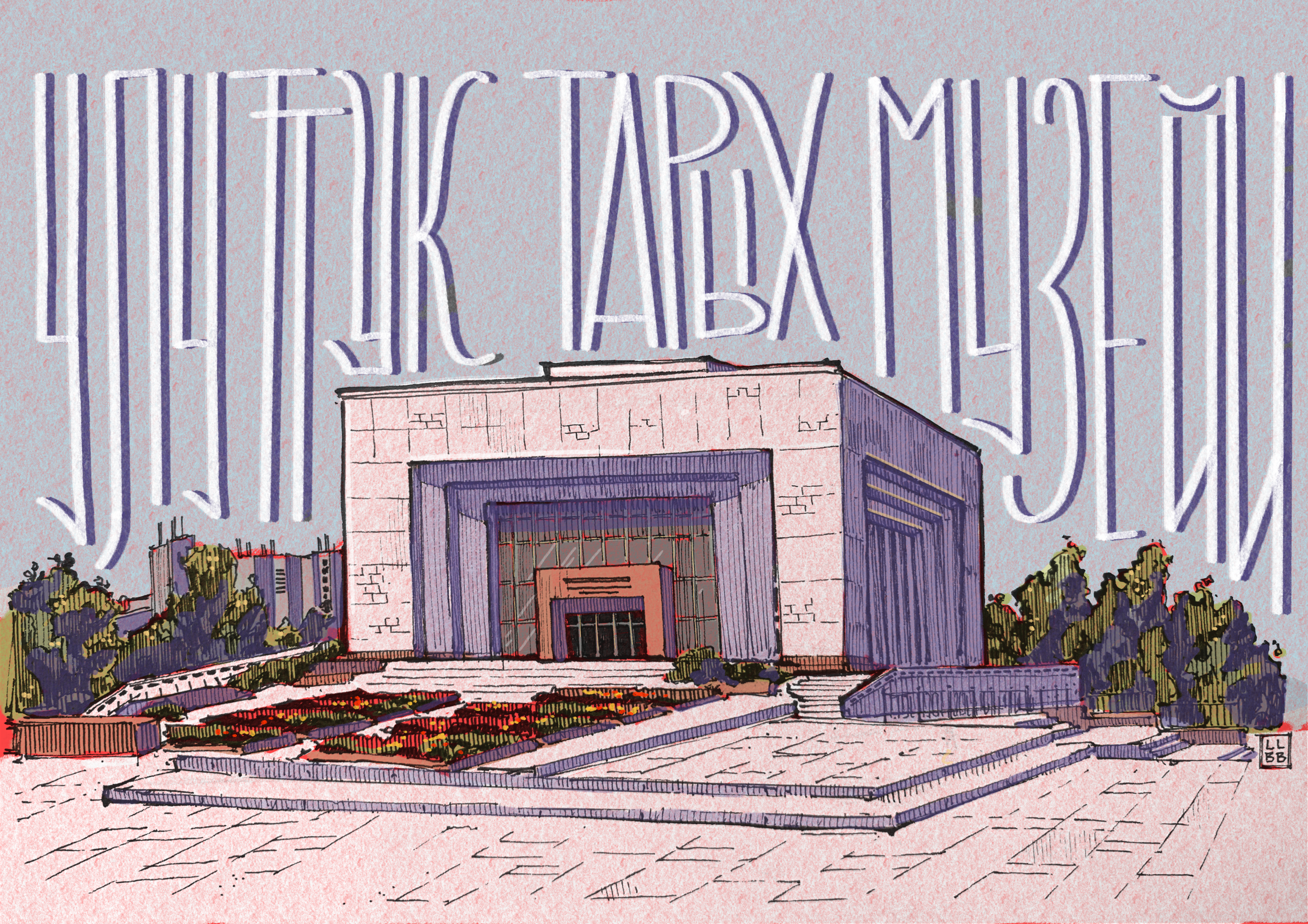
Bishkek is not a city built for tourists. Travel blogs typically recommend day trips to nearby national park Ala-Archa, or swapping the city altogether for the astonishing beauty of Kyrgyzstan’s countryside. Nevertheless, most sites do highlight a handful of urban attractions, The National History Museum [kyrg. Улуттук тарых музейи] almost always counted among them.
Approaching the museum from any direction, the first thing one sees is Ala-Too Square’s forty-five-metre-high Kyrgyz flag, flapping in the breeze above Bishkek’s oak-lined streets. Reaching the square, one encounters trios of goose-stepping armed guardsmen, on perpetual patrol as if commanded by the impressive presence of the big white cube.
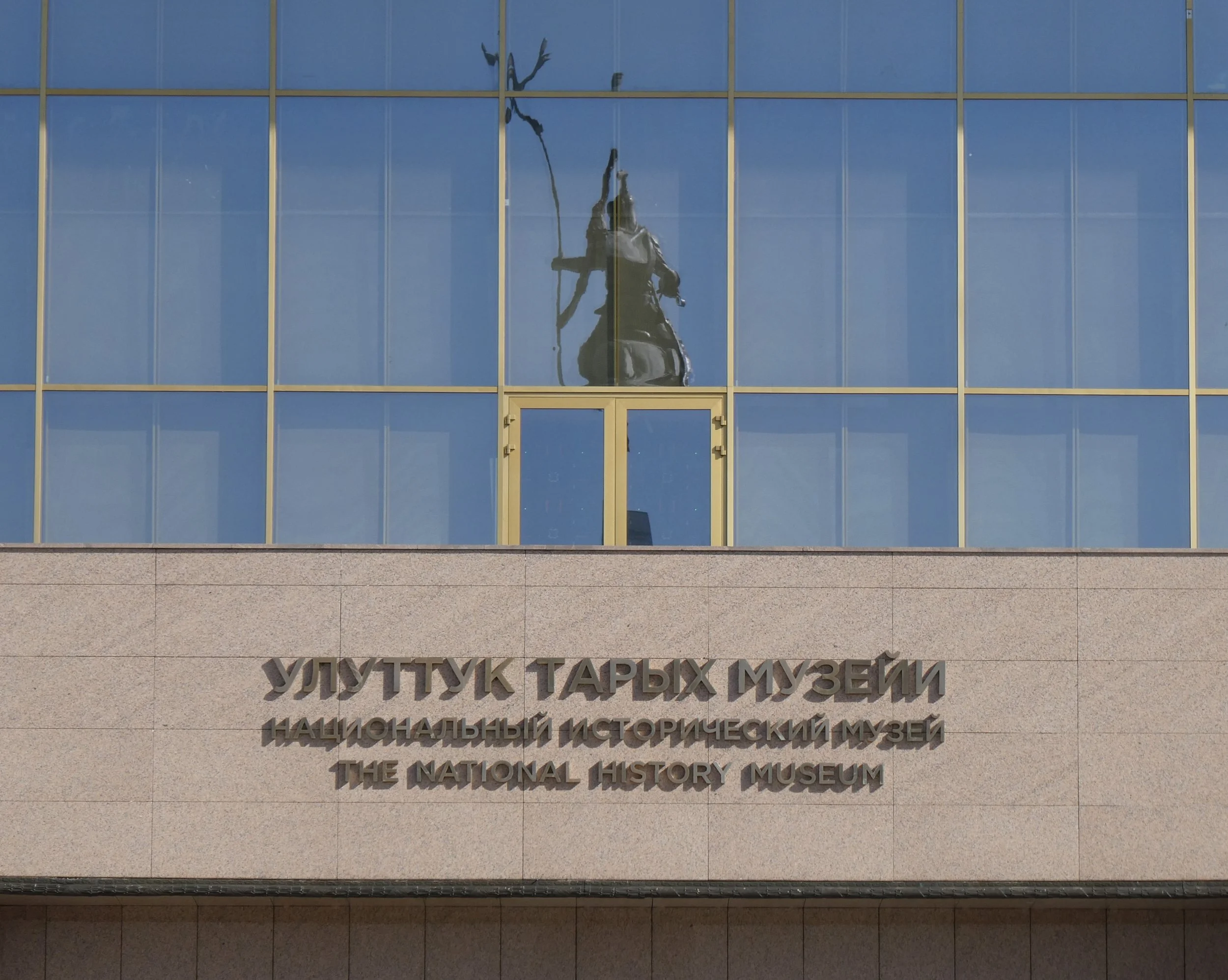
The massive monument to Manas, Kyrgyzstan’s national folk-hero, is appropriately reflected in the darkened-glass façade of the museum entrance.
The institution has not always sat on this strange marble expanse. It’s first exhibition was held in 1927 in the house of the parents of Mikhail Frunze – Bishkek’s founder and former namesake. It reflected the then-popular practices of ethnography and ‘local lore studies’ (rus. «краеведение»), focusing on the natural world, archaeology, and rural life. The museum then went through a series of different names and locations, until in 1984 its current home was constructed. But the changes did not stop there. From 2016 to 2021 the museum was closed for a total makeover, delivered with the obligatory dose of controversy and corruption. The interior was stripped of its Soviet sculptures and murals, a mysterious fire did more damage than officially declared, and former Prime Minister Sapar Isakov was sentenced to 18 years in prison for embezzling some of the over $21 million in funds allocated to the project [1]. The surprisingly sleek result of this somewhat chaotic renovation is what visitors experience today.
After passing the disinterested security guards and paying the standard entrance fee of 200 Kyrgyz Som (just under £2), the receptionist waves you in the vague direction of a dim set of steps to her right. The museum’s centrepiece is a stately marble staircase, yet at various points staff assertively usher you towards a small, peripheral lift instead.
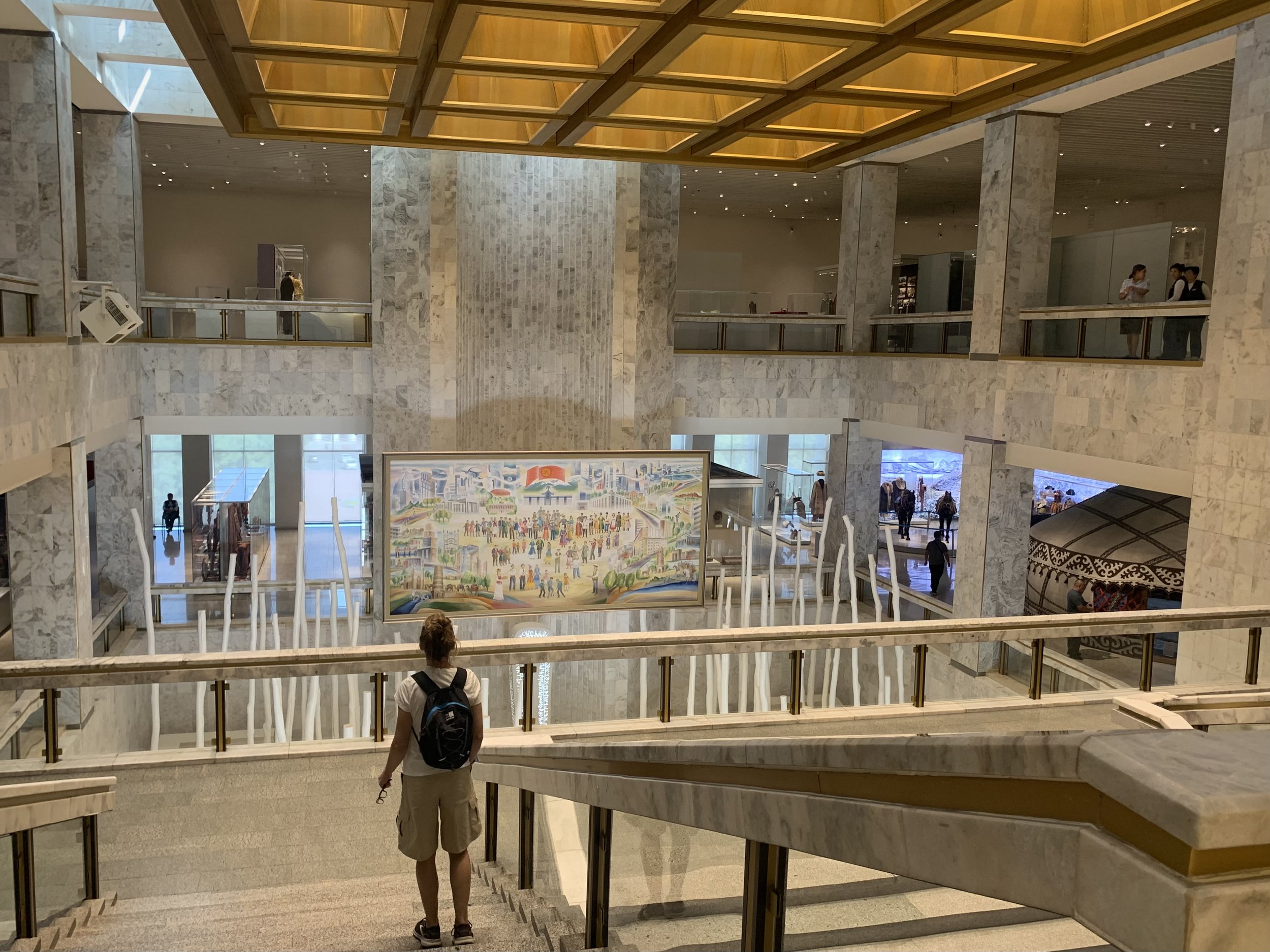
Upon entry, visitors glimpse the grand marble staircase, golden waffle skylights, and a giant president-sponsored tapestry entitled ‘The Spirit of a People is its Primordial Path’.
The exhibition starts on the second [first] floor with the stone age: a classic collection of tools, jewels, mammoth remains, and other miscellaneous early-man items. The rest of the level displays artefacts from the various Turkic and Mongolian nomadic cultures and states of the medieval period, the highlight being a fifth-century AD gold leaf mask with ‘almond eyes of coloured stone’ [2]. On this floor one also finds a large stone Buddha, although the main attraction here appears to be its glass case, a gift from the Indian government ‘as a sign of India-Kyrgyz friendship’.
This spirit of international cooperation is echoed on the next level, where upon exiting the lift, one is thrust into a carefully curated, colourful world of treasures from Kyrgyzstan’s Eastern neighbour. What is supposed to highlight the epic civilisation encounter of the Silk Road reads more like blatant Chinese propaganda. In its own words, the collection ‘presents the core spirit of the Chinese nation: harmony amid diversity’, and ‘illuminates our shared path forward… without borders’. Interestingly, there are no Russian captions here, the information is only in Kyrgyz, Mandarin, and English. This must have delighted Chinese first lady Peng Liyuan, who, along with her Kyrgyz counterpart Aigul Japarova, had a private tour of the museum during the Shanghai Cooperation Organisation’s Bishkek summit this September.
Continuing past the stunning yet strange Sino-section, the third floor narrates the cultural development and ‘continuous struggle for independence’ of the Kyrgyz people from the fifteenth century to the mid-nineteenth century. Here one finds an explanation of Kyrgyz tribal structure, tributes to notable warriors and thinkers, an elaborately decorated yurt, traditional textiles, and elements of ‘spiritual culture’ such as amulets, games, and children’s dolls. I ran into some trouble with the display dedicated to Manas and his Epic, as the captions were primarily in Kyrgyz [3]. Also of note is that, despite Kyrgyzstan’s ethnic diversity, the museum focuses almost exclusively on the ‘Kyrgyz nation’, with only small collections of curios relating to other groups [4].
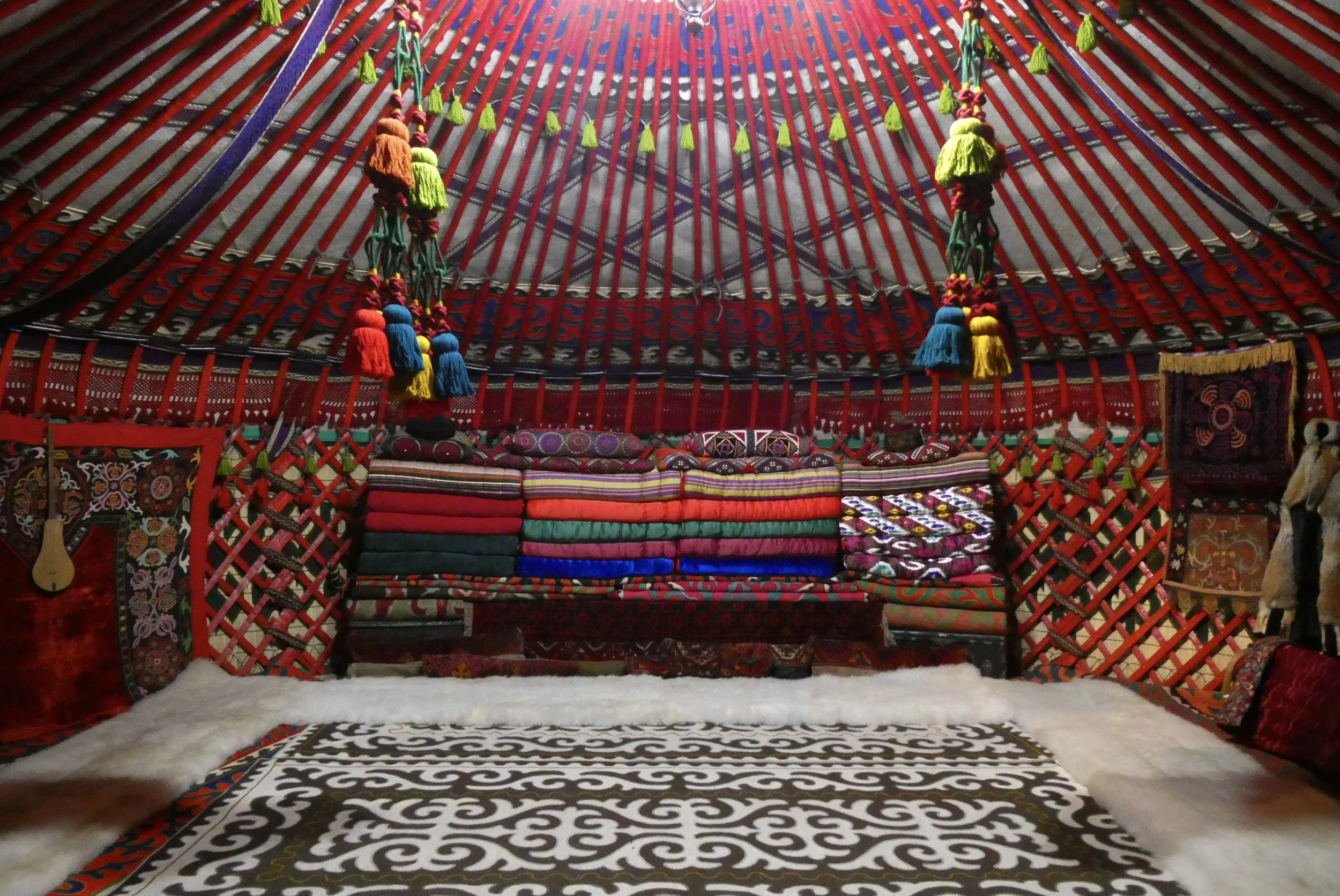
A curated traditional yurt, complete with felt ‘Shyrdak’ rugs and a Komuz, a fretless three-stringed lute typically made from a single piece of apricot or juniper wood.
In the next section we are formally introduced to the Russians, although observant visitors will have already sensed their presence: Lenin looms out the rear window [5], and the original stone stele, who’s replica is at the heart of the installation on the stairs, is currently housed in Minusinsk Regional Museum, Russian Federation. In 1865, the territory of Turkestan, which included the Kyrgyz people, formally came under Russian control. Although labels mention resentment towards Russian settlers and tax collectors, the first impression we receive of colonial rule is surprisingly positive and focuses on advances in communication, transport, and trade infrastructure. We hear the story of Kurmanjan Datka, a woman born into a nomadic family who rose to become a powerful political leader and ‘strengthened the unity and cohesion of the people’ by peacefully accepting Russian rule. The imperial part closes on a more solemn note, with an account of the brutal tsarist response to the series of local revolts that here are collectively labelled the ‘national-liberation uprising’ of 1916.
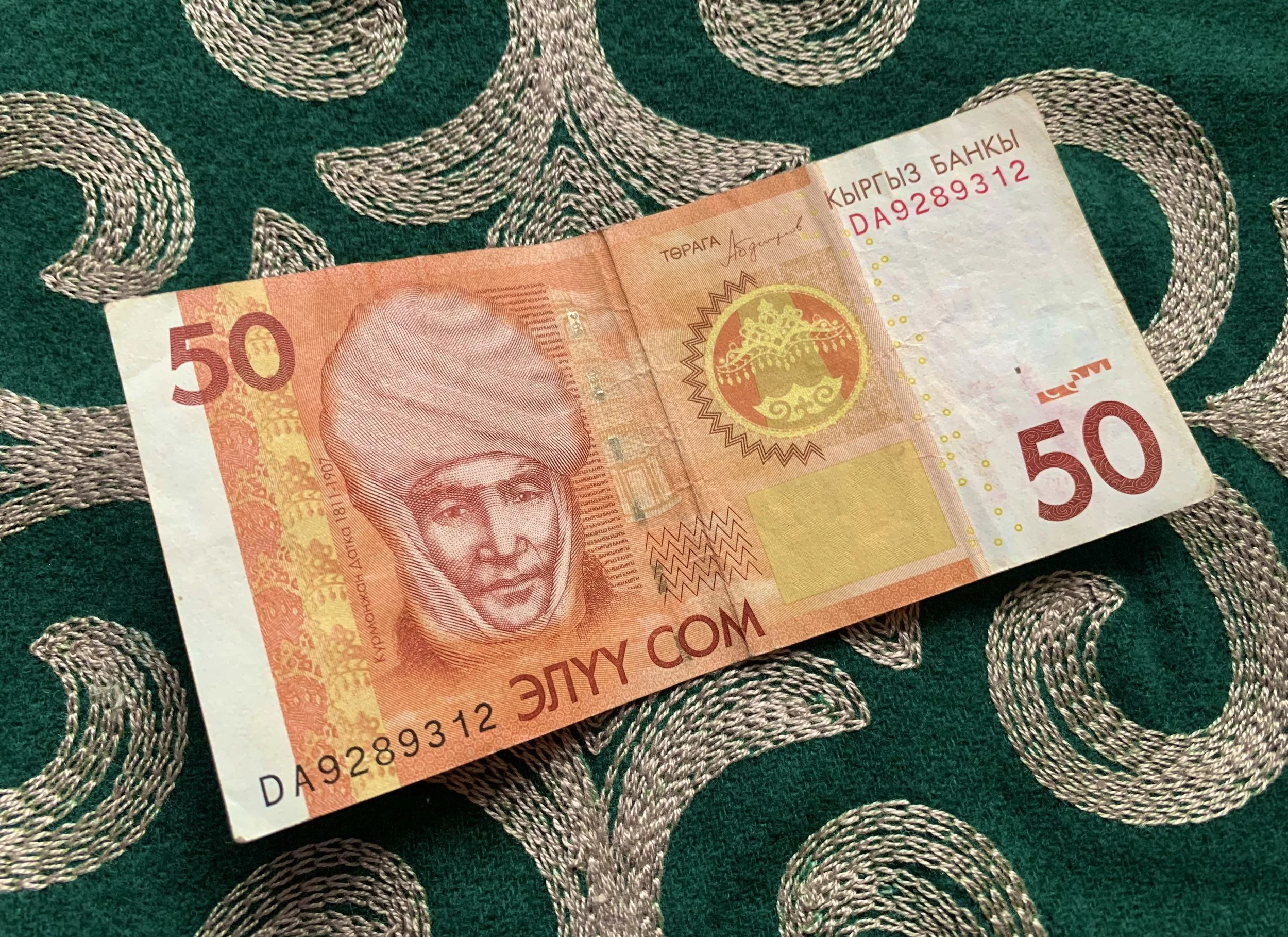
Kurmanjan Datka – wise, peace-loving politician to some, Russian puppet to others - appears on the 50 Som banknote. The Republic’s 2000 Som banknote, as proudly narrated later in the exhibition, won ‘Best Regional Banknote 2018’.
Another short journey in the lift and one arrives at the final floor: 1917-present. The general picture of the Soviet period is one of progress and development. Indeed, the introductory caption credits the October Revolution with creating ‘the prerequisites for reviving statehood for the Kyrgyz people’. The Great Patriotic War (WWII) is presented as a triumph rather a tragedy, and the account of repression in the 1930s is remarkably brief. There are model trains and tractors, celebrations of literacy campaigns, and many, many tributes to best and brightest of the Kyrgyz SSR, whether they be soldiers, sportsmen, film directors or writers. The section is stuffed full of the debris of everyday life under socialism: posters, portraits, shoes, neckties, letters and more. Compared with this clutter, the post-independence part of the museum appears rather empty.
Entering the 1990s, so to speak, one walks through a simple white room with a large Kyrgyz flag in the centre. Beyond this, sparsely placed glass cases commemorate individual achievements since independence, such as that of Mambet Mamakeev, photographed with his Guinness World Record certificate for the longest career as a surgeon. Many of the collective triumphs of Kyrgyz people, enterprise and government displayed here are accompanied by a quote or two from the current president, Sadir Japarov. There is some documentation of post-independence political turmoil [6], although the information is largely in Kyrgyz and throughout this section a considerable number of plaques appear to be missing. It seems the official history of the last 35 years has yet to be written.
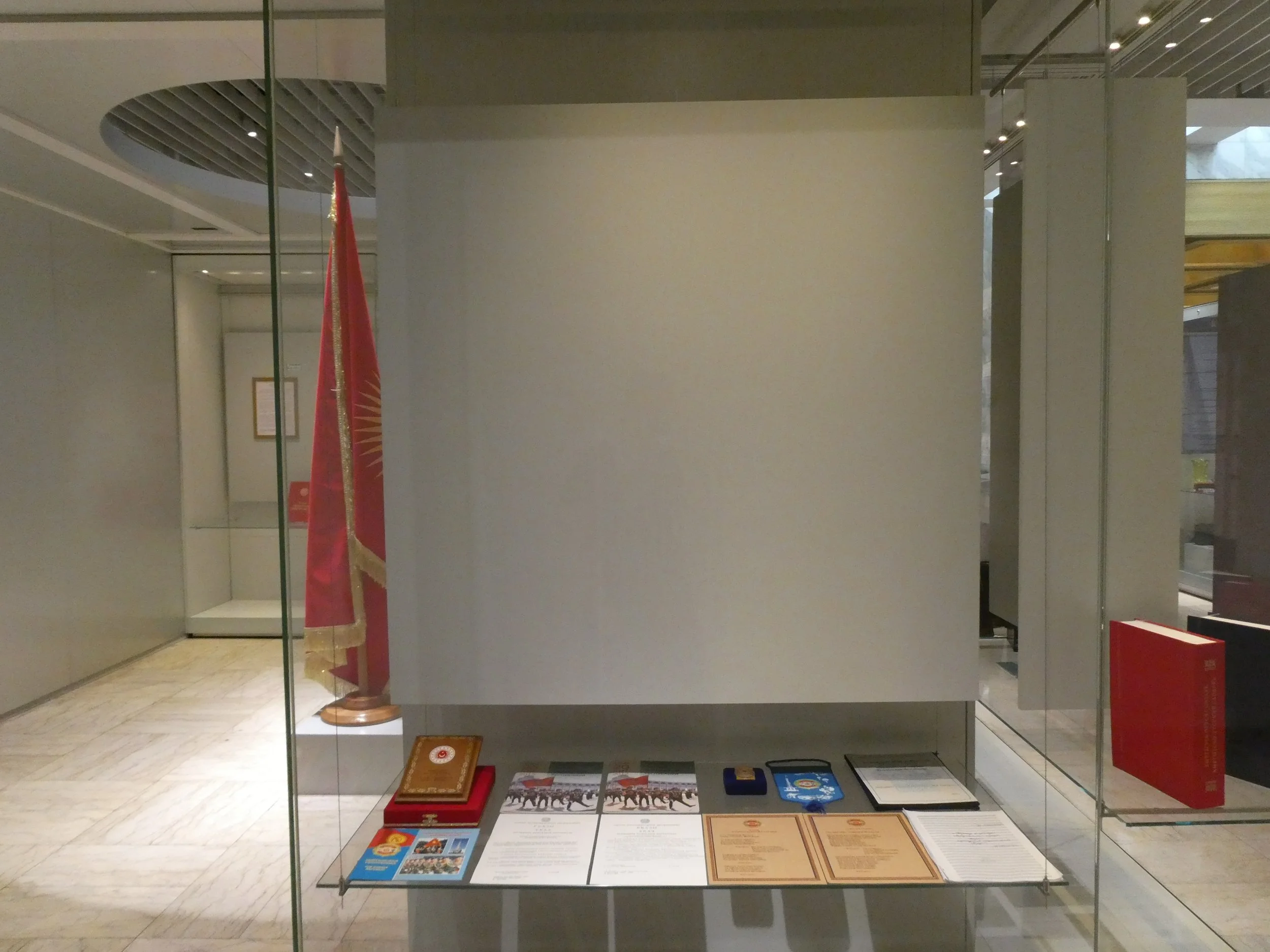
Negative space dominates the final part of the exhibition.
The exhibition officially ends with a photo of two young girls, one of whom I assume to be ethnically Russian, smiling at the camera in traditional Kyrgyz costume. This curious, anonymous portrait captures what Damira Umetbaeva calls the ‘historical double think’ of Kyrgyz attitudes to the past [7]. The museum’s main exhibit tells two stories simultaneously: one is a ceaseless struggle for independence against aggressive colonial ‘others’, and the other is a tale of reliance upon and genuine gratitude towards such powers, whether tsarist or Soviet. For now, these contradictions peacefully coexist inside their big marble cube, but one wonders what future awaits a collection – and country – repeatedly undergoing revolution. The ‘bilyet’ one buys in ten years’ time will probably be for something completely different.
Notes
1. There was also the strange case of a 1500-year-old mummy being hastily removed on the government’s request. Apparently, mystics foretold that the upcoming elections would not be peaceful if the body remained uninterred. Read a full investigation here: https://kloop.kg/blog/2021/05/20/besprizornaya-kultura-kak-kyrgyzstan-teryaet-istoricheskie-tsennosti-iz-za-halatnosti-i-nepodotchetnosti-chinovnikov/
2. A quote from the Museum site, where you explore some of their collection. Many pages have contained little-to-no information, although the Kyrgyz and Russian language versions of the site are more detailed than the English: https://historymuseum.kg/en/home/
3. Had I attended 2020’s record-breaking fourteen-hour continuous recital of the Epic outside the museum, I might have got the gist. As the exhibit itself explains, ‘oral national creation’ is an essential part of Kyrgyz culture.
4. Kyrgyzstan’s large non-Kyrgyz ethnic minorities have proved a challenge for politicians, especially since independence in 1991. See, for example, the 2010 riots in the South of the country that left hundreds of ethnic Uzbeks dead or homeless: https://www.rferl.org/a/kyrgyzstan-s-deadly-ethnic-clashes-10-years-later/30654022.html
5. See last week’s article, Да здравствует Ленин!? (Long Live Lenin!?)
6. Kyrgyzstan has experienced multiple violent ‘revolutions’ since independence, most notably the ousting of president Askar Akayev in 2005 (The Tulip Revolution) and the removal of president Kurmanbek Bakiyev in 2010 (The April Revolution).
7. In her 2012 article ‘National Memory in Kyrgyzstan: Attitudes towards the Soviet Past’, Umetbaeva explores the paradoxical discourse of Kyrgyz history textbooks.
All images belong to Lyra Browning, unless otherwise stated.