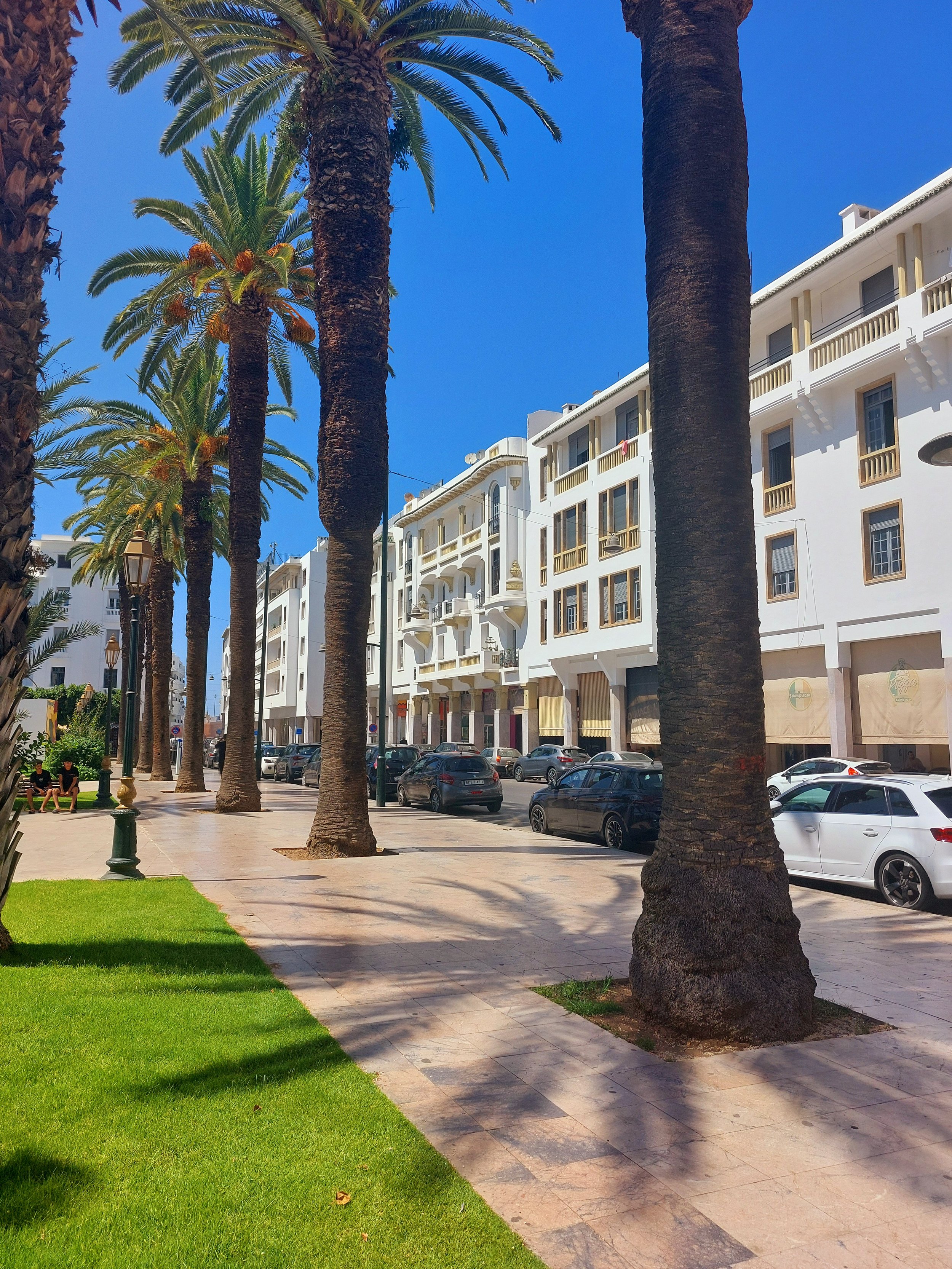
Palm trees in front of art-deco offices in Rabat's ville nouvelle, all images are the author’s own unless otherwise stated
One day, having arrived on a sleek TGV high-speed train, I made my way into the city centre. “Bonjour,” I said politely to the café’s waiter. “Un café américain, s’il vous plaît.” As he walked away, I looked out onto the wide boulevard before me, across the street from the grand Cinéma Renaissance and around the corner from the beautiful Cathédrale Saint-Pierre. It would have been easy to believe that this scene was taken straight out of France, but the writing on the central train station wall told a different story altogether: Gare Rabat Ville (Rabat City Station). This was Rabat: the capital city of Morocco. That Art Deco neighbourhood of manicured streets, grand buildings, and spacious parks is the city’s ville nouvelle (new town), a 1910s addition to the city upon becoming the administrative centre of what was then the French Protectorate of Morocco. A short walk down the road, however, was Rabat’s kasbah (old town): a dense, walled area combining markets, residential areas and tourist sites.
The differences between the Moroccan and French developments are striking: snaking passages replaced by tree-lined streets, souks by boutiques, practicality by opulence. These contrasts are not unique to Rabat, however; in cities throughout the country, I encountered the distinct bifurcation of the local medina and a French-built ville nouvelle. This is no mere architectural quirk: this is the legacy of a colonial urban strategy whose influence persists, long after independence.
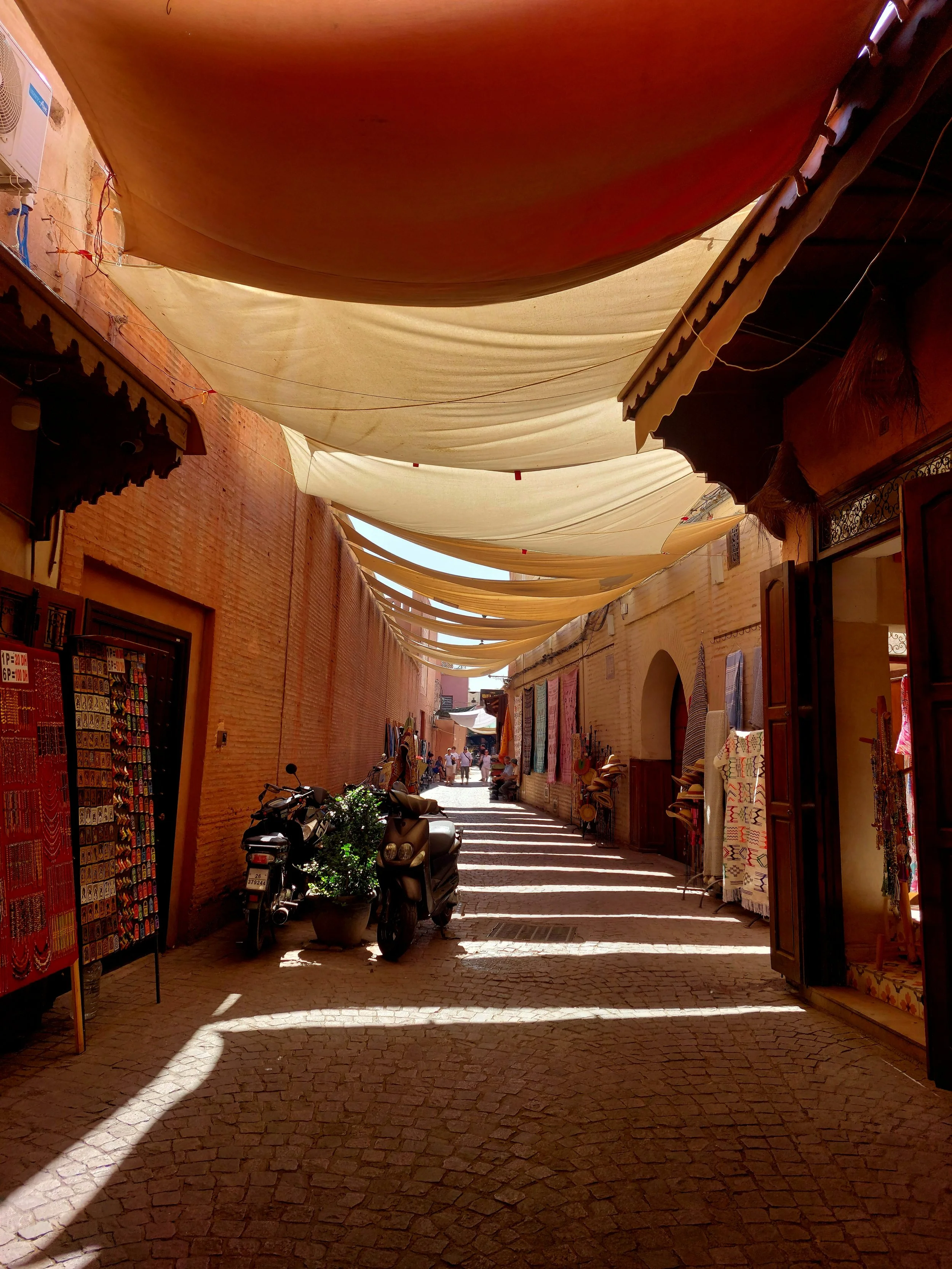
A covered market in Marrakesh
Morocco's “red city,” Marrakesh, is the primary tourist destination of the country. With bustling markets, historic mosques and ancient links to the Sahara Desert, the city has cemented its reputation as Morocco’s most exciting city for a tourist to visit. Yet, as you walk from your hotel, stepping over smooth stone, sheltered from the burning heat by narrow streets designed to maximise your shade, you reach the embodiment of the medina/ville nouvelle divide: Bab Doukkala (Doukkala Gate). On one side, the city’s vibrant commercial life persists in intricately patterned spaces designed for the hot climate and social interaction, and on the other, boulevards and art deco façades reflect 20th-century French urban design, using air conditioning rather than architecture to alleviate the 40-degree heat.
Strolling down the long, wide street towards the train station, you reach Plaza Guéliz, the heart of Marrakesh’s Ville Nouvelle. In the Guéliz neighbourhood to the right – beyond Zara and McDonald's – art galleries, hotels, and European cafés dominate. In the Hivernage neighbourhood to the left, nightclubs, upscale hotels and even a casino exemplify France’s influence on the city.
The broad streets and French signs are a clue to the causes of this urban divide. When Marrakesh burst past its city walls in the 20th century, French administrators decided on the construction of a new city, a European city, separating colonial rule from the social hub of the medina. Keeping to Marrakesh’s traditional sandstone red buildings, an art deco city sprang up, where most foreign consulates, the city hall, and the hulking main train station are all still located today.

Place Nations Unies in Casablanca
The train journey to Casablanca could almost be mistaken for a French one. Morocco’s railway company, operating a fleet of modern TGV high-speed trains built in France, connects its coastal cities with speed, style and efficiency. You would think you were on France’s train network, until you realise your first-class high-speed train ticket only costs £30. Leaving, you take one of the city’s trams towards the coast, the maritime climate almost removing the need for air conditioning inside the carriage. Stepping off at Place Nations Unies (United Nations Square), you are met with a profoundly colonial sight: a large square surrounded by protectorate-era buildings, branching off towards offices, consulates and monuments. As you walk towards the coast through the medina, however, the facade begins to slip. The streets narrow and the walkways become more and more crowded. Casablanca is a city built for business, not tourism, and this medina is much less polished than that of Marrakesh.
Taking a wrong turn, the atmosphere changes completely. You are hassled for money, graffiti appears on walls, and the noise of the motorway mere metres away gets louder and louder. The “romantic” vision of Casablanca disappears completely less than a mile from Rick’s Café. The city’s many sides become evident beyond the landmarks; in relation to the planned colonial areas, historic neighbourhoods see more infrastructure problems and persistent social issues. These disparities reflect the legacies of a colonial system which prioritised European development, leaving the medina lacking services, money and space. As you make your way back to the main drag, the French Consulate and its towering statue of former French Resident-General Hubert Lyautey serve as a reminder of the men who planned this divide. These romantic assumptions about Casablanca, immortalised in the eponymous film, fail to capture the nuances of this sprawling metropolis, obscuring the underinvestment in its traditional areas and confining the city’s perception to that of the lives of its Western and Westernised elite.
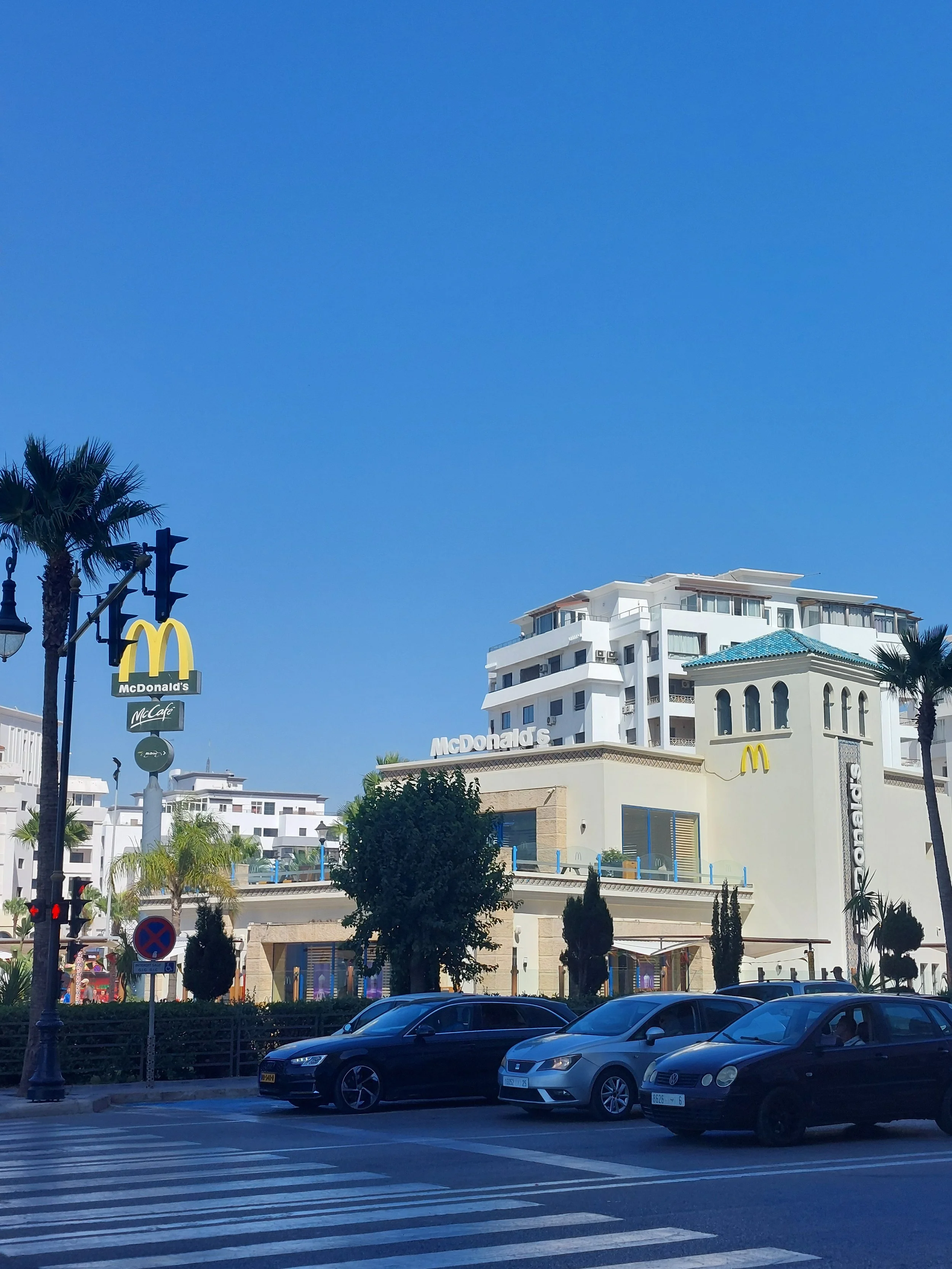
A branch of McDonalds in Tangier's upscale marina area
Disembarking from the train in Tangier, things look ordinary by the standards of Moroccan urban architecture. Although French buildings are not concentrated in a distinct ville nouvelle like other cities in the country, the divide between traditional and colonial architecture remains noticeable. Drinking mint tea with too much sugar at the Gran Café de Paris across from the beautiful French Consulate, featured as the backdrop in the James Bond film The Living Daylights, you reflect that tea here is double the price compared to other areas in the city. Although the medina feels safer and more integrated than elsewhere in the country, the colonial divide still feels tangible.
Tangier is the site of a locally planned development project to turn the coast into the image of global capitalism. Here, branches of McDonald's, Burger King, Puma, and Starbucks remain, catering to international audiences even as these companies lose business across the Islamic world. Tangier’s “marina” has wide boulevards like the French streets of elsewhere in the country, white buildings evoking the stuccoed aesthetic of older colonial construction and art deco designs in the interior of new, modern hotels. The parallels are hard to miss. Despite the end of imperialism, the West continues to be perceived as a cultural aspiration for Moroccans, contributing to European-style architecture becoming the default for new developments. Although planned and funded by Moroccans, this visually enforces the same divide between elite European-style areas and more economically marginalised local districts. As you walk down the corniche, you reflect that, whilst the French may be long gone, their architecture is here to stay.
Paris’ rule over Morocco ended in 1956, but its legacy endures. The physical divides between villes nouvelles and medinas mirror broader socioeconomic divide that remains in the country today. This reality raises a pressing question: with Morocco continuing to develop towards Western standards and aesthetics, should we see this as development, or has the legacy of French-style architecture superseded traditional Moroccan designs? The answer lies in how this is approached by Moroccan urban planners: continuing to develop to Western designs risks reinforcing colonial hierarchies, but a full return to tradition may neglect contemporary needs. A promising path is a hybrid of traditional designs integrated into modern architecture, such as the new generation of Moroccan train stations like Casa Voyageurs, the main station in Casablanca. This station has new, modern platforms built to Western standards, all under a mashrabiya roof, fusing intricate Islamic art with modern Moroccan designs. The future of the Kingdom’s cities will define whether these colonial shadows fade, or simply change shape.