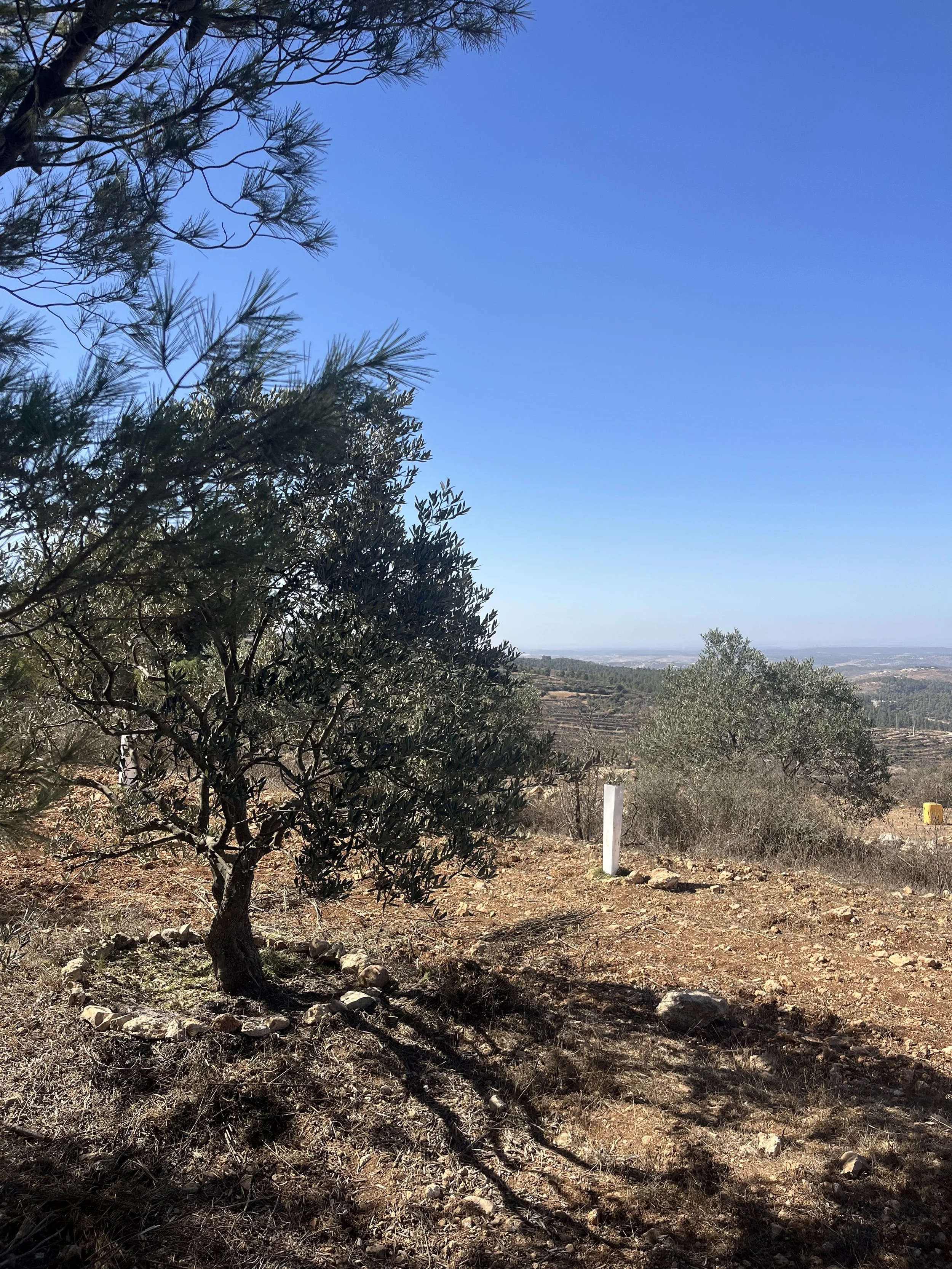
An olive tree on the Tent of Nations farm, Image belongs to author.
At the end of October, I took part in Palestine’s annual olive harvest (موسم قطف الزيتون). Enriched as it is by the prevalence of community, culture and history, the harvest marks a key event in the calendar. Whilst the oil, soap and wood produced here are important for Palestinian livelihoods, the harvest also stands as an expression of peaceful resistance to the occupation.
The harvest traditionally commences after the season’s first rainfall, but this year’s October skies were still stubbornly blue. On our arrival, most of the olives had already been picked so we were tasked instead with re-mulching the trees, (less picturesque than olive picking, but crucial to the tree’s health.) The task entailed surrounding the trunk with wood chippings and cuttings to keep moisture in the soil and prevent weed growth. Admittedly, my mulching experience is not extensive but I was pleasantly surprised that we were using what had previously been pine trees. Filling each wheelbarrow with the piney scented chippings, I could smell December, and considering we were only a short distance from Bethlehem, thoughts of Christmas felt rather fitting.
For both Palestinians and Israelis, many events of commemorative, religious or cultural significance are marked by violence. The olive harvest is no exception. It has been threatened by a much graver pest than those of weeds or climate change: settler attack.
The history of such attacks is not a fresh one but in recent years the situation has worsened considerably, filling our news feeds with incidents. The week of my visit to the farm, a video bearing witness to the beating of an elderly woman opened the eyes of many to what has been occurring in the West Bank with total impunity.
But what happens when these cameras stop recording? When we have seen the clips and statistics and reports twenty times over? When the activists and journalists head home? How do Palestinian families wake up every morning in the face of such a persistent threat? The Nassar family’s farm (the Tent of Nations) offers one answer.
The Tent of Nations farm sits atop a hill just 10km southwest of Bethlehem in the West Bank, overlooking the village of Nahalin which spills down into the valley. The five hills surrounding Nahalin are all occupied by Israeli settlements, including those in the Gush Etzion settlement bloc. The settlers rapidly build and build, their settlements creeping down the hill towards Nahalin. Less than one kilometre of no man’s land remains. The natural and dreaded assumption is that the village’s hill, the Nassar’s farm, is the settler’s next building project.
This assumption is not unfounded. The settlers have already cut roads across the Nassar’s farm, blocking access to 15 acres of their own property, burning and bulldozing their trees and beleaguering them with incidents of aggression. Damage costs are more than €150,000. Recently, an outpost housing five families in fully fitted homes was constructed only feet from their fence. This threatening gesture did not require the additional vocal threats that were hurled at a few volunteers the day of my visit.
Despite the family’s retention of the original land registrations and deed documents, in 1991 the Israeli administration declared their farm as “state land”. Thus, for the following 37 years, the Nassar family has been traipsing between Israeli Military Courts, the Appeals Committee and the Israeli Supreme Court in order to re-register their land. Restrictions on Palestinians’ movement make these journeys time-consuming and cumbersome. Around Nahalin, military gates, flying checkpoints and road closures make leaving and entering the village a challenge. Sometimes, these restrictions seal off entire communities without warning; pre-planning is rendered impossible and progress regarding both the individual and the community may be unexpectedly halted. Planning ahead was a freedom I had always taken for granted before I came here.
Despite these legal and physical injustices, the Nassar family chooses to build bridges through creativity, education and sustainable agricultural projects. From painting to constructing compost toilets, the Tent of Nations invites marginalised locals and international volunteers to share in their transformation of the community’s pain into sustainable productivity.
Here, hope is not abstract; it is planted, watered, and harvested every day. Every tree planted and every visitor welcomed affirms the simple truth that love is stronger than fear and that peace must begin with how we live, even under occupation. - ToN
Their God-rooted faith inspires an exceptionally humble and forgiving ethos. The farm’s four guiding principles are testimony to this: a refusal to be victims, a refusal to hate, acting upon faith and a belief in justice. Their refusal to blame any but injustice for their hardship is a true testament to these values and is remarkably refreshing in a situation steeped in blame. It makes me rather sheepish to recall how easily I turn to blame in my comparatively easy life.
Whilst pain and exhaustion are unavoidable, the Nassar’s channel them into physical reconciliation with the land, which itself stands at the centre of the conflict. Before visiting the farm, I had not appreciated the psychological feat it must be to love such a politically loaded patch, to continually care for land which puts you and your family at risk every day, with no authority to protect you.
In connecting both locals and volunteers with the land, they remind us all that love outstrips injustice. In reconciling with the soil, the trees, the olives, they are rooted and united in the service of the environment, whose future we are all responsible for. The progress of their sustainable projects is a huge achievement under the thumb of such a harsh system.
Rutger Bregman, the speaker of 2025’s Reith Lectures declared: “These lectures are my attempt to explore how moral ambition can help us face the challenges of our age.” His Moral Revolution calls for small-scale change. In the face of such injustice, stripped of opportunity and rights, the Nassar family refuse to be enemies or victims. Instead they choose to shape a positive future with their own hands. If a moral revolution begins modestly, then the Nassar family are nothing short of revolutionaries.
We believe that peace with justice can only grow from the bottom up, like an olive tree. - ToN
As a small family organisation, the Tent of Nations relies on the support of international awareness, visitors and donations. As their situation in the West Bank continues to worsen, international presence is more important than ever before. The farm welcomes both short and long-term volunteers; I can guarantee that if you wish to visit them, you will be in excellent company and, most importantly, extremely well fed!