Image belongs to author.
When we arrive, I am acutely aware that it is English, without translation, that welcomes me: there is no merħba (welcome in Maltese) that greets us. The streets and road signs bear their names in English too. In spite of gaining independence in 1964, Malta has retained a 99% English language fluency amongst its people. 62 years later, Maltese is still alive, and common, but so is English, and for complicated reasons, its presence is unlikely to change.
In some sense, Malta is a place of birth. A reference point surrounded by the stellar blue Mediterranean. Ħaġar Qim stands, foreboding on the hillside; the world’s oldest man-made structure. It has a dreamlike quality, stone so orange, rock walls so thick and impressive: a reference point from which to place all other archaeological sites. The independence monument stands large too, at 8.5 metres, and in its own way symbolises rebirth, a new sunrise descending upon the land.
But there is England too, staining like a teabag: English chain stores, flags, churches, and people. And it is undeniable how modern Malta has been shaped by its colonial past. Empirical shadows are complicated, so is guilt, so is blame. There are strong feelings that stretch and stretch across the Mediterranean from the descendants of both sides. But it is true, in Fort Rinella, in Victoria Gate, in spite of Malta bearing and birthing her landscapes, over and over, in each iteration, England has persisted.
Image belongs to author.
We drive down a curving road carved into the mountain, overlooking the sea. There are flat-roofed houses carved out in sand dune yellow brick, with balconies just big enough to see the sea from. The smell of salt, and some intermingling of spices, is so vivid as we drive down the highway. The world is so loud here, so abundant, so bright, tinged with a hazy yellow filter that promises an endless summer. The green plains stretch beyond the horizon and trees sway softly playing with the sun. The colours, the cats darting in and out of shadows, the smells, all evoke profound nostalgia. It reminds me so intimately of Egypt, of Alexandria, and also the outskirts of Cairo. I live my life in English, yet like Malta I am torn between two linguistic worlds, English and Arabic. I am half conquered, half conqueror. And yet, none of it at all. I am half North African, half American, yet British in feeling and through this iteration, I am displaced. But here, in this place, this beautiful place, draped in the Mediterranean ocean, is an island harbouring my mother tongue, English, alongside its own Maltese, with an architecture exceptionally reminiscent of the colour of my pyramid heart.
Malta is certainly unique: it has a rich language, culture and cuisine of its own – rabbits, for instance, are a staple. The language is a vibrant blend of Arabic, Italian and other Romance tongues. The lifestyle is community focused, with deep-rooted Roman Catholic traditions. In essence, Maltese culture is deeply blended, reflective of a long history of foreign rule, predating the British. And in this way it is at the cultural and linguistic intersection of two continents. A mode of life carved out in the shadows of Europe and the lights of North Africa. And I feel that in some sense, I too have become my own incongruous island of English, Egyptian and American, food, religion, and language.
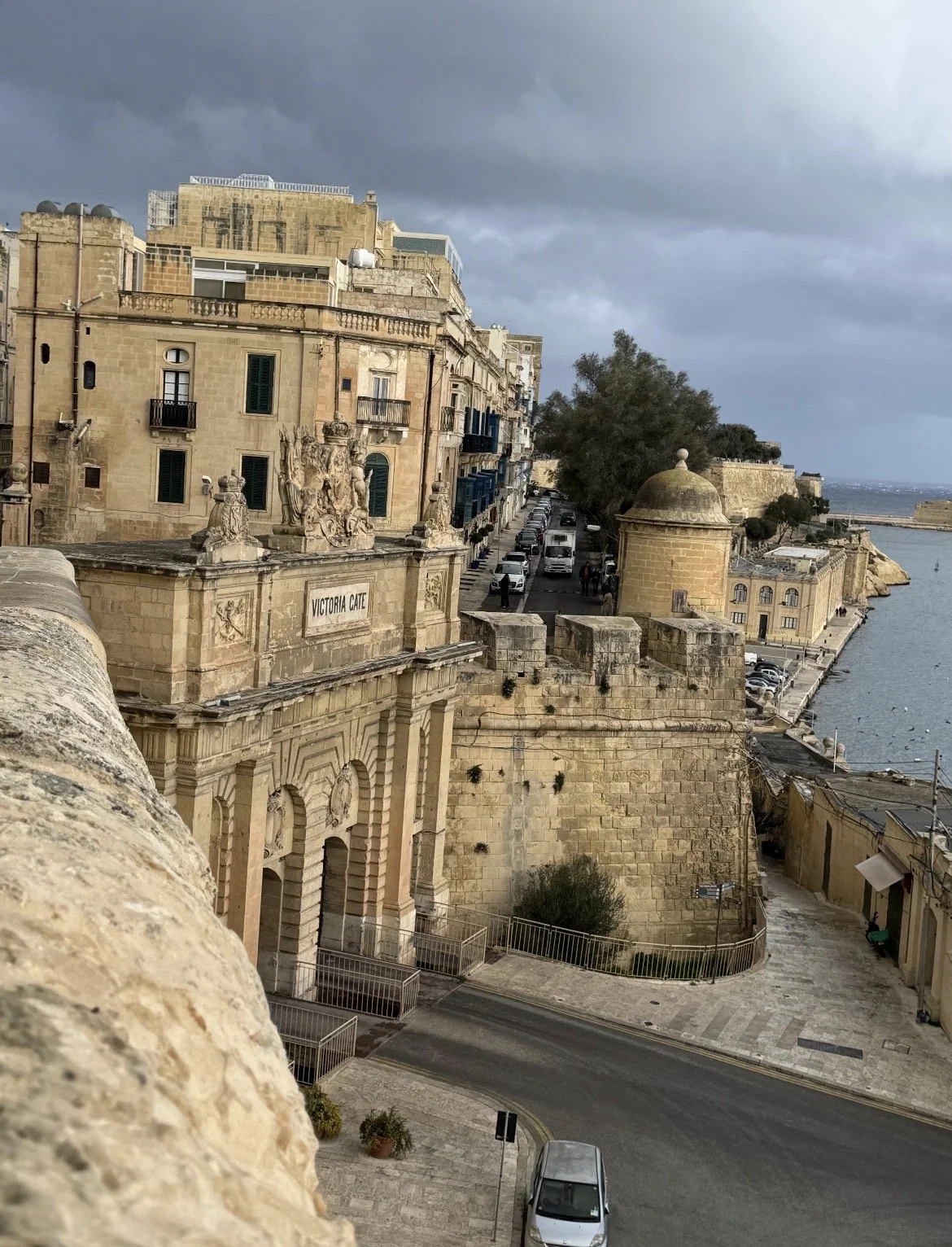
Image belongs to author.
I am sitting on the sand of Comino, home to Malta’s blue lagoon, and it is January. There are Venezuelans in the water across from me, laughing and talking with us. There are British Muslims on the shore. And though the lagoon is blue, a colour which none of us are, it wraps itself around us all, and whispers that it is January, and in some places it is not dark.
There are all kinds of people in this world. And as I look across this small boat, which takes us from Comino to the mainland, I see most of them: I see three friends, asleep with their feet against the railing, a young girl full of so much joy and a mother full of pride. And I turn and I see my love, watching me watch the human condition. And I realise that is all we are, observers. And these islands have served as an observation point, nestled between continents, from which to gaze at how humankind has manifested itself for thousands of years, how similar and different people have blended language, and culture, and worship – and ultimately have loved.
I have learnt how to love in many languages. And yet I am ignorant in so many more, and there are many languages I do not know exist. And because of this ignorance, there are many stories I cannot carry with me, so many modes and mechanisms of the human condition that exist “somewhere” beyond my reach.
Although, I am not sure I can define anywhere as being somewhere. “Distinct” is hard to pinpoint. Everything has a relation, a similarity, a reference point to something else. Otherness is hard to create, and hard to lose. Is it simply geography that makes us identify with one tribe, or is there something more that tethers us to a certain crowd? I think it is human to feel distinct. It is human to feel so wretchedly different. In fact, I would argue it is the most shared feeling of the human experience.
I am a mixed being, with mixed feelings, but I know that people and places can be bridges: an island in the middle of the sea can unify British colonial, European and North African identity, yet simultaneously mirror none of them, for it is its own. I bear Britain, North Africa, America, and yet none of it at all, for I am my own, shaped in the shadows and lights of North Africa and Europe, like Malta itself. And we both have a unique story to tell.
And it is here in this singular place that I welcome in another place, time, and people: a story to hold, and a place to remember.
I find the Merhba sign as I leave the airport.