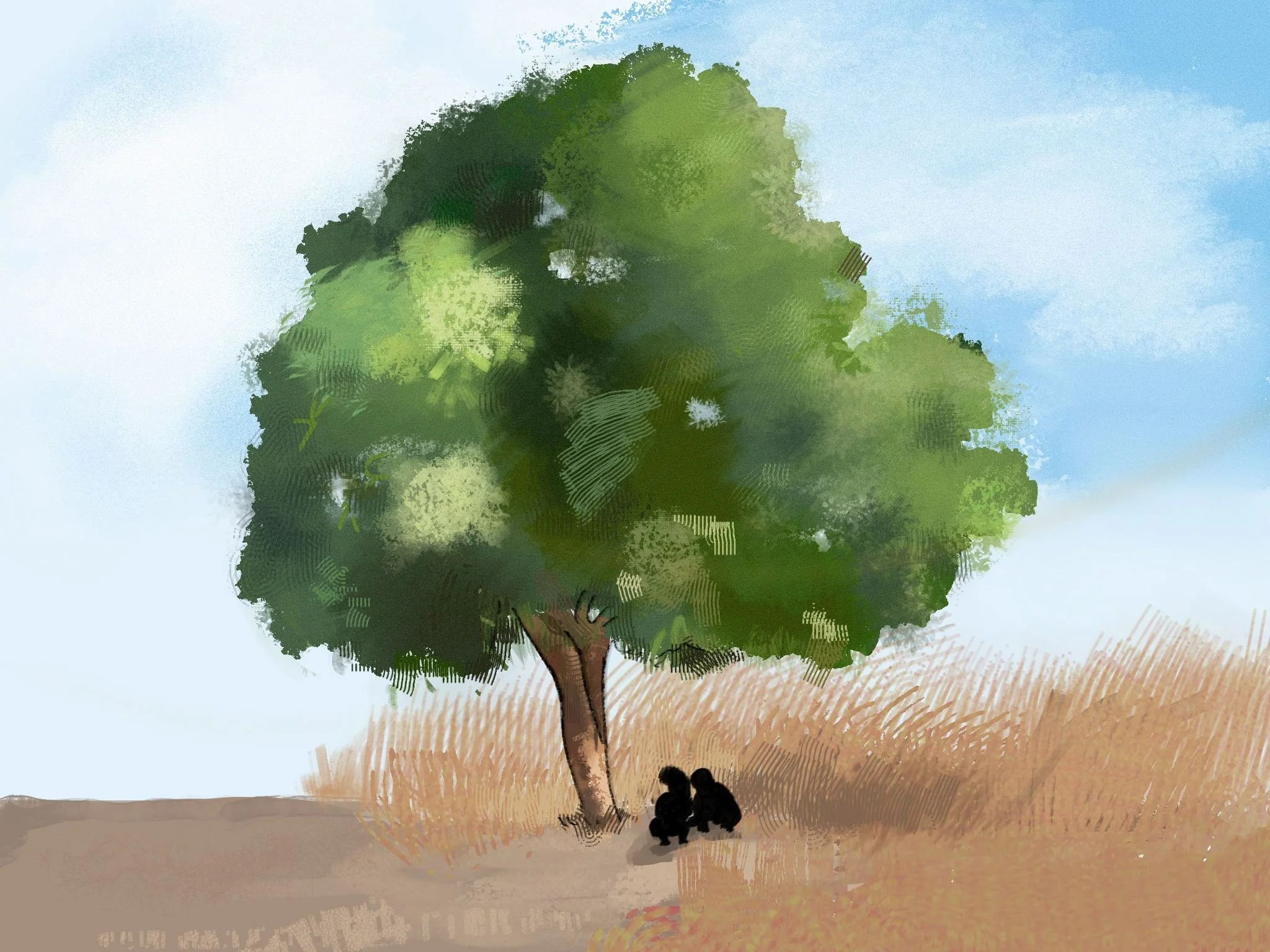
Original illustration by Rachael Aina
August 5, 1967
Chidiebere.
The Sisters say you have joined the fighting. I suppose that is fitting for you, Chidiebere, the one who always treated life like a competition. Always pushing me aside to snatch the first piece of meat from the pot or racing me to the end of the street by the sickle-shaped mango tree. Those moments seem so long ago and yet I wish I had cherished them more deeply. Your name means God is merciful. Sometimes, before bed, I whisper it slowly, tracing each syllable like a prayer, as if saying it aloud could somehow bring you back. Chidiebere. I hope God will be merciful to you now.
The school is quiet – just me and a few girls remain. The Sisters have been kind to me and are trying so hard to maintain a sense of normalcy. Truthfully, it all feels like a parody. Like they’re characters in a play and everybody knows it but them.
It’s strange, this quietude. At times it becomes paralysing, wrapping itself tightly around my neck to the point where it’s difficult to breathe. I feel so helpless sitting here in this convent, knowing that you are out there. Knowing that Nsukka, our home, is gone. Knowing that mother is alone. Knowing that father is dead.
I often pray that God is merciful to you even though I was not. Do you remember when father caught you at Obinna's junction? He beat you terribly that night while mother wailed helplessly. And I remember your face: steel-like, unflinching. It was the first time I genuinely felt fear toward you because I knew that you knew I was the one who told him. Since I found out you joined the fighting, I have been wondering how I would be able to keep on living if you died. But then I realise, on that night, hadn’t I already watched you die?
Growing up, you were better than me at everything and I resented you for it. Though you were my junior, mother constantly compared me to you.
"Why can't you be like Chidi?"
"Why can't you bring back good marks like your brother?"
"Nne, they should have born me Chidi before you."
So, when I saw you laughing with Obinna's gang I thought to myself, I will show our parents the true colours of this Chidi they so adore. And yet, seeing you get beaten like that brought me no joy at all. That hatred is still there but now it is aimed at myself.
They say hatred breeds hatred. Chidiebere, please do not hate me.
December 9, 1967
Chizaram.
Your name is deeply ironic now. God answered me. Well, I know you will never answer me, seeing as there is no way to send this letter to you. But maybe God will answer me by granting us success in this war. Though I doubt it. They have finally allowed me to train with a rifle. It's old and the trigger jams if I pull it too hard, but still – it is better than a stick. There is talk that the men on the other side have Sterling submachine guns and actual rifles. They say those men are better armed, better trained and have blocked off nearly all Biafran supply lines. Our last stronghold is Port Harcourt. It won't be long until that falls too – I'm sure of it. We are fighting a losing battle, but I guess that is fitting for me.
Training in these dark, cold barracks with nothing but sharpened sticks, empty stomachs and a shared sense of impending doom – it feels like a sick metaphor for my whole life. When I joined this war, it wasn't because I was convinced by some nationalist dream of freedom, neatly wrapped in half of a yellow sun. It wasn't even because I saw the other side as enemies. I joined because if this really is a losing battle, then I might as well go out with some dignity, right?
When I think of home, I picture mother with her brows furrowed, pounding uziza seeds in the mortar while I watch, quietly sharing her sense of dread. That same dread which I now wear like a noose, stubbornly hanging around my neck. I barely notice it anymore. It steadies me when I hear the shells bursting too close outside or the quick succession of feet tearing through the underbrush. Perhaps it was the noose around mother’s neck, now passed down onto mine. She was always so busy with the housework, her hands constantly moving, her head always bowed in the presence of father. I think I envied you. The way you seemed to sidestep that oppressive dread so easily. How you could move through that house untouched, unbothered. That must have been nice. You could just be.
The lamp will soon go out. Wherever you are, I hope you are well.
May 26, 1968
Chidiebere.
They have taken Port Harcourt. That is what Sister Nancy told me last night, nervously fingering her rosary while averting my gaze. That anxious expression on her face reminded me of something you said years ago. It was when you were about twelve and clearly had been listening to too much of father and uncle's political arguments. You came into my room and asked me, “why do the white people think they know more about Nigeria than us?” I didn’t know what you meant. But now with the Sisters constantly hovering over me, suffocating me with their prayers and incense and supplications, I just can’t stand the ceremony of it all. I know they mean well when they encourage us to ask God for peace, but I can’t take them seriously when they don’t even have to be here. I wanted to ask Sister Nancy why she was telling me this instead of going back to Britain and demanding that her leaders stop this nightmare. I wanted her to go back and show the world that Biafra is dying, that our children are being starved. I want her to demand that the world see us. But instead, her and all the other Sisters are still here, ushering themselves into our dorms to announce the next headless body found, the next town under siege, the next clinic populated by babies with stomachs swollen from kwashiorkor. I know my anger is misplaced. I know that without the Sisters sheltering us like this, I might have been the next news headline. I just hate not being able to do anything.
Whether I live or die is no longer a question that concerns me. My only fear is that you will die. Actually, what scares me the most is the thought of you dying without knowing how truly sorry I am. I am your elder sister and yet I hated you with the fury of a thousand scorching suns. And now, as I sit in this lonely room, with Biafra and its false promises of hope and glory crumbling all around me, that hatred inside me has collapsed into nothing but emptiness.
Maybe this is God's judgement. I sound like Sister Beatrice now (you know the one I told you had that funny walk?) but unlike her, I'm not referring to this war. I’m saying I think I needed to be separated from you like this to realise how cruelly I treated you. Perhaps I needed all this pain to finally understand yours.
The only peace I pray for now is yours. In my last letter, I said you treated life like a competition but I’m starting to see that you’ve had to navigate life with your fists constantly raised. You had to learn to build an endurance that not even father’s brutality could break, so what more is a war to you? If anyone deserves peace now, it is you Chidi.
January 13, 1970
Chizaram.
I am thinking of that bended mango tree. The one at the end of the street, near Ogige market. Those mangoes were really sweet, weren't they? Sometimes, when I eat the pap they serve at mealtimes, I close my eyes and pretend it’s syrupy mango juice trickling down my throat. They stopped air-dropping food weeks ago, but I wonder – have you had the chance to taste a mango again?
Last night, I dreamt of that harmattan we had a few years ago and how, when it ended, I brought back four mangoes from the tree. Mother helped me wash, peel and dice them for you. They were so ripe and as much as I wanted them for myself, I brought them to your room instead. And I remember how you smiled. It was the first time in a long time that I had seen you smile. I hope, despite everything, you still get to smile like that.
This morning, they said that the General fled to Ivory Coast. He wasn't really the inspiring type. We will lose this war, undoubtedly. I knew that already. But maybe when all is said and done, I'll finally be allowed to just exist. Like you did.
Morale is practically non-existent among the men now. Our platoon has more than halved. On excursions, every few metres we are picking up the limbs of fellow men, picking up pieces of lives severed from their bodies. We gather their remains and write letters of condolence that will never be sent and will never be read.
I saw the corpse of a man who reminded me of father. In some twisted way, I am glad that, at the very least, he died at the start of this war. He doesn’t have to be tormented by the blood of innocent men as they cry out from the ground. You remember we used to call him Iron Man? He was as hard as nails, totally unyielding. It’s what got him killed in the end. His final moments replay in my mind every time I’m sure death is about to capture me in its snare: the night they came to take him, there was no fear in his eyes. He was completely unmoved. I wonder, when death finally does come to greet me, will I be the same?
My letters are beginning to pile up beside my mattress. They will never reach you but writing them is the only time I experience peace, even if it's short-lived. It’s the only time when that noose around my neck loosens, just for a moment.
Do you still pray? Does God answer you, Chizaram? When I had that dream about the mangoes, I'm almost certain that God was answering me. At least He is reading these letters.
It is getting late, they will order us to turn our lights out soon.
If, as the saying goes, history really is written by the victors, I hope whoever finds these letters will write mine: the story of a fighter-boy with a rusted rifle and a hunger for a life as sweet as mangoes.