Alexandria: City of Lonely Wonders
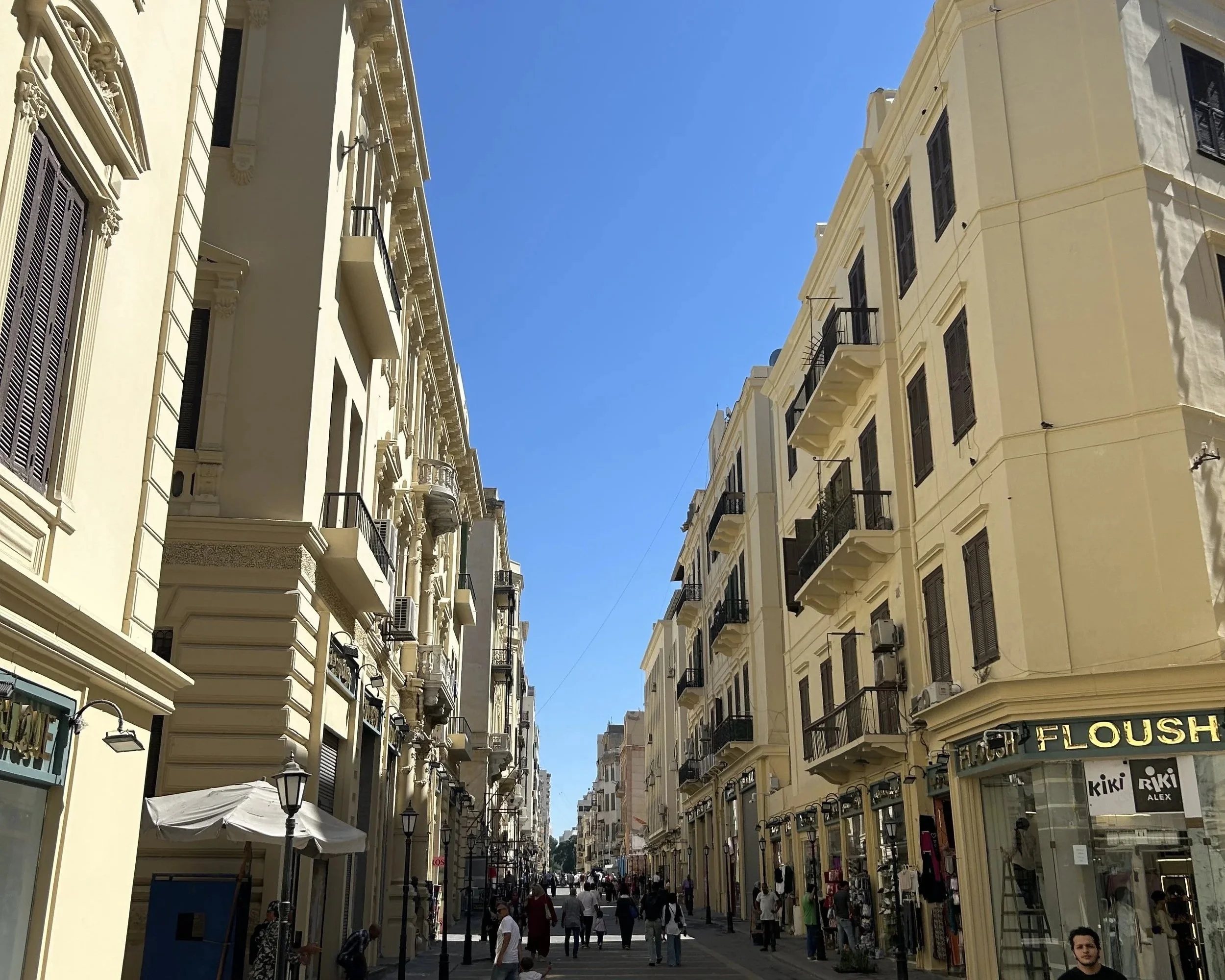
Prophet Daniel Street (Arabic: Shāriʿ Nabī Dānyāl), Central Alexandria. Image belongs to author.
Most travellers in Egypt follow one of two well-trodden paths. There is the easy, relaxing option: begin in Cairo, take your obligatory photo with the Pyramids, and then fly to Sharm el-Sheikh for a simple week of sunbathing and snorkelling. Then there is the slightly more intrepid option: from Cairo, go south to Luxor, the site of the Valley of the Kings and Tutankhamun’s Tomb, and perhaps even to Aswan, the pearl of the Southern Nile.
But even among these tourists, exceptionally few travel north to the great city of Alexandria; in my three days there, the only other tourists I encountered were visitors from other parts of Egypt! When my college tutor asked what I’d done over the summer, and I told him I had been to Egypt, even he, a Professor of Classics, was surprised to hear that I visited Alexandria: “I have only ever really thought of it as a Classical city,” he confessed. Yet Cleopatra’s city still stands in the 21st century, and its soil and streets contain every layer of history since.
My friend’s first comment on arriving in Alexandria was “this feels like Naples or Marseille.” Although I have been to neither Naples nor Marseille, Alexandria certainly bears the unmistakable signature of a city of the Mediterranean. In the centre of town, you will find broad, pedestrianised streets marked by cafés and patisseries; head north and you can take a tram along the seafront, up to a seafood restaurant or a Greek bar. Make no mistake, you are still firmly in Egypt: eat at the Mohammed Ahmed Restaurant for incredible falafel and fūl, or go east to the El-Qā’id Ibrāhīm Mosque from which the Call to Prayer rings out five times daily. Nevertheless, this is likely far from what most Westerners imagine when they picture the Middle East or North Africa. It is tempting here to reach for a clichéd phrase of “where East meets West,”but I am resistant to this notion. What cities such as Alexandria really represent is not a meeting of ‘East’ and ‘West’, but the reality that such a line of separation does not really exist at all.
Easy to miss, surrounded by tall buildings on a side street, is the most mundanely remarkable of Alexandria’s wonders: the Coptic Cathedral of St Mark. Egypt is home to over 9 million Christians, however this is not necessarily Christianity as you know it. Coptic Christianity parted ways with European Christianity in 415 CE, 500 years before the split of Catholicism and Eastern Orthodoxy, and over a millennium before the birth of Protestantism. Here, you will find prayers chanted in the Coptic Language, the final evolution of the very same Ancient Egyptian tongue which hieroglyphs transcribe. Though the last evidence of Coptic as a spoken language sadly dries up in the 19th century, it lives on as the Church’s liturgical language, akin to Catholicism’s use of Latin. In St Mark’s Cathedral, you can hear prayers uttered to pnoute – God, the very same word that the Ancient Egyptians used to address their deities.
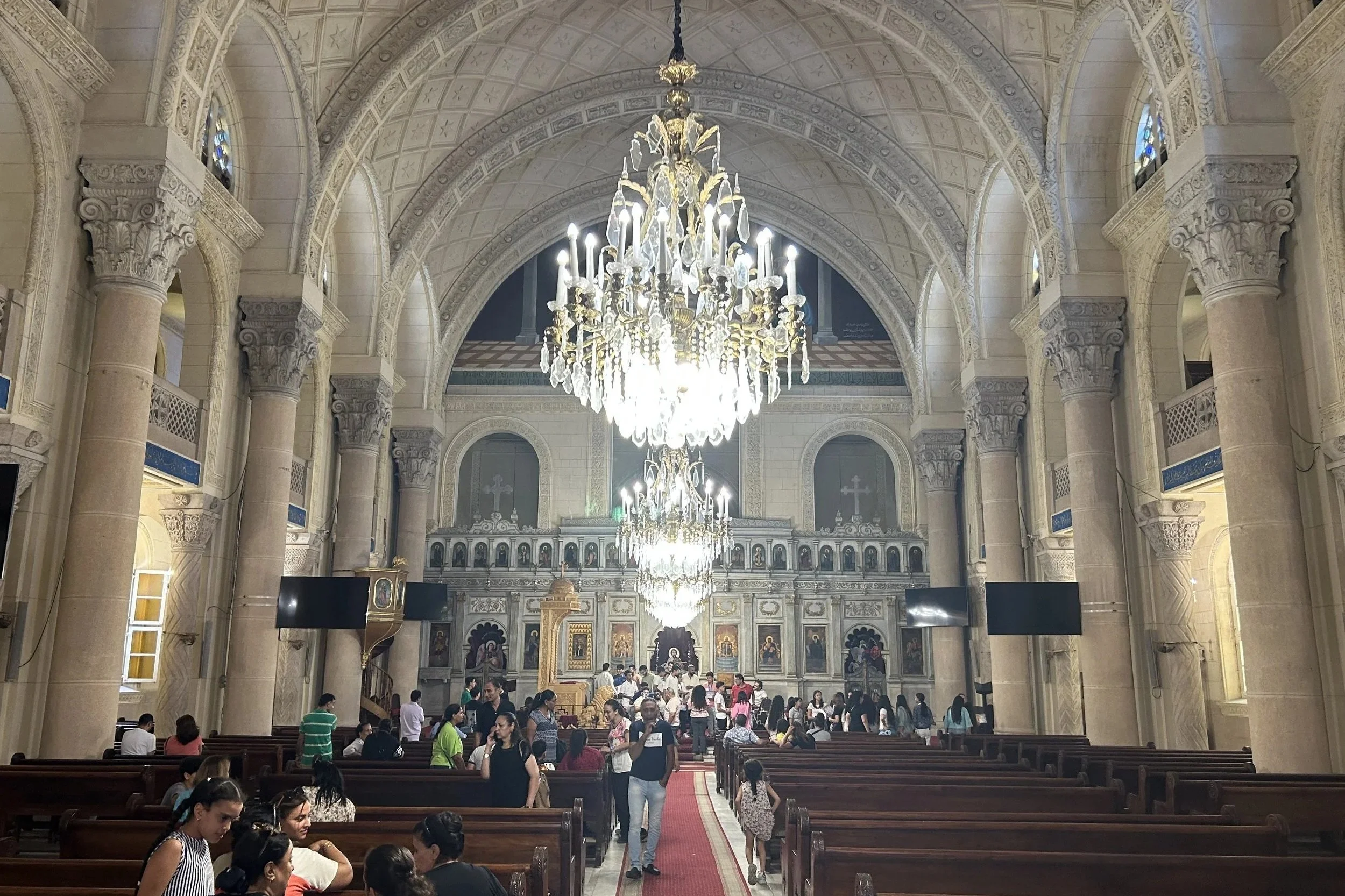
The interior of St Mark’s Coptic Orthodox Cathedral. Although the Church was founded in 311 CE, most of the modern interior dates to the 19th century, and was expanded in 1952. Image belongs to author.
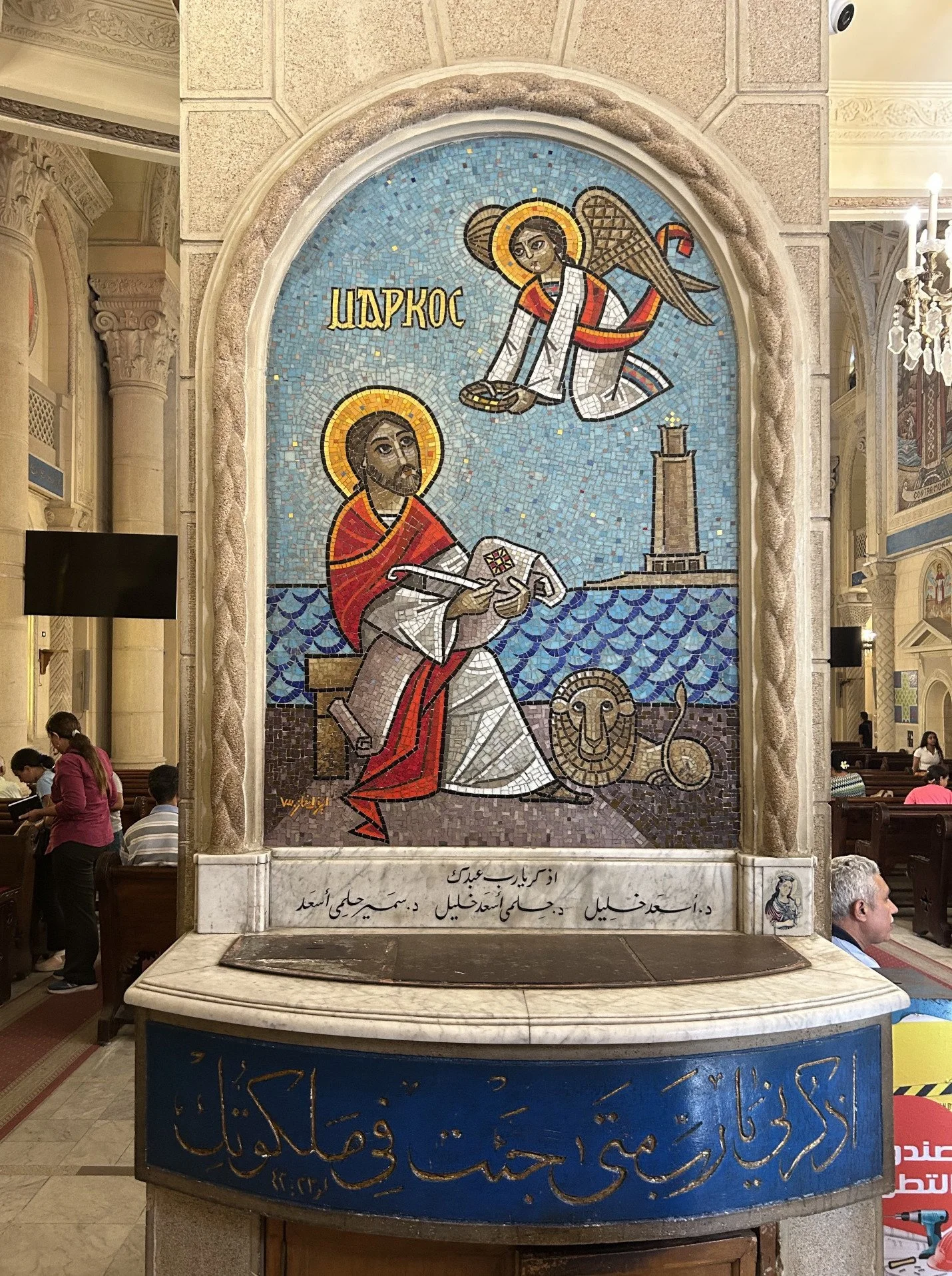
A mosaic of the Cathedral’s eponymous Saint. His name, Markos, is written in the Coptic script, which was based on the Greek Alphabet. The Arabic below is a quotation from Luke’s Gospel (“Remember me, Lord, when you come into your Kingdom.”) Image belongs to author.
Perhaps the most remarkable thing about St Mark’s Cathedral is that it is not a piece of history, rather it is a piece of the present. Whilst at the ruins of ancient temples in Luxor and Aswan, I would close my eyes and imagine what these places must have been like in their heyday millennia ago, St Mark’s requires no imagination. On our visit, we saw children playing football outside, a small school awards ceremony taking place in a corner of the vast main hall, priests stepping out of cars to greet families; the loud noise of life and community everywhere you turn. The Cathedral demonstrates the beauty of the everyday: where, for me, this was an extraordinary place, for Alexandria’s many thousands of Copts, this is simply their weekly church and local community.
Alexandria equally has no shortage of wonders that carry echoes of the more distant past. When flipping through the travel guide, one site in particular caught my eye: the Catacombs of Kūm al-Shuqāfa. Deep underground, these cavernous tombs bear religious artwork that represents centuries of history and a remarkable clash of cultures, with 3,000 years of heritage calling out to you from the black stone. The first great relief you will encounter depicts a traditional Egyptian scene of the gods Anubis and Horus presiding over the body of the deceased, weighing his soul. But take a closer look: the Egyptian gods are wearing Roman tunics and armour. Turn into another room, and you will see a relief of one of the most famous Greek myths, Hades’ abduction of Persephone, the alleged cause of the cycle of the seasons. These Catacombs date to the 2nd century CE: at this point Egypt had been a province of the Roman Empire for over a century, and before its conquest had spent the previous 300 years under the rule of the Greek-speaking Ptolemaic Dynasty, of which Cleopatra was the final ruler. These tombs exhibit an extraordinary blending of faiths, cultures, and worlds; and yet, we had this extraordinary place all to ourselves—not a single other tourist was interested in exploring this extraordinary piece of history beneath the earth at 3pm on a Saturday! Even the lady at the ticket booth had seemed surprised by our arrival—we had interrupted her reading the Quran, and I offered pious apologies in my best Arabic. By the way, here I will provide my one and only travel tip for Egypt: bring your Student ID! You can get discounts, often as much as 50%, on tickets for historical sites and museums. My friend had left her Cam Card at home, and it was expensive (and embarrassing) to buy one student and one adult ticket at every place we visited. Alexandria is undeniably a city of hidden gems, with some quite literally hidden beneath the surface.
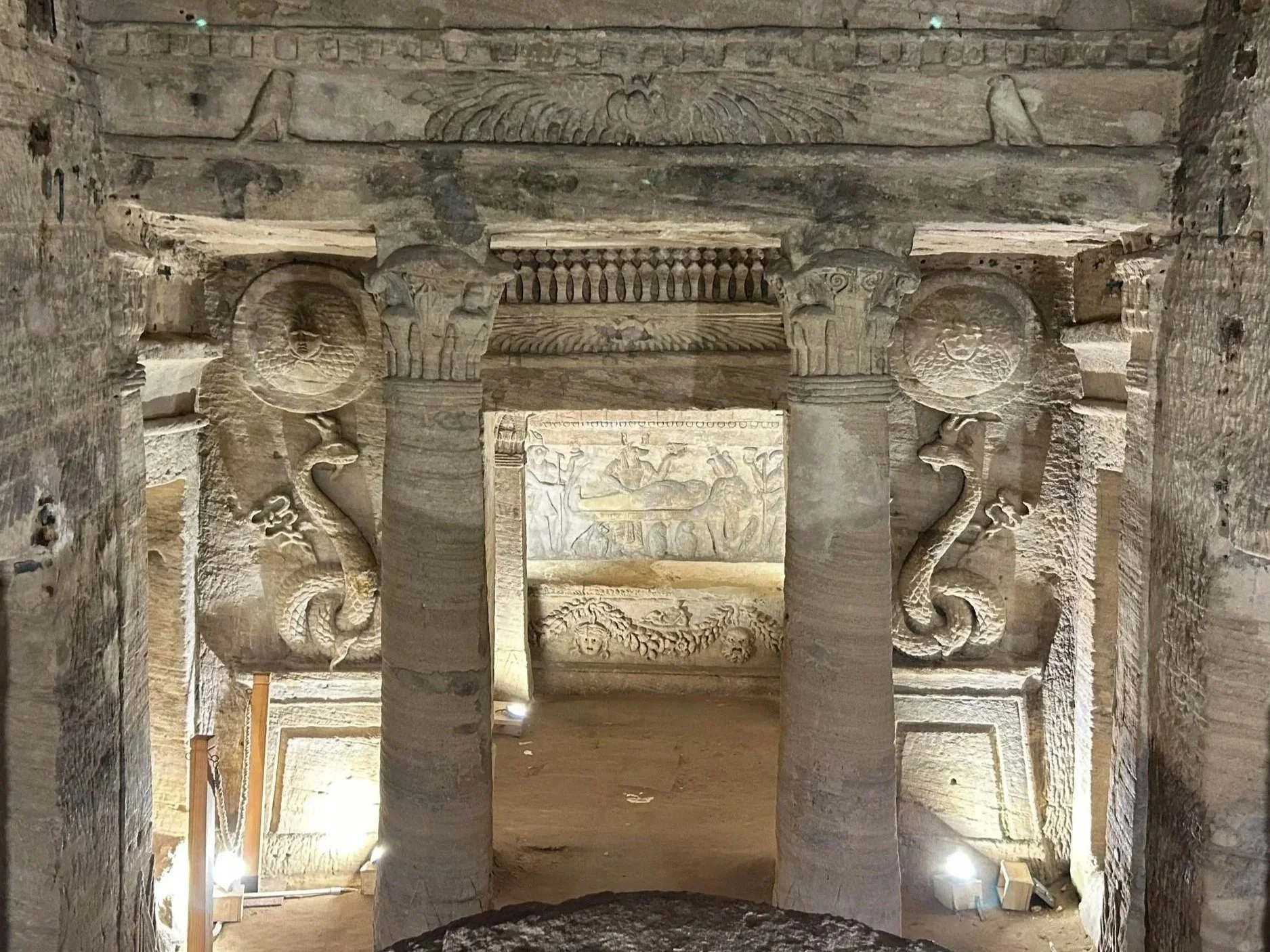
This is the view that greets you upon completing your descent to the Catacombs. The relief of the sarcophagus can be seen on the opposite wall through the enterance. Image belongs to author.
Any visitor to Alexandria should also not ignore the city’s fascinating modern heritage. A stroll down the shoreline will take you past a prominent statue of a man with a bushy moustache and a tall fez gazing out to sea, surrounded idyllically by palm trees and greenery. This man is Saʻad Zaghlūl, one of the heroes of Egyptian independence. Though Egypt was never officially conquered or colonized by a European power, Britain exerted a great deal of de facto control over the country from 1882 onwards in the so-called ‘veiled protectorate’. Zaghlūl, who was born in a small rural village yet rose to become an affluent lawyer, spearheaded an independence movement that united Muslims and Christians in a common Egyptian identity. For this, he was exiled to Malta in 1919 (his statue’s gaze is directed toward that distant island). This led to Egypt’s first great popular revolution, a precursor to the Arab Spring of more recent times, which resulted in Egypt being granted true legal independence in 1922, and Zaghlūl eventually became its Prime Minister in 1924. However, Britain retained control of the Suez Canal and substantial influence over Egypt’s affairs—leaving latent tensions that would rise to the surface in the Suez Crisis of 1956.
Beneath Zaghlūl’s statue is a woman with outstretched wings, her face angled sideways in the style of ancient Egyptian art. It is clear that the key to establishing Egypt’s modern identity was the reclamation of its ancient past, the Egyptian heritage that had been dug out of the sand by European archaeologists of the 19th century which was now finally being reclaimed by its own people.
Alexandria is a jewel of the Mediterranean. Not a lost relic of a bygone Classical Age, but a living city of extraordinary wonders. So, if you ever do find yourself in Egypt, and are overwhelmed by the busy cacophony of Cairo’s immense metropolis, perhaps you should take the £3 bus (or the £20 train) northward, across the lush green of the Nile Delta, to a city like no other that you may very well have all to yourself.