Gran Canaria: Where Continents Converge
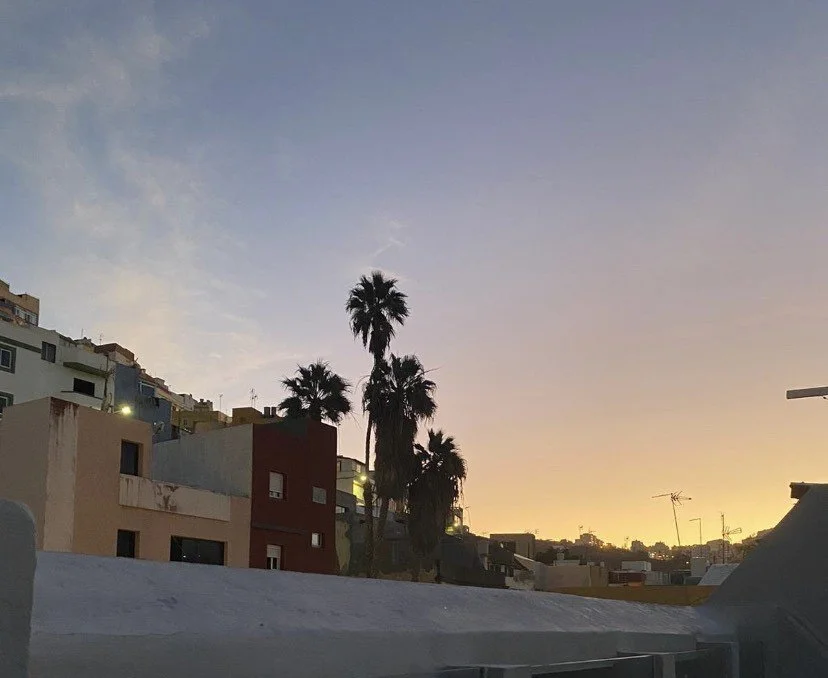
The sunset at Gran Canaria. Image belongs to author.
The lady on the bus from the airport to Las Palmas says “mi cielo” pointedly. I glance reflexively over my shoulder before I realise she is addressing me, a stranger, as “my sky.” I move out of her way and am thanked with “ohh, gracias, cariño” (“ohh, thank you, darling”) before — noticing I am travelling alone — she asks me where I am going and why. Within a couple of minutes, she has texted her daughter who lives in Vegueta and opened up her camera roll to show me which buildings offer the best glimpses of the city’s sunset skylines.
The bus then swerves to a halt and she skips off, nearly leaving her phone on the seat until I get up to give it back to her before she jumps off the bus. “Eres muy maja, mi ‘jita” (“you are very lovely, my daughter”), she says, and then she is gone. I am left to my playlist and the views of the volcanic, oceanic, and historic island of Gran Canaria, the emerald of the Atlantic. It takes me under an hour to discover that such verbal affection towards strangers is not only common but customary among Canarians, particularly women. Arriving in the pastel-tinted town of Vegueta, I buy sandals for €10 from Anna Lisa beside the bus station and the shopkeeper calls me “mi niña” at least four times in the five-minute exchange. The cleaning lady in the hotel I check into that evening repeats this greeting as we pass one another in the corridor. Although it is no different from a British lady calling you “love”, there is a sweetness and a slowness to the rhythm of island life here that I cannot help but savour.
I have booked this trip last minute, fuelled by the academic athlete’s high that accompanies the closure of a Cambridge term. I chose Gran Canaria as a two-day getaway for the tourist’s trinity of sea, sun, and surfing. I ended up entranced by the Old Town of Vegueta, touched by the kindness shown to me by strangers, and extending the trip by an extra night after being offered a second boat trip around the island’s coastline to see some of Gran Canaria’s resident bottlenose dolphins (the dolphins, alas, remained elusive both times).
What makes Gran Canaria so uniquely beautiful is that it embraces its contradictions and honours its liminality. Like its neighbours, it functions legally, practically, and linguistically as part of Spain, yet its location a stone’s throw from the coastline of Morocco positions it at the crossroads of two continents. Long before the Castilian conquest which introduced Spanish, still the island’s lingua franca, to Gran Canaria, the population descended from Amazigh peoples (the indigenous peoples of North Africa) of what is now Morocco. Geometric motifs in pottery and rock carvings of the island’s many volcanic caves are enduring embodiments of this heritage. Gofio is another.
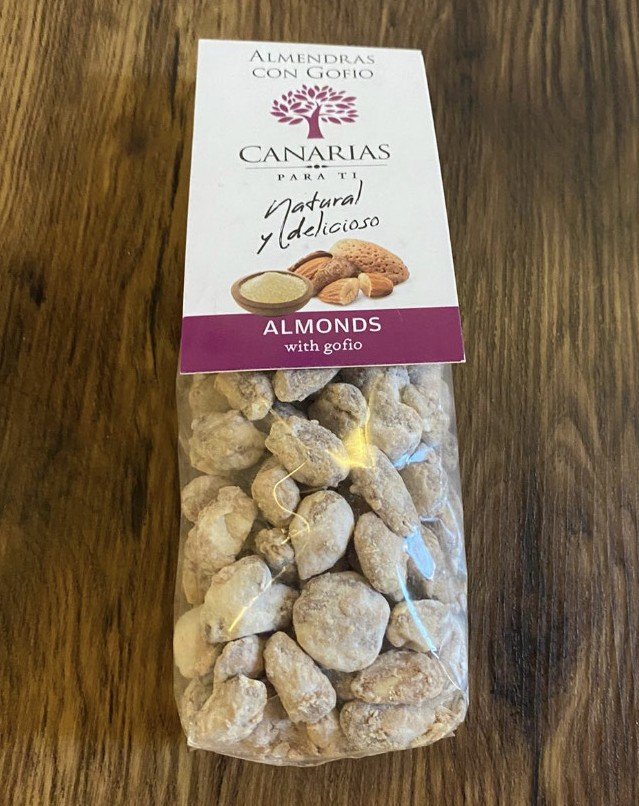
Gofio can take a wide range of forms, including as almond flavouring. Image belongs to author.
A delicious staple of Canarian cuisine, gofio is flour made from grains that are roasted before being ground. Traditionally, gofio was prepared using cebada (barley) and sometimes chickpeas, mixed grains, or occasionally wheat. After contact with the Americas was made, millo (maize) was introduced into recipes. As well as giving gofio a nutty, slightly bitter flavour, the roasting ensured a long shelf life and resistance to humidity and spoilage. This was perfect for pastoral societies operating in arid environments, as it required no oven and only minimal water to prepare, and gofio remains a simple, practical staple in Canarian kitchens today. Gift shops in Vegueta often sell gofio-dusted almonds as a Christmas treat, comparable to turón in mainland Spain, and the gofio flour symbolises both Canarian indigenous traditions and historic cultural fusions.
Many cultural fusions are far more recent. In particular, cyclical migration of Gran Canarians to the Caribbean, especially Cuba and Venezuela, in the 19th and 20th centuries have left an indelible mark on the island, not so much in its architecture, which preserves European colonial facades and even situates Casa de Colón (where Cristobal Colon stayed on his way to the Americas) among its streets, but in its residents’ language, gestures, and habits. The affectionate, endearing phrases addressed to strangers that I experienced on my first day on the island can be seen as manifestations of emotional expressiveness far closer to Caribbean than Iberian norms. Even Canarian speech, which shows strong consonant weakening and often aspirates or drops its words’ final [s] and [d] sounds, is linguistically close to Cuban Spanish. This reflects the cyclical migration of past centuries.
Yet it is the Maspalomas Dunes that cement Gran Canaria as a crossword between worlds. Within minutes of leaving behind a manicured resort, you will find yourself standing on Saharan sands in a mini-desert shoring the island. Until the mid-twentieth century, Maspalomas was largely empty land until Spain’s push toward mass tourism in the Franco era. It magnetised Northern Europeans seeking winter sun and relative freedom, even as a governmental vision of Maspalomas as a planned leisure utopia emerged back home.
Ironically for the Francoist regime, it was the queer community that sought its freedom here. The combination of climate, privacy, and tourism infrastructure made Maspalomas a place where people could experiment with identity long before that was widely accepted elsewhere. Maspalomas’ immense economic value as a tourist hub meant the regime was reluctant to risk its influx of foreign capital by drawing scrutiny to its repression of minorities, particularly in a space populated by tourists from democratic and liberal nations. Today, Maspalomas is home to one of the largest Pride events in Europe, while also being renowned for its exuberant nightlife throughout the year.
Between this living desert and the Atlantic Ocean stands the Faro de Maspalomas, limestone beige and towering as tourists encircle it. Before night settles, it casts its pearl-grey shimmer across the dunes like frosting. Shaded, moss-thick laurisilva rainforests brushed with mist stud the island’s northern coast and conceal the only coffee plantation in Europe, while volcanic caves bring Spanish locals into intimate contact with ancient Amazigh art on their walls.
But it is the sea itself, of course, that breathes life into the island, orbiting the pastel-tinted Vegueta and the silvered Faro de Maspalomas alike beneath the Atlantic breeze and the Mediterranean sun.
Image belongs to author.