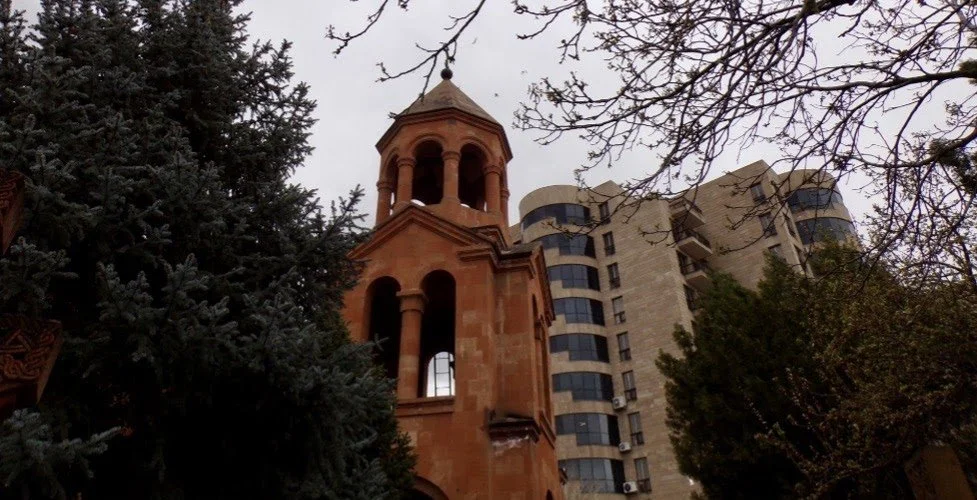
Saint John the Baptist Church, Yerevan (Սուրբ Հովհաննես Մկրտիչ Եկեղեցի) - all images are the author’s own unless otherwise stated
Yerevan is one of the oldest continuously inhabited cities in the world, dating back to approximately the eighth century BC,[1] and every era of its rich past is tangible in the fabric of the city. From the views of Mount Ararat, the mountain upon which Noah is said to have docked his ark, to the beautiful, if brutal, Soviet opera house that stands in the centre of the city, Yerevan is a patchwork of all it has witnessed.
This was instantly noticeable to me this April, when I, along with several course mates, visited Yerevan for a Russian language course. For me, the most striking example was found in a small garden containing a beautiful orange stone church and several traditional khachkar (see Lyra Browning’s article on Mother Armenia). Yet just outside this garden the unmistakable noise of modern Yerevan hummed and clattered with the dissonance of construction work and traffic jams while high-rise buildings loomed over it. A church from an era long in the past, in a city determined to build itself into the future.
The smell of incense was noticeable even before stepping inside the church, and inside, life went on as it presumably has for generations. During the short time we were sat at the back, several people, young and old, arrived, paused for a moment to pray, and left again. There was something distinctly authentic and habitual about their ceremony, as if they might stop by in this small church on their way home from work every day. Before leaving, we were told that with respect to Armenian Apostolic tradition we must walk backwards out of the church so as to never turn our backs on God.
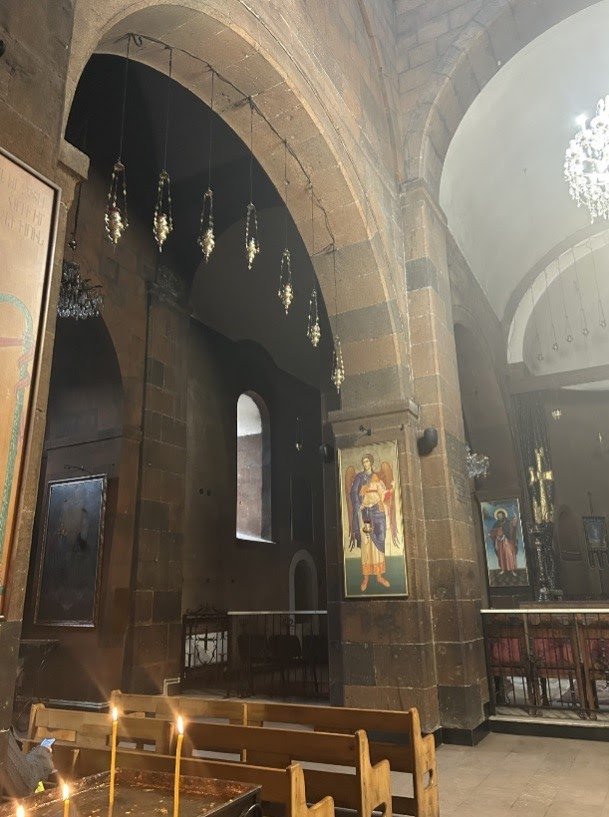
Interior of Saint John the Baptist Church
This sense of continuity is difficult to separate from Armenia’s national identity. Armenia takes considerable pride in its Christian heritage, the first state to adopt Christianity as its official religion, broadly dated to 301 AD.[2] The Armenian Apostolic Church is central to this history, and throughout our time in the country we were repeatedly reminded that it must not be confused as a branch of the Greek or Russian Orthodox churches, but is a distinct and ancient Christian tradition of its own.
This insistence on distinction seems to extend far beyond religion. Armenians are fiercely conscious of their history and culture and how it differs to their historical neighbours. Their alphabet, for example, created in the fifth century by the monk Mesrop Mashtots,[3] remains one of the most original and immediately recognisable symbols of Armenian identity.
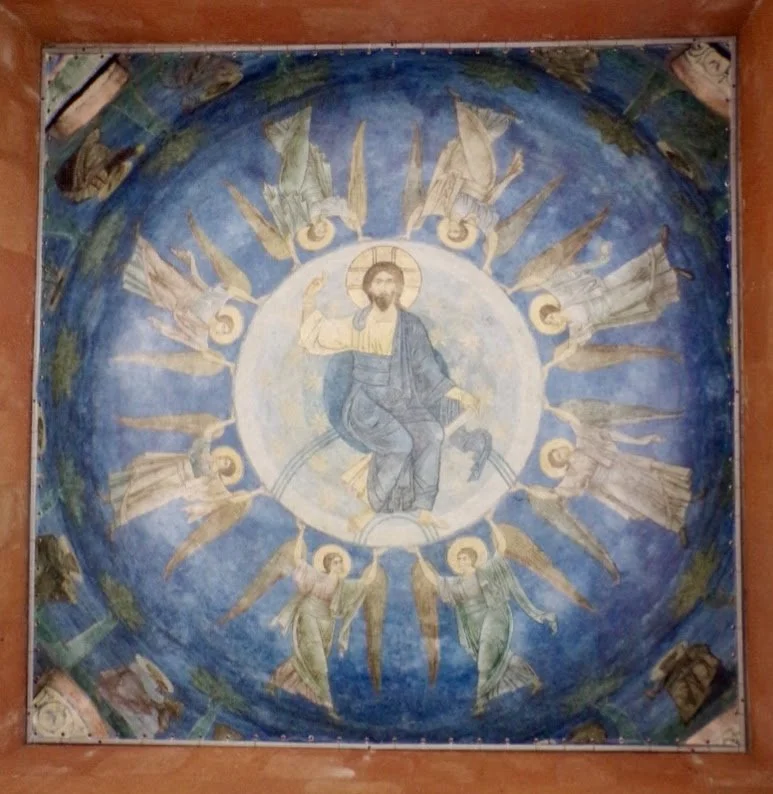
Painting of the Ascension of Christ, Saint John the Baptist Church
Yet for all the emphasis on what makes Armenia uniquely Armenian, it is impossible in the 21st century to experience the country, or its capital at least, without noticing how deeply its culture has become entangled with the rest of the world.
The church we visited was not tucked away in a carefully preserved ‘old town’, separated from the commercial life of the modern city. It stood in the middle of life, surrounded by change, and was still experiencing frequent visitation. Whether one sees this as chaotic town planning or charming integration is a matter of personal perspective.
Much of Yerevan seemed to be an open building site this spring. Roads were littered with potholes and roadworks, our taxi drivers swung unpredictably around barriers, regarding traffic laws as nothing more than a vague suggestion. The result of this insistent progression is a city where the old and new are impossible to separate.
This comparison could be drawn in the market too. Alongside traditional Armenian ceramics and hand-crafted chess sets were Soviet relics and rather more unexpectedly, Nazi memorabilia. Even road signs and advertisements tell the story of Armenia’s history. The distinctive Armenian alphabet sometimes appears alongside Cyrillic script, inherited from Armenia’s membership of the Soviet Union, while some use Latin letters, reflecting the country’s increasing connection to Europe and the wider Western world.
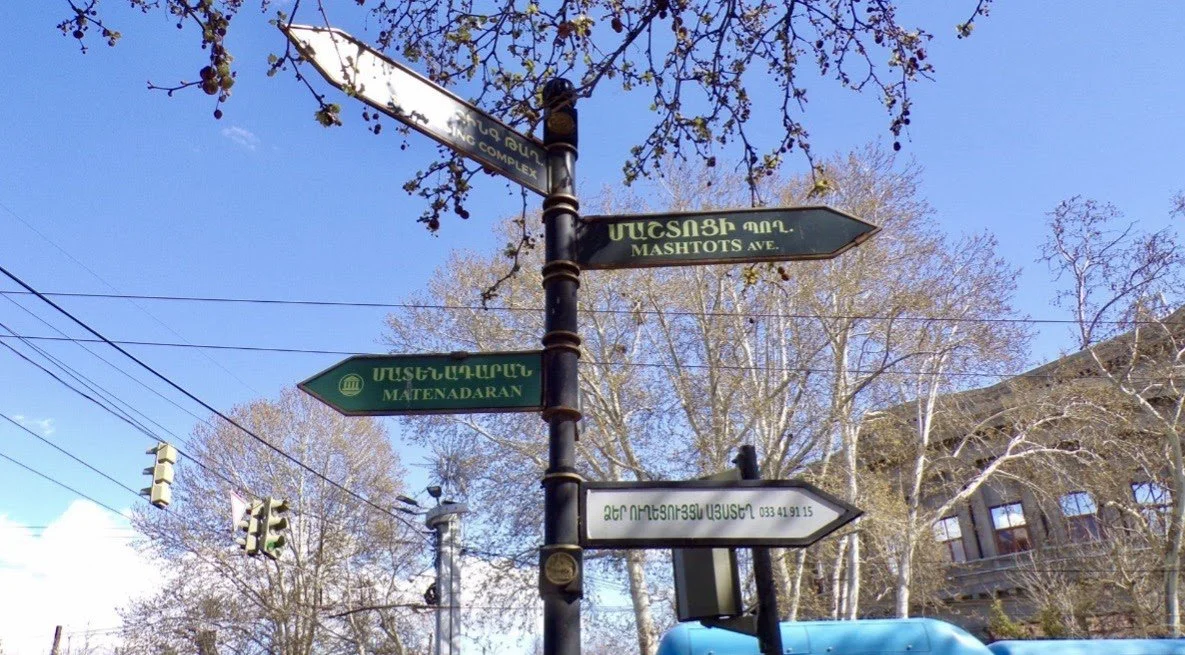
Multilingual street signs in Yerevan
After dutifully leaving the church backwards, we continued our walking tour. Our teachers at the Russian language school had placed great emphasis on the Armenian people’s knowledge of and respect for their culture. So, it was slightly ironic that our walking tour was led by two enthusiastic but chaotic, young, Armenian men who spoke very little Russian – the very reason we were visiting Armenia in the first place. They weren’t very reliable historians, telling us the church was ‘around 10,000 years old’, and they were far more interested in asking us about Central Cee and practicing their Scouse accents on us. But perhaps they were a more revealing introduction to modern Armenia than a perfect tour by an expert could have been. They possessed an instinctive familiarity with their own culture without attempting to present it as something frozen in time. If lacking in knowledge, they certainly possessed an admirable respect and pride for their cultural heritage.
Our sometimes-stern Russian teacher might not have approved, but to me it seemed rather fitting. Armenia’s churches, alphabet and history are guarded with an intense sense of pride, but they exist alongside constant construction and growth, Soviet remnants, globalisation and the endlessly shifting influence of the modern world.
When we left the church, we did so backwards. Then we turned around and walked straight into the noise of the city. This is true, too, of Armenia in the 21st century. A culture which is striding decidedly into the future, developing its infrastructure and its global relations, but refusing to turn its back on the past in doing so.
[1] https://whc.unesco.org/en/tentativelists/6809/
[2] https://www.christianitytoday.com/2026/01/first-christian-nation-armenia-history-book/