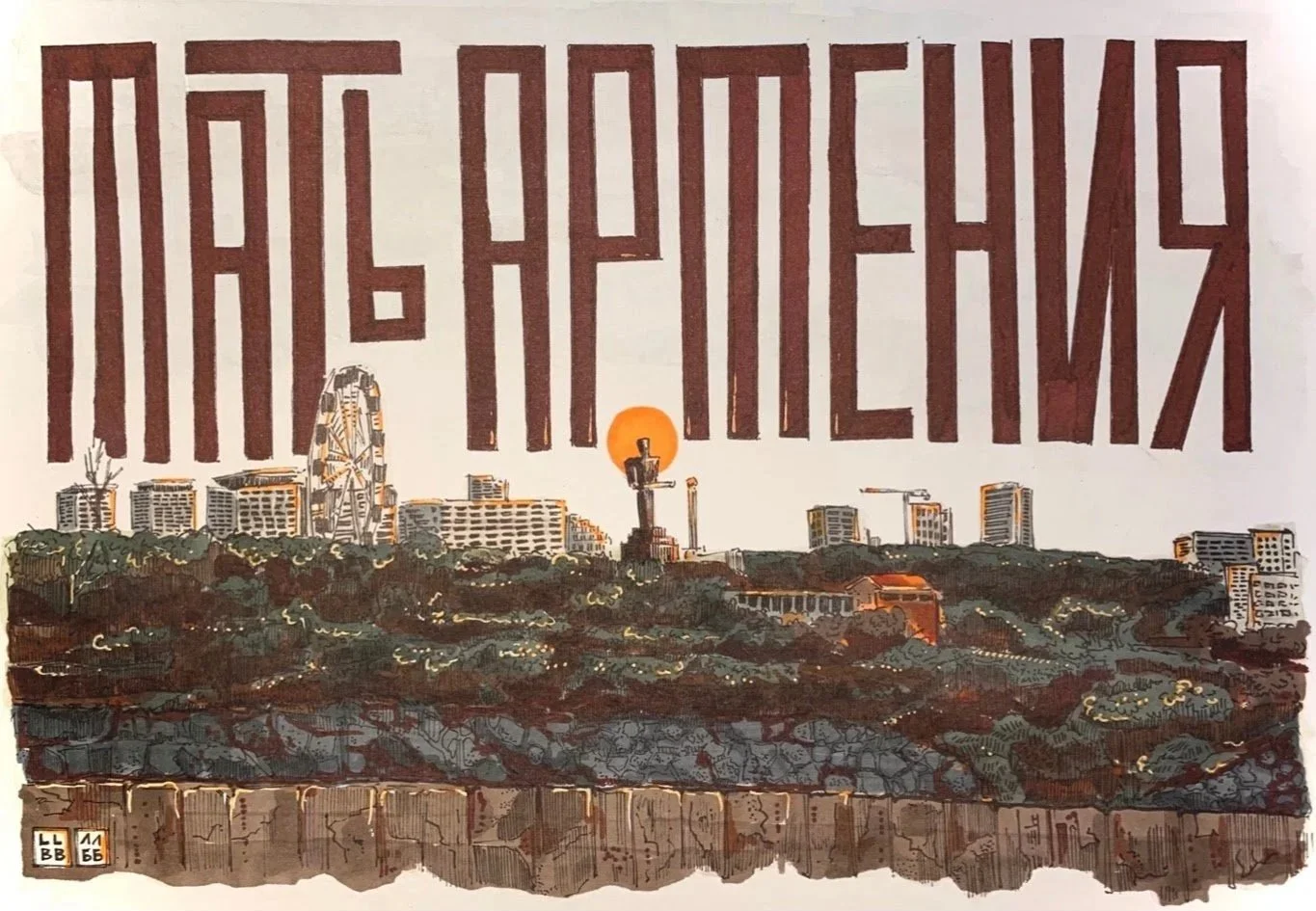
Mother Armenia - all images are the author’s own unless otherwise stated
This drawing of Mother Armenia (Armenian: Մայր Հայաստան [Mayrig Hayastan]; Russian: Мать Армения [Mat’ Armeniya]) started as a sketch I made during a week-long Russian language course in the country’s capital, Yerevan, earlier this year. Each day, our commute to the local university would pass under the watchful eye of the twenty-two-metre-high copper matriarch, who has towered over the city since 1967.
Who is she? The multitudinous ways of writing her name alone point to her plural personalities and pasts. Initially, it was not a mother but the Great “Father of Nations” Josef Stalin himself that stood atop the plinth.[1] At the time, the bronze Georgian was lauded as a masterpiece and stood taller than all other contemporary Stalins. After just twelve years, however, he was purged in line with Khrushchev’s policy of de-Stalinisation and discussions began about who could fill his massive metaphorical – and physical – boots. Eventually, sculptor Ara Harutyunyan was commissioned to fill the disturbing negative space left behind by the previous occupant. Harutyunyan found his muse in local teenager Genya Muradian, exaggerating her striking features in an attempt to capture the essence of strong femininity. [2] Muradian, now in her eighties, kept her modelling secret for decades, but in recent years has come to terms with, and even found strength through, her role as the face of the Armenian Motherland.
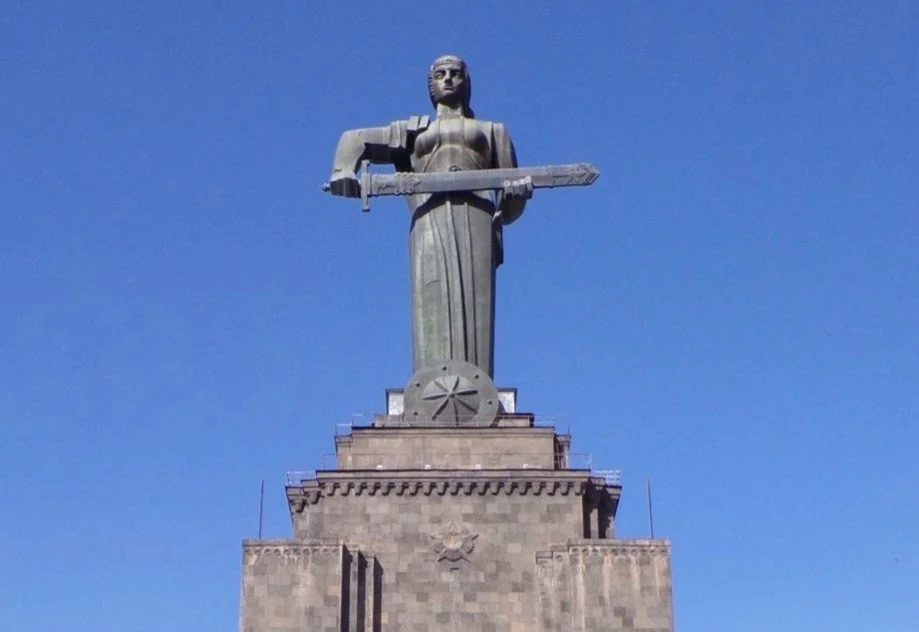
Mother Armenia: feminine power personified.
A quick Google search reveals that said stern countenance stands for ‘peace’, yet you would be easily forgiven for thinking the opposite. Mother Armenia wields a colossal sword, bicep tense as if ready to strike. Strewn at her feet are tanks, anti-tank missiles, and a fighter jet. The force of her gaze is directed due west towards Turkey, Armenia’s traditional enemy that is widely recognised to have committed genocide against the nation during the First World War.[3] Her base also houses a harrowing museum that documents the painfully recent conflict with Azerbaijan over the disputed region of Nagorno-Karabakh.[4]
The base of the monument plays perhaps an even stronger symbolic role than Mother Armenia herself. If we learned one thing at the Russian language school, it was that Armenians are fiercely proud of their Christian heritage. In 301 CE, the Kingdom of Armenia became the first state to adopt Christianity as its official religion, and the Armenian Apostolic Church has been hugely instrumental in the country’s cultural development ever since.[5] Hence, architect Rafayel Israyelian modelled the base on an archetypal three-nave basilica and borrowed motifs from the khachkar, a traditional cross-stone stele. This plinth, and the faith it stands for, has outlived dictators, survived the fall of socialism, and held fast in devastating earthquakes. But what of its future?
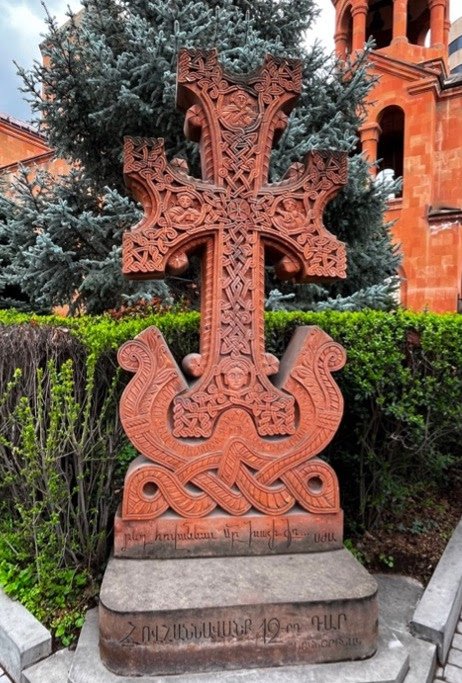
An Armenian khachkar (Armenian: խաչքար) decorated with characteristic interlacing detail. Photo credit: Mo Frankland.
In recent years, the statue has been neglected. This is in no small part down to the practical challenges of cleaning and maintenance, but it also owes to the monument’s complicated portrait of Armenia’s delicate history. The big, red, Russian lettering of my own portrait hints at how she is haunted by her associations with the Soviet past. She is almost lost in the skyline, standing smaller than the skyscrapers and looking out at a dark, fractured landscape. In an era of renewed conflict with her neighbours, Russian aggression, and growing environmental pressures, Mother Armenia’s identity is once again fragile and flexible, yet she remains haloed by the apricot-orange glow of a steadily – if cautiously – rising sun.
[1] As Graeme Gill explains in his article ‘The Soviet Leader Cult’, propaganda emphasised Stalin’s paternal role and depicted him as the ‘father of the great socialist family of peoples’. https://www.jstor.org/stable/193478
[2] In an interview with RadioFreeEurope, Muradian recalls being surprised upon the statue’s unveiling as Harutyunyan had given her a vast, imaginary monobrow. https://www.rferl.org/a/mother-armenia-yerevan-iconic-statue/31145539.html
[3] Turkey explicitly denies that the Ottoman Empire’s massacres and deportations from 1915-1923 constitute a genocide, and it is interesting to note that in the United Kingdom, only Wales and Scotland have recognised this status. https://www.armenian-genocide.org/recognition_countries.html
[4] The International Crisis Group highlights that the struggle over Nagorno-Karabakh is the longest running conflict in post-Soviet Eurasia, beginning in 1988 and with over 1,200 casualties in the 2020-2023 period alone. https://www.crisisgroup.org/visual-explainers/nagorno-karabakh-conflict-visual-explainer
[5] Armenia is now a secular state, but Article 18.1 of its constitution stipulates that the Armenian Apostolic Holy Church has an ‘exclusive mission… in the spiritual life of the Armenian people, in the development of their national culture and preservation of identity’. https://www.president.am/en/constitution-2015/