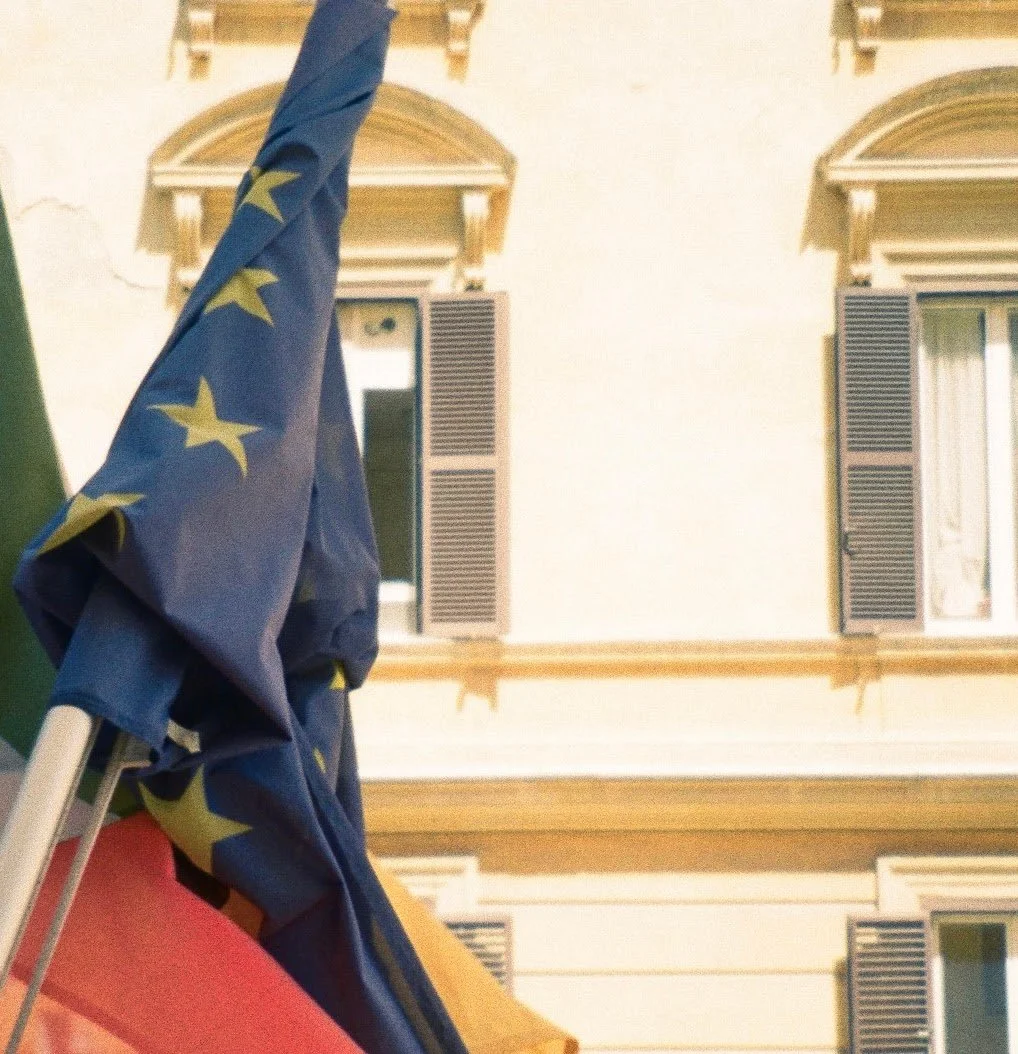
Photo credit: Sophie Levy
In an era when Europe appears to be drifting steadily to the right, Spain’s Prime Minister has become something of a political outlier. Across the continent, conservative governments have seen a resurgence in popularity with the far right continuing to gain ground, whilst many centre-left movements have found themselves at odds amid growing dissatisfaction among voters.[1] Yet in Madrid, Prime Minister Pedro Sánchez appears to have chartered a different course. Since taking office in 2018, the leader of the Spanish Socialist Workers' Party known as the PSOE (Partido Socialista Obrero Español) has pursued a progressive domestic agenda while repeatedly positioning Spain as an independent voice on the international stage. This approach, coined by the media as ‘Sánchismo’, combines progressive social reform, a more assertive foreign policy, and a willingness to break with traditional political conventions.
However, with approval ratings having fallen sharply since the beginning of 2026,[2] Sánchez has found himself under growing political pressure. A series of corruption investigations involving individuals close to him, as well as his own decision to use a state military aircraft for personal travel, have intensified scrutiny of his leadership.[3] When coupled with devastating wildfires and renewed tensions surrounding migration in the Spanish enclave of Ceuta, Sánchez’s 2027 re-election hopes seem increasingly distant. As Spain prepares to elect a new government, opposition parties are seizing upon growing frustration among voters, casting doubt over whether Sánchez can preserve the political legacy he has spent years constructing.
Before his ascension to leader of the PSOE, the Prime Minister, affectionately known as ‘Mr Guapo’, studied economics before joining the party he would later lead to victory in 2018. However, he quickly found himself in conflict with conservative factions of Spain’s political elite, particularly Mariano Rajoy, who served as Prime Minister from 2011 to 2018. Rajoy was later ousted in a historic vote of no confidence initiated by Sánchez,[4] a move that would pave his way to office. His election brought hope for a country that had been rocked by the recent corruption scandal that toppled Rajoy and disturbed a political status quo. Paired with Sanchez’s multitude of appearances on Spanish daytime television, he appeared to be a more accessible and recognisable figure, helping him to distance himself from a more traditional image of Spanish politics.
After coming into office in 2018, Sánchez sought to distinguish his government through an ambitious programme of social reform and an independent foreign policy, positioning Spain as a progressive counterpoint to the increasingly conservative direction taken by many European governments. His government has steadily introduced further gender equality measures, strengthened protections against gender-based violence, and has become one of the first countries in the world to introduce paid menstrual leave for those suffering from severe period pain.[5] Economically, Sánchez raised Spain’s minimum wage and introduced labour reforms aimed at reducing temporary employment and strengthening workers’ protections.[6] This highlights a contrast between the more market-oriented approaches favoured by many centre-right governments like that of Luís Montenegro in neighbouring Portugal.
In turn, this progressive approach has expanded beyond domestic policy and is reflected on the global stage. In contrast to many European leaders who have adopted a more cautious approach to Palestinian sovereignty, Sánchez became one of the EU’s most outspoken advocates for granting Palestine greater diplomatic recognition. In 2024, Spain formally recognised the State of Palestine alongside Ireland and Norway, dealing a blow to Spain’s relationship with Israel, a decision also incurred fierce criticism from the Spanish far-right. The move was met with accusations from VOX that the Prime Minister was ‘using the people of Gaza as a political distraction’, arguing that his focus was intended ‘to draw attention away from corruption allegations involving people close to him and his government’.[7]
Domestically, one of the clearest examples of Pedro Sánchez's departure from his predecessors — particularly Mariano Rajoy — is his approach towards Spain's unresolved relationship with its Francoist past. Since coming into office, Sánchez has placed historical memory at the centre of his political agenda in defiance of the 1977 Pacto de Olvido (Pact of Forgetting), seeking to confront the legacy of Francisco Franco’s dictatorship as opposed to a form of ‘institutional amnesia’. His administration introduced the Democratic Memory Law in 2022,[8] which aimed to expand the recognition and assistance available for victims of the Civil War and Franco’s regime, remove remaining symbols linked to the dictatorship, and support the recovery of the remains of those who were disappeared during the bloody conflict.
In addition to this, his dependence on and collaboration with Catalan separatist groups in order to pass legislation has further defined Sánchez’s break with the approach of previous Spanish leaders. During Mariano Rajoy’s premiership, relations between Madrid and Catalonia soured dramatically following the disputed 2017 independence referendum, which had been declared illegal by Spain’s Constitutional Court. Rajoy responded by removing the Catalan regional government from office inflaming tensions and reinforcing the view among many in the independence movement that Madrid was unwilling to engage in constructive dialogue. Sánchez, by contrast, has incorporated and even relied on the support of parties such as the Republican Left of Catalonia to maintain his government and offer a viable counter to a right-wing coalition between the People’s Party and VOX. This approach was central to securing his second term in 2023, when agreements with Catalan separatist groups included a controversial amnesty law for those involved in the failed independence attempt.[9] For supporters, this represents a willingness to break with the status quo and reduce tensions with Catalonia; for critics, it demonstrates a willingness to sacrifice constitutional principles for political survival and an unnecessary revisiting of Spain’s traumatic past.
As Spain approaches a highly anticipated general election in the coming year, Sánchez must navigate an increasingly dissatisfied Spain which has been hit with one of the highest youth unemployment rates in the EU, acute housing shortages and growing concerns about immigration.[10] Opposition parties, in particular a more powerful far-right VOX, have weaponised these issues to demonstrate his inability to lead Spain into the future. Will he be able to overcome these challenges and maintain his position as one of Europe’s last remaining progressive leaders or will growing public dissatisfaction mark the beginning of the end for so-called ‘Sánchismo’?
[1] The Guardian reported that the proportion of European voters supporting far-right parties has more than
doubled over the past decade, rising from around 10% to over 23%, compared with around 5% in 1995.
[2] A study by the Centro de Investigaciones Sociológicas (CIS) found that the proportion of Spaniards expressing
no confidence in Sánchez has risen sharply, from 25.9% in 2018 to 47.1% today.
https://www.cis.es/es/series/grado-de-confianza-en-el-presidente-del-gobierno-pedro-sanchez-iii-
[3] Oposition leader Alberto Núñez Feijóo has called for Sánchez’s resignation amid corruption investigations,
arguing that the scandals have increasingly weakened his position.
In December 2022, Vox criticised Sánchez for using a Falcon and Super Puma to travel to Barcelona for Juan
Manuel Serrat’s final concert, questioning whether the state should cover the cost of what it described as a
private trip.
[6] In 2022, El País reported that Sánchez’s government had raised the minimum wage to €1,000 per month and
introduced labour reforms aimed at reducing temporary employment and increasing job stability.
[8] La Moncloa, the Spanish government’s official website, reported on 5 October 2022 that the Senate had
definitively approved the Democratic Memory Law, which strengthened protections and recognition for victims
of the Civil War and Franco dictatorship.
[9] In an announcement from the PSOE, Sánchez explicitly defended reaching agreements with Catalan political
forces and described the amnesty as part of this approach. It says that “more than 80%” of Catalan
representatives supported the agreement-based route and that the PSOE was choosing dialogue and
agreement to secure political stability.
[10] According to Eurostat, Spain’s youth unemployment stood at 23.4% for June 2026, above the EU average of 15.5%.
https://ec.europa.eu/eurostat/web/products-euro-indicators/w/3-30072026-bp
Banco de España’s 2025 annual report found that Spain faced an accumulated housing shortfall of approximately 750,000 homes between 2021 and 2025.
Growing concerns over immigration have also emerged as a significant political issue, with 20.3% of Spaniards identifying it as one of the country's main problems according to the Centro de Investigaciones Sociológicas (CIS) in 2026.