“It was never about the dress”: in defence of Mrs Harris Goes to Paris
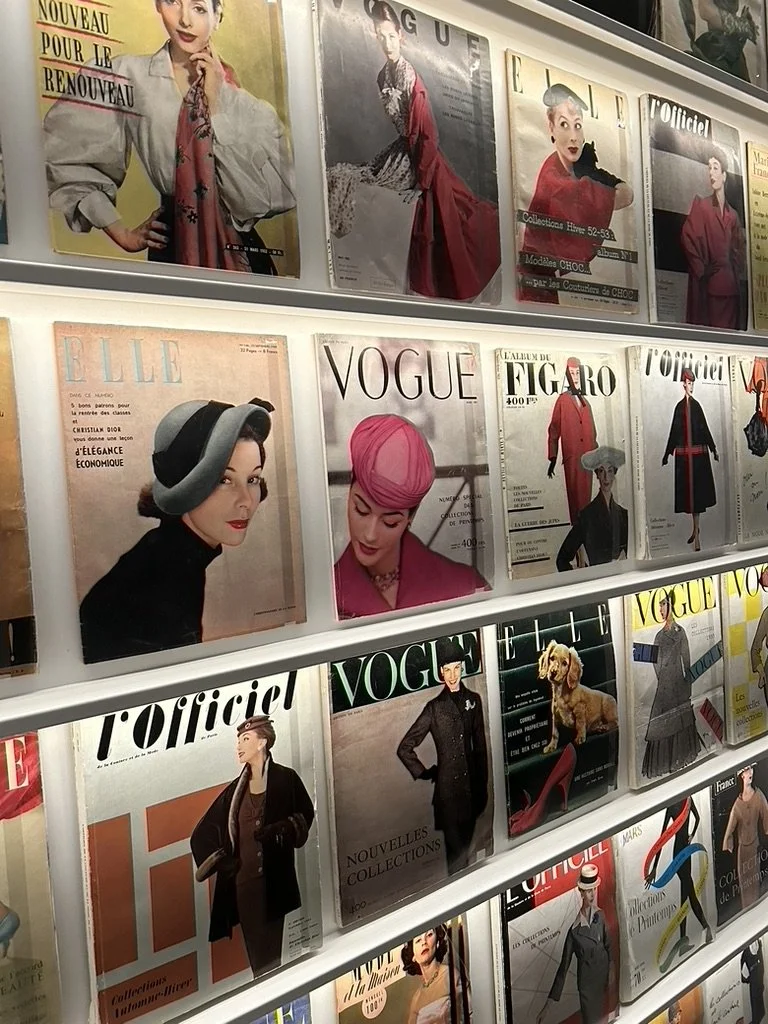
An exhibit in La Galerie Dior on Rue François 1er, Paris - all images are the author’s own unless otherwise stated
The lighting is soft and warm and the music light and waltzing. Chimes tinkle as sequins reflect the hazy light and Mrs Harris first catches sight of that sparkling Dior gown. Anthony Fabian’s 2022 remake of Mrs Harris Goes to Paris radiates warmth and nostalgia, imbued with the same magic as the very first films of childhood.
After the news of her husband’s passing, war widow and London cleaning lady Ada Harris saves and scrounges for a trip to Paris. Inspired by the Dior gown she finds in a client’s wardrobe, she sets her heart on a Dior gown of her very own. Among the glittering sequins and glamorous folds of Avenue Montaigne, Mrs Harris rediscovers life after loss, and reclaims the joy she’s lost to grieving. Fearlessly kind and unwittingly charming, Mrs Harris eventually befriends even the coldest of Parisians. The film is a love letter to 1950s Paris and couture and, while maybe not revolutionary, is a tale that transcends class, age, and culture.
Comfortably in my Letterboxd top four, I was saddened to see that Mrs Harris Goes to Paris had received tepid or downright scathing reviews from some of my friends. Shocked as I was, I think unfavourable opinions of Mrs Harris may have become a dealbreaker for me. So, to try and salvage these friendships, I’m going to try to change their minds.
The one prevailing criticism was that the film is shallow. There are two obvious issues with this: firstly, the film is not actually about fashion, which is, I assume, why some people found it shallow, and, secondly, if it was all about fashion, that still wouldn’t have made it an automatically shallow film.
Let’s start with why the film is not just about couture. As one of my male friends astutely – note my sarcasm – asserted, “It was never about the dress”. Just like the romantic subplot, the dress is used only as a tool to support the narrative; it was never intended to be the main event. The pursuit of the dress gives Mrs Harris a tangible and realistic goal, through which we see her grapple with grief, self-discovery, and cross-cultural, cross-class, intergenerational friendships. The Dior gown, put simply, is a physical symbol of the joy Mrs Harris both searches for and brings to all those around her.
Secondly, there is nothing superficial about clothing in film. Couture is a quintessential part of Parisian culture, and an undeniable force in film history. Fashion houses have long contributed to film projects around the globe, and Dior itself has designed for films that people would rather call classic than shallow. Take, for example, Hitchcock’s Stage Fright. Couture is an appropriate subject for Mrs Harris Goes to Paris, which is an ode to 1950s Paris in all its glory.
At the very, very least, the Dior gowns in Mrs Harris Goes to Paris – courtesy of three-time Academy Award winning costume designer Jenny Beaven – are so sublimely beautiful that they make the film instantly enjoyable to watch. Then, on a deeper level, how often have you seen an older actress celebrated for her body and allowed to feel beautiful on screen? Why should a love for fashion make a strong female protagonist less sympathetic or less profound? Fashion is not her only love. How could one dress make a whole film shallow?
I’m not arguing that Mrs Harris Goes to Paris is novel, revolutionary, or really exceptional in any way. I was just so moved by the beauty of the film and the charm of its characters that I feel a duty to defend them. I want you to love Mrs Harris as much as I do, and as much as my friend does, who watched it thrice and cried every time – admittedly, I don’t find it that moving, but I appreciate the solidarity.
Most importantly, even if you personally did not like Mrs Harris Goes to Paris – for some irrational and inexplicable reason – you cannot argue that it’s a ‘shallow’ film. You especially cannot argue that it’s a ‘bad’ film. I’ll leave you with this quote, which I found while translating a page from La Plus Secrète Mémoire, by Mohamed Mbougar Sarr,
“Il n’y a pas de mauvais livres, seulement des livres qu’on n’a pas aimés”
There’s no such thing as a bad book, only a book you didn’t like.
Taste is a matter of opinion and, if, for some strange reason, you didn’t like Mrs Harris Goes to Paris, we will have to agree to disagree.